
Logging · head to head
Honeycomb vs Loki

The short version
- Loki is free; Honeycomb starts at $150/mo.
- Where Honeycomb falls short: free tier caps at 20 million events per month and 100 million metrics data points.
- Where Loki falls short: the Grafana Cloud free tier caps log ingestion at 50 GB a month with 14 day retention.
- Prices and features on this page were last checked on 13 November 2026.
Where they differ
Only the attributes on which Honeycomb and Loki actually diverge.
Identical on both: starting price (Free), free tier (Yes), category (Logging).
Not yet recorded: founded for Honeycomb.
What each one covers
Drawn from each product's published feature list. An absence here means we hold no record of it - not that the product lacks it.
Only in Honeycomb
Nothing recorded that Loki does not also cover.
Only in Loki
- Log aggregation
- Label-based indexing
- Real-time log streaming
- LogQL query language
- API
- Webhooks
- REST
- Web support
What people use each for
The jobs each tool is most often brought in to do.
Honeycomb
- Tracing requests through distributed microservicesnot Loki
- Observing AI agent behavior in productionnot Loki
- Debugging cloud migrations in real-timenot Loki
- Monitoring Kubernetes across multiple cloudsnot Loki
Loki
- Aggregating application and infrastructure logs with label based indexingnot Honeycomb
- Querying logs alongside metrics in Grafananot Honeycomb
Where each one falls short
Documented limitations, not opinions. Every one is a constraint you would hit in normal use.
Honeycomb
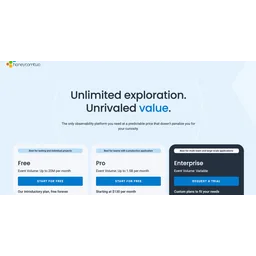
- Free tier caps at 20 million events per month and 100 million metrics data points
- Pro tier starts at $150 per month for only 50 million events, with cost scaling per additional event block up to its 750 million event ceiling
- Enterprise tier's event and data point volumes are variable and its price is custom, requiring direct sales contact
- Telemetry Pipeline is billed separately at $0.10 per GB on top of the base plan price
Loki
- The Grafana Cloud free tier caps log ingestion at 50 GB a month with 14 day retention
- Paid log pricing is split across three separate meters, at $0.050 per GB processed, $0.400 per GB written and $0.100 per GB retained
- Retaining logs is billed separately from ingesting them, so keeping data costs on an ongoing basis rather than once
- The Pro plan carries a $19 a month platform fee before any usage charges
Pricing, plan by plan
Honeycomb
Free- FreeFree
- 20M events per month
- 100M metrics data points per month
- 2 Triggers
- Pro$150/mo
- 750M events per month
- 3.75B metrics data points per month
- 100 Triggers
Loki
Free- FreeFree
- Log aggregation
- Label-based indexing
- Real-time log streaming
Which should you pick?
Choose Loki if
- You need log aggregation.
- You want to start without paying.
- You work on Web, API.
- You also want label-based indexing.
Questions people ask
- Is Honeycomb or Loki better?
- Neither clearly leads. Honeycomb starts at Free and Loki at Free, and user ratings are close enough to be indistinguishable. Choose on capability and platform support.
- Which is cheaper, Honeycomb or Loki?
- Honeycomb starts at Free and Loki at Free.
- Does Honeycomb or Loki run on more platforms?
- Honeycomb runs on Web. Loki runs on Web, API.
- Can I use Honeycomb for free?
- Both have a free tier, so you can try either at no cost before committing.
- What is Honeycomb best used for?
- Honeycomb is most often used for tracing requests through distributed microservices, observing ai agent behavior in production, debugging cloud migrations in real-time, monitoring kubernetes across multiple clouds. Of those, tracing requests through distributed microservices and observing ai agent behavior in production are not what Loki is typically brought in for.
- What can Honeycomb do that Loki cannot?
- Loki covers Log aggregation, Label-based indexing, Real-time log streaming, LogQL query language.
Answered from the vendors’ own pages
Honeycomb: Is Honeycomb free forever?
Honeycomb offers a free plan forever with up to 20M events per month and 100M metrics data points per month, best for testing and individual projects.
SourceLoki: What does it cost to use Grafana Loki?
Loki is open source and free under the AGPLv3 license for self-hosted deployments. Grafana's managed Cloud Logs service includes a free tier up to 50GB of logs at no cost.
SourceHoneycomb: What is the cost of Honeycomb's Telemetry Pipeline?
Honeycomb's Telemetry Pipeline starts at $0.10 per GB, with monthly or annual billing options available.
SourceLoki: Are there paid options for Loki beyond the free tier?
Yes. Grafana Cloud Logs offers paid tiers for teams and enterprises, and Enterprise Logs provides self-managed options with expert support for organizations with data localization or privacy requirements.
SourceHoneycomb: Can I get custom Honeycomb pricing?
Yes, Honeycomb offers Enterprise plans with custom pricing and a base allowance starting at 10 billion events per year with dedicated support.
SourceLoki: What license does open source Loki use?
Loki is released under the AGPLv3 license, which requires you to share modifications and publish your source code if you deploy modifications publicly.
SourceRelated pages
Other head to heads
- Honeycomb vs Better Stack
- Honeycomb vs Coralogix
- Honeycomb vs Datadog
- Honeycomb vs InfluxDB
- Honeycomb vs Checkmk
- Honeycomb vs Rollbar
- Honeycomb vs Site24x7
- Honeycomb vs Traceloop
- Honeycomb vs New Relic
- Honeycomb vs Elastic Stack
- Honeycomb vs Bugsnag
- Honeycomb vs Dynatrace Logs
- Honeycomb vs Datadog Logs
- Honeycomb vs Telegraf
- Honeycomb vs Elastic
- Honeycomb vs Elastic APM
- Honeycomb vs Elasticsearch Service
- Honeycomb vs ELK Stack
- Honeycomb vs Graylog
- Honeycomb vs Loggly
- Honeycomb vs Openstatus
- Honeycomb vs Rootly
- Honeycomb vs UptimeRobot
- Honeycomb vs Checkly
- Honeycomb vs CloudWatch
- Honeycomb vs New Relic Logs
- Honeycomb vs Dynatrace
- Honeycomb vs Filebeat
- Loki vs Better Stack
- Loki vs Coralogix
- Loki vs Datadog
- Loki vs InfluxDB
- Loki vs Checkmk
- Loki vs Rollbar
- Loki vs Site24x7
- Loki vs Traceloop
- Loki vs New Relic
- Loki vs Elastic Stack
- Loki vs Bugsnag
- Loki vs Dynatrace Logs
- Loki vs Datadog Logs
- Loki vs Telegraf
- Loki vs Elastic
- Loki vs Elastic APM
- Loki vs Elasticsearch Service
- Loki vs ELK Stack
- Loki vs Graylog
- Loki vs Loggly
- Loki vs Openstatus
- Loki vs Rootly
- Loki vs UptimeRobot
- Loki vs Checkly
- Loki vs CloudWatch
- Loki vs New Relic Logs
- Loki vs Dynatrace
- Loki vs Filebeat