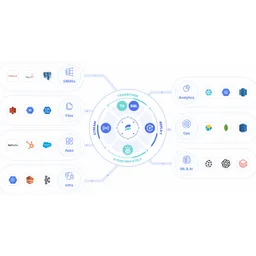
Real-time data integration combining streaming, CDC, and batch
Free, then $0.5/GB10 researched notes


A distributed engine for batch, SQL, streaming and machine learning workloads over data that does not fit on one machine.
As of 13 November 2026, Apache Spark is free to use. Spark is the default engine for large-scale data processing on the JVM, with APIs in SQL, Python, Scala, Java and R. Softwr lists it under Databases.
Overview
Apache Spark is a distributed data processing engine hosted by the Apache Software Foundation and licensed under Apache 2.0. It runs on the JVM and exposes the same execution engine through Spark SQL, DataFrames, Structured Streaming and MLlib, with language bindings for Scala, Java, Python, R and SQL. It runs on Kubernetes, YARN and its own standalone scheduler, and reads from object storage, HDFS, JDBC sources and table formats including Delta Lake, Apache Iceberg and Apache Hudi. Spark 4.0, released in 2025, made ANSI SQL mode the default and expanded Spark Connect, which separates the client from the cluster. What distinguishes it is that one engine covers batch ETL, interactive SQL, stream processing and model training with the same code and the same cluster. That consolidation is the commercial argument: an organisation does not have to run and staff separate systems for its nightly pipelines, its analytics queries and its feature engineering, and a data engineer who learns the DataFrame API can move across all three. It is also why Spark is the assumed engine on every managed data platform, from Databricks and AWS EMR to Google Dataproc and Microsoft Fabric, which makes it the skill most easily hired for in data engineering. It is bought by organisations with genuinely large datasets and a data platform team, usually as a managed service rather than a self-run cluster. The trade-off arrives in two forms. First, the failure modes are distributed ones: skewed shuffles, executor out-of-memory errors and serialisation costs, none of which are visible in the code and all of which require somebody who reads the Spark UI. Second, the fastest Spark is not the Spark you can download, because Databricks' Photon engine and comparable vendor accelerations are proprietary, so published performance figures often describe a fork you can only rent.
The honest half
Concrete and checkable, so you can decide whether any of them matter to you. This is the half of a review a vendor will not write about Apache Spark.
Capabilities
Unified engine
Batch, SQL, streaming and machine learning share one execution engine, one cluster and one API surface
Catalyst optimiser
Rewrites and plans queries, with adaptive query execution that changes join strategies and partition counts at runtime
DataFrame and SQL APIs
The same logical plan whether expressed as SQL or as DataFrame code in Python, Scala, Java or R
Structured Streaming
Incremental micro-batch processing with exactly-once semantics against the same DataFrame API as batch code
Spark Connect
A thin client protocol that decouples the application from the cluster, so clients no longer need a co-located JVM driver
Kubernetes and YARN support
Runs as a native Kubernetes scheduler or under YARN, letting clusters be created per job rather than left running
Table format integration
Reads and writes Delta Lake, Apache Iceberg and Apache Hudi tables with transactional semantics on object storage
MLlib
Distributed implementations of common algorithms and pipeline abstractions for training over data larger than one machine
Answered, with sources
Each answer names the page it came from, so you can check it rather than take our word for it.
When your data fits comfortably on one machine. DuckDB or Polars will process hundreds of gigabytes on a single large node faster than a Spark cluster, without a scheduler, a driver or a shuffle. Spark earns its overhead when the data genuinely does not fit.
No. Databricks runs its own runtime including the proprietary Photon engine and its own optimisations, so performance figures and some behaviours do not carry over to open source Spark on EMR, Dataproc or your own Kubernetes cluster.
For near-real-time, yes, with Structured Streaming's micro-batch model, which lands in the sub-second to seconds range. For true per-event latency in the low milliseconds, Flink is the usual choice.
Yes, by design in some cases. Spark 4.0 makes ANSI SQL mode the default, which converts previously silent overflow and cast failures into runtime errors. Upgrades need a testing pass over production pipelines rather than a version bump.
No. Python covers the vast majority of work and PySpark is the most common interface. Scala still helps when reading the source, writing custom data sources or diagnosing errors that surface as JVM stack traces.
Keep looking
Real-time data integration combining streaming, CDC, and batch
Streaming SQL engine built on ClickHouse internals, shipping as one small binary
The original open source framework for distributed storage and batch processing on commodity servers, now largely a legacy platform.
Distributed AI search platform for retrieval, ranking, and inference
MIT-licensed analytical SQL database that runs inside your process, with no server, no dependencies and one writer at a time.
AWS-only managed key-value and document database with fixed per-partition throughput limits and no ad hoc queries.
SQLite-lineage database platform for running very large numbers of small per-tenant databases, with an MIT-licensed engine.
Cloud-native messaging and streaming with separated storage
Softwr does not host reviews and shows no star rating for Apache Spark, because a rating we did not collect is not ours to publish. What is here is the pricing and platform detail from the vendor’s own pages, limitations we could state concretely, and alternatives a reviewer confirmed people weigh against it. Tell us if any of it is wrong.
What people switch to, and what they give up
Every tier, and where the cost actually lands
Put it head to head with anything we hold
Its rating, and an embed for your own site
Secure access for everyone
The digital analytics platform to understand your users
Apple's WebKit browser, available only on Apple operating systems and updated only with them.
free