
Business Intelligence · head to head
Deepnote vs Invoca
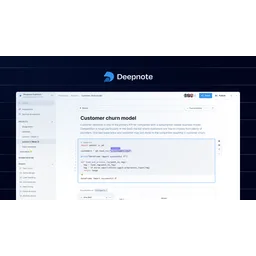
Deepnote
Business Intelligence
Collaborative cloud workspace for data analytics and machine learning
- From
- Free
- Free plan
- Yes

Invoca
Marketing
Call tracking and conversation analytics that ties inbound phone calls back to paid marketing spend
- From
- On request
- Free plan
- No
The short version
- Deepnote is a collaborative cloud-based workspace.
- Deepnote starts at $39/mo; Invoca prices on request.
- Only Deepnote lists collaborative notebooks; only Invoca lists dynamic number insertion.
- Where Deepnote falls short: free plan limited to 3 editors, restricting team usage.
- Prices and features on this page were last checked on 20 November 2026.
How do Deepnote and Invoca differ?
Deepnote and Invoca differ on starting price (Free against On request), pricing model and free tier (Yes against No). Only the attributes on which Deepnote and Invoca actually diverge.
Not yet recorded: founded for Invoca.
Which features does each one have?
They share no listed features; 8 appear only for Deepnote and 8 only for Invoca. Drawn from each product's published feature list. An absence here means we hold no record of it - not that the product lacks it.
Only in Deepnote
- Collaborative notebooks
- Interactive dashboards
- Data agent building
- Scheduled pipelines
- Model management
- 100+ integrations
- GPU support
- API deployment
Only in Invoca
- Dynamic number insertion
- Signal AI
- Ad platform integration
- Call transcription
- PreSense
- Call routing
- Quality management
- Compliance redaction
What is each one used for?
Deepnote is most often brought in for data exploration and analysis workflows. The jobs each tool is most often brought in to do.
Deepnote
- Data exploration and analysis workflowsnot Invoca
- Building interactive business intelligence dashboardsnot Invoca
- Collaborative machine learning model developmentnot Invoca
- Automating ETL and data pipeline orchestrationnot Invoca
- Creating shareable reports without exportsnot Invoca
Invoca
- A multi-location healthcare group proving which paid search keywords produce booked appointments rather than just call volumenot Deepnote
- An insurance carrier feeding qualified call outcomes back into Google Ads so bidding optimises on written policies instead of raw callsnot Deepnote
- An automotive dealer group working out which regional campaigns generate service bookings versus tyre-kicker enquiriesnot Deepnote
- A home services franchisor allocating budget across franchisees by attributing revenue-producing calls to the campaigns that caused themnot Deepnote
Where do Deepnote and Invoca fall short?
Deepnote's most cited limit: free plan limited to 3 editors, restricting team usage. Documented limitations, not opinions. Every one is a constraint you would hit in normal use.
Deepnote
- Free plan limited to 3 editors, restricting team usage
- Limited revision history on free plan compared to competitors
- Requires Team plan or higher for automated scheduling
- GPU support incurs additional charges beyond base subscription
- No mentioned offline capability
Invoca
- Entry pricing commonly starts around 1,500 US dollars a month before call minutes, plus a setup and training fee, which prices out agencies and small businesses that only need attribution for a few hundred calls
- Telephony minutes and tracking numbers are metered separately from the platform fee, so a seasonal advertising spike produces an invoice nobody forecast
- Signal AI, PreSense and quality management are frequently sold as add-on modules rather than included, meaning the demo you were shown may cost noticeably more than the quote you were given
- Contracts are annual or multi-year with usage minimums and no month-to-month option, so a campaign strategy that shifts away from phone calls leaves you paying for capacity you no longer use
- The product is deep on inbound phone attribution and shallow elsewhere; if your buying journey also involves chat, forms and in-store visits, Invoca covers only one channel and you still need a separate attribution model for the rest
How much do Deepnote and Invoca cost?
Deepnote has a free plan, with paid plans from $39/mo; Invoca is priced on request. Plan by plan below, from each vendor's own pricing page.
Deepnote
Free- FreeFree
- Up to 3 editors
- Up to 5 projects
- Limited Deepnote AI
- Team$39/mo
- Unlimited viewers and notebooks
- Full Deepnote AI access
- Premium integrations
- EnterpriseOn request
- Everything in Team plan
- Custom contracts
- Priority support
Invoca
On request- ProOn request
- Around 6,000 annual local or toll-free numbers
- 5 custom Signals
- Dynamic number insertion
- EnterpriseOn request
- Around 12,000 annual numbers
- 50 custom Signals
- Advanced routing
- EliteOn request
- Around 18,000 annual numbers
- 100 custom Signals
- Full analytics suite
- Performance ProfessionalOn request
- Pay-per-call network features
- Publisher and affiliate call tracking
- Payout management
Which should you pick?
Choose Deepnote if
- You need collaborative notebooks.
- You want to start without paying.
- You work on Web, API.
- You also want interactive dashboards.
Questions people ask
- Is Deepnote or Invoca better?
- Neither clearly leads. Deepnote starts at Free and Invoca at On request, and user ratings are close enough to be indistinguishable. Choose on capability and platform support.
- Which is cheaper, Deepnote or Invoca?
- Deepnote has a free tier; the other does not. Paid plans start at Free for Deepnote and On request for Invoca.
- Does Deepnote or Invoca run on more platforms?
- Deepnote runs on Web, API. Invoca runs on Web.
- Can I use Deepnote for free?
- Yes. Deepnote has a free tier, so you can try it without paying. Invoca starts at On request.
- What is Deepnote best used for?
- Deepnote is most often used for data exploration and analysis workflows, building interactive business intelligence dashboards, collaborative machine learning model development, automating etl and data pipeline orchestration. Of those, data exploration and analysis workflows and building interactive business intelligence dashboards are not what Invoca is typically brought in for.
- What can Deepnote do that Invoca cannot?
- Deepnote covers Collaborative notebooks, Interactive dashboards, Data agent building, Scheduled pipelines. Invoca covers Dynamic number insertion, Signal AI, Ad platform integration, Call transcription.
Answered from the vendors’ own pages
Deepnote: What is included in the free Deepnote plan?
The free plan includes up to 3 editors, up to 5 projects, limited Deepnote AI, basic machines with 5 GB RAM, and 7-day revision history.
SourceInvoca: Does Invoca publish prices?
No. Every deal is quoted from call volume, number count and which modules you licence. Independent reports put the entry point near 1,500 US dollars a month plus minutes.
Deepnote: What data sources can Deepnote integrate with?
Deepnote integrates with 100+ data sources including major data warehouses like Snowflake, BigQuery, and Redshift, as well as BI platforms like Looker, Tableau, and Power BI.
SourceInvoca: Is this different from CallRail?
Yes, in ambition and price. Invoca targets enterprise attribution with automated outcome classification fed back to ad bidding; lighter call tracking tools stop at source attribution.
Deepnote: Does Deepnote support collaboration?
Yes, Deepnote provides real-time collaborative notebooks where multiple team members can work simultaneously. The Team plan allows unlimited viewers and notebooks.
SourceInvoca: Is it HIPAA compatible?
Invoca sells heavily into healthcare and offers redaction and compliance controls for regulated recordings; confirm the specific terms in your contract.
Deepnote: What compliance certifications does Deepnote have?
Deepnote is SOC 2, HIPAA, GDPR, and CCPA compliant and offers role-based access control, single sign-on, and directory synchronization.
SourceInvoca: Do we need a contact centre platform as well?
Yes. Invoca tracks and analyses calls, it does not run your contact centre.
Related pages
Other head to heads
- Deepnote vs Hex
- Deepnote vs Mode
- Deepnote vs Fabi
- Deepnote vs Yellowfin
- Deepnote vs TIBCO Spotfire
- Deepnote vs Databox
- Deepnote vs Klipfolio
- Deepnote vs DashThis
- Deepnote vs Domo
- Deepnote vs Luzmo
- Deepnote vs Rill Data
- Deepnote vs Grow
- Deepnote vs Cyfe
- Deepnote vs Exa
- Deepnote vs Glassbox
- Deepnote vs Oracle Analytics Cloud
- Deepnote vs Quantum Metric
- Deepnote vs Stripe Dashboard
- Deepnote vs CallRail
- Deepnote vs Ruler Analytics
- Deepnote vs Northbeam
- Deepnote vs Attribution
- Deepnote vs Dreamdata
- Deepnote vs Madgicx
- Deepnote vs Marketing Evolution
- Deepnote vs DV Rockerbox
- Deepnote vs Triple Whale
- Deepnote vs Freshpaint
- Deepnote vs Moz
- Deepnote vs Postscript
- Deepnote vs Leadpages
- Deepnote vs Lucky Orange
- Deepnote vs Mautic
- Deepnote vs Microsoft Clarity
- Deepnote vs Postmark
- Deepnote vs WebEngage
- Invoca vs Hex
- Invoca vs Mode
- Invoca vs Fabi
- Invoca vs Yellowfin
- Invoca vs TIBCO Spotfire
- Invoca vs Databox
- Invoca vs Klipfolio
- Invoca vs DashThis
- Invoca vs Domo
- Invoca vs Luzmo
- Invoca vs Rill Data
- Invoca vs Grow
- Invoca vs Cyfe
- Invoca vs Exa
- Invoca vs Glassbox
- Invoca vs Oracle Analytics Cloud
- Invoca vs Quantum Metric
- Invoca vs Stripe Dashboard
- Invoca vs CallRail
- Invoca vs Ruler Analytics
- Invoca vs Northbeam
- Invoca vs Attribution
- Invoca vs Dreamdata
- Invoca vs Madgicx
- Invoca vs Marketing Evolution
- Invoca vs DV Rockerbox
- Invoca vs Triple Whale
- Invoca vs Freshpaint
- Invoca vs Moz
- Invoca vs Postscript
- Invoca vs Leadpages
- Invoca vs Lucky Orange
- Invoca vs Mautic
- Invoca vs Microsoft Clarity
- Invoca vs Postmark
- Invoca vs WebEngage