
Business Intelligence · head to head
Deepnote vs Mode
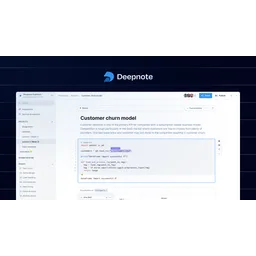
Deepnote
Business Intelligence
Collaborative cloud workspace for data analytics and machine learning
- From
- Free
- Rated
- -

The short version
- Each has a real cost: Deepnote free plan limited to 3 editors, restricting team usage; Mode free tier limited to 4GB RAM and 1 CPU for SQL notebooks, insufficient for large datasets
- They diverge on capability: Deepnote covers Collaborative notebooks, Mode covers SQL Editor.
- Prices and features above were last checked on 30 August 2026.
Where they differ
Only the attributes on which Deepnote and Mode actually diverge.
Identical on both: starting price (Free), free tier (Yes), user rating (Not yet rated), category (Business Intelligence).
What each one covers
Drawn from each product's published feature list. An absence here means we hold no record of it - not that the product lacks it.
Only in Deepnote
- Collaborative notebooks
- Interactive dashboards
- Data agent building
- Scheduled pipelines
- Model management
- 100+ integrations
- GPU support
- API deployment
Only in Mode
- SQL Editor
- Python/R Notebooks
- Interactive Reports
- Version Control
- Scheduling
- Snowflake
- Redshift
- BigQuery
What people use each for
The jobs each tool is most often brought in to do.
Deepnote
- Data exploration and analysis workflowsnot Mode
- Building interactive business intelligence dashboardsnot Mode
- Collaborative machine learning model developmentnot Mode
- Automating ETL and data pipeline orchestrationnot Mode
- Creating shareable reports without exportsnot Mode
Mode
- Self-service analyticsnot Deepnote
- Data explorationnot Deepnote
- Ad-hoc reportingnot Deepnote
- Collaborative analysisnot Deepnote
- Embedded analyticsnot Deepnote
Where each one falls short
Documented limitations, not opinions. Every one is a constraint you would hit in normal use.
Deepnote
- Free plan limited to 3 editors, restricting team usage
- Limited revision history on free plan compared to competitors
- Requires Team plan or higher for automated scheduling
- GPU support incurs additional charges beyond base subscription
- No mentioned offline capability
Mode
- Free tier limited to 4GB RAM and 1 CPU for SQL notebooks, insufficient for large datasets
- Requires SQL knowledge for most analysis tasks, creating dependency on technical resources
- Paid plan pricing not publicly listed; requires sales consultation
- Recently acquired by ThoughtSpot in 2026, creating product direction uncertainty
- Limited customization options for visual aspects and embedded analytics
Pricing, plan by plan
Deepnote
Free- FreeFree
- Up to 3 editors
- Up to 5 projects
- Limited Deepnote AI
- Team$39/month
- Unlimited viewers and notebooks
- Full Deepnote AI access
- Premium integrations
- Enterprise$null/custom
- Everything in Team plan
- Custom contracts
- Priority support
Mode
Free- FreeFree
- SQL Editor
- Python/R Notebooks
- Basic Charts
- Business$65/month
- Advanced Visualizations
- Collaboration
- Integrations
Which should you pick?
Choose Deepnote if
- You need collaborative notebooks.
- You want to start without paying.
- You work on Web, API.
- You also want interactive dashboards.
Choose Mode if
- You need sql editor.
- You want to start without paying.
- You also want python/r notebooks.
Questions people ask
- Is Deepnote or Mode better?
- Neither clearly leads. Deepnote starts at Free and Mode at Free, and user ratings are close enough to be indistinguishable. Choose on capability and platform support.
- Which is cheaper, Deepnote or Mode?
- Deepnote starts at Free and Mode at Free.
- Does Deepnote or Mode run on more platforms?
- Deepnote runs on Web, API. Mode runs on Web.
- Can I use Deepnote for free?
- Both have a free tier, so you can try either at no cost before committing.
- What is Deepnote best used for?
- Deepnote is most often used for data exploration and analysis workflows, building interactive business intelligence dashboards, collaborative machine learning model development, automating etl and data pipeline orchestration. Of those, data exploration and analysis workflows and building interactive business intelligence dashboards are not what Mode is typically brought in for.
- What can Deepnote do that Mode cannot?
- Deepnote covers Collaborative notebooks, Interactive dashboards, Data agent building, Scheduled pipelines. Mode covers SQL Editor, Python/R Notebooks, Interactive Reports, Version Control.
Answered from the vendors’ own pages
Deepnote: What is included in the free Deepnote plan?
The free plan includes up to 3 editors, up to 5 projects, limited Deepnote AI, basic machines with 5 GB RAM, and 7-day revision history.
SourceMode: What languages does Mode support for analysis?
Mode notebooks support SQL, Python (3.11 with pandas, NumPy, scikit-learn, matplotlib), and R (4.2.0 with ggplot2, dplyr, tidyr). Both Python and R allow additional library installation at runtime.
SourceDeepnote: What data sources can Deepnote integrate with?
Deepnote integrates with 100+ data sources including major data warehouses like Snowflake, BigQuery, and Redshift, as well as BI platforms like Looker, Tableau, and Power BI.
SourceMode: Can I integrate Mode notebook results into reports?
Yes. Mode allows adding notebook cell results directly to reports, with synchronized scheduling so reports re-run to keep data current.
SourceDeepnote: Does Deepnote support collaboration?
Yes, Deepnote provides real-time collaborative notebooks where multiple team members can work simultaneously. The Team plan allows unlimited viewers and notebooks.
SourceMode: Does Mode support collaborative analysis?
Yes. Mode notebooks provide moveable code blocks and markdown cells enabling exploratory analysis and team collaboration on data queries and visualizations.
SourceDeepnote: What compliance certifications does Deepnote have?
Deepnote is SOC 2, HIPAA, GDPR, and CCPA compliant and offers role-based access control, single sign-on, and directory synchronization.
SourceRelated pages
Other head to heads
- Deepnote vs Fabi
- Deepnote vs Hex
- Deepnote vs TIBCO Spotfire
- Deepnote vs Yellowfin
- Deepnote vs Klipfolio
- Deepnote vs Domo
- Deepnote vs Periscope Data
- Deepnote vs Databox
- Deepnote vs Cyfe
- Deepnote vs DashThis
- Deepnote vs Grow
- Deepnote vs Zoho Analytics
- Deepnote vs Baremetrics
- Deepnote vs Board International
- Deepnote vs Cabin
- Deepnote vs Celonis
- Deepnote vs GoodData
- Deepnote vs Qlik Sense
- Deepnote vs Cube
- Deepnote vs Geckoboard
- Deepnote vs Google Data Studio
- Deepnote vs Lightdash
- Deepnote vs Oracle Analytics Cloud
- Mode vs Fabi
- Mode vs Hex
- Mode vs TIBCO Spotfire
- Mode vs Yellowfin
- Mode vs Klipfolio
- Mode vs Domo
- Mode vs Periscope Data
- Mode vs Databox
- Mode vs Cyfe
- Mode vs DashThis
- Mode vs Grow
- Mode vs Zoho Analytics
- Mode vs Baremetrics
- Mode vs Board International
- Mode vs Cabin
- Mode vs Celonis
- Mode vs GoodData
- Mode vs Qlik Sense
- Mode vs Cube
- Mode vs Geckoboard
- Mode vs Google Data Studio
- Mode vs Lightdash
- Mode vs Oracle Analytics Cloud