
Databases · head to head
Estuary vs Hasura
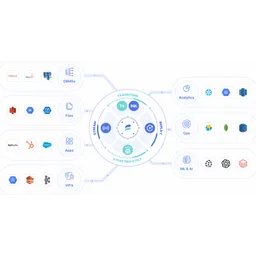
Estuary
Databases
Real-time data integration combining streaming, CDC, and batch
- From
- Free
- Rated
- -

Hasura
APIs
GraphQL engine that instantly creates production-ready GraphQL API from databases
- From
- Free
- Rated
- -
The short version
- Each has a real cost: Estuary per-GB pricing adds up quickly for high-volume scenarios; Hasura active model definition: model/command accessed more than 1,000 times monthly
- They diverge on capability: Estuary covers Real-time data delivery, Hasura covers GraphQL API.
- Prices and features above were last checked on 30 August 2026.
Where they differ
Only the attributes on which Estuary and Hasura actually diverge.
Identical on both: starting price (Free), free tier (Yes), user rating (Not yet rated).
What each one covers
Drawn from each product's published feature list. An absence here means we hold no record of it - not that the product lacks it.
Only in Estuary
- Real-time data delivery
- Change data capture
- Batch processing
- Data transformation
- Pre-built connectors
- Multiple deployments
- RBAC and monitoring
Only in Hasura
- GraphQL API
- Real-time subscriptions
- Access control
- PostgreSQL
- MySQL
- Webhooks
- REST APIs
- Cloud support
What people use each for
The jobs each tool is most often brought in to do.
Estuary
- Real-time data replication to data warehousesnot Hasura
- Change data capture from operational databasesnot Hasura
- Feeding analytics and BI systems with fresh datanot Hasura
- Powering real-time AI and ML data pipelinesnot Hasura
Hasura
- Automatic GraphQL API generation from existing databasesnot Estuary
- Real-time data subscriptions for modern applicationsnot Estuary
- Backend infrastructure for web and mobile applicationsnot Estuary
- Event-triggered webhooks for database changesnot Estuary
Where each one falls short
Documented limitations, not opinions. Every one is a constraint you would hit in normal use.
Estuary
- Per-GB pricing adds up quickly for high-volume scenarios
- No transparent per-connector volume discounts below 6 connectors
- Limited to data movement; transformation capabilities are basic
- BYOC and private deployment requires enterprise plan
- Smaller ecosystem compared to established alternatives
Hasura
- Active model definition: model/command accessed more than 1,000 times monthly
- Private DDN requires Base or Advanced plan
Pricing, plan by plan
Estuary
Free- DeveloperFree
- 10 GB per month
- 2 connector instances maximum
- No credit card required
- Cloud$0.5/GB
- $0.50 per GB of data moved
- $100 per connector monthly (6+ connectors $50 each)
- 200+ connectors
- Enterprise$null/custom
- Volume-based discounts
- SOC 2 and HIPAA compliance
- SSO authentication
Hasura
Free- DDN FreeFree
- Unlimited models
- 1 supergraph developer
- 15-minute observability retention
- DDN Base$5/month
- Per active model billing
- Unlimited developers
- 30-day observability retention
- DDN Advanced$30/month
- Per active model billing
- Federated collaboration
- Multi-repo CI/CD
Which should you pick?
Choose Estuary if
- You need real-time data delivery.
- You want to start without paying.
- You work on Cloud, Private Cloud, BYOC.
- You also want change data capture.
Choose Hasura if
- You need graphql api.
- You want to start without paying.
- You also want real-time subscriptions.
Questions people ask
- Is Estuary or Hasura better?
- Neither clearly leads. Estuary starts at Free and Hasura at Free, and user ratings are close enough to be indistinguishable. Choose on capability and platform support.
- Which is cheaper, Estuary or Hasura?
- Estuary starts at Free and Hasura at Free.
- Does Estuary or Hasura run on more platforms?
- Estuary runs on Cloud, Private Cloud, BYOC. Hasura runs on Web.
- Can I use Estuary for free?
- Both have a free tier, so you can try either at no cost before committing.
- What is Estuary best used for?
- Estuary is most often used for real-time data replication to data warehouses, change data capture from operational databases, feeding analytics and bi systems with fresh data, powering real-time ai and ml data pipelines. Of those, real-time data replication to data warehouses and change data capture from operational databases are not what Hasura is typically brought in for.
- What can Estuary do that Hasura cannot?
- Estuary covers Real-time data delivery, Change data capture, Batch processing, Data transformation. Hasura covers GraphQL API, Real-time subscriptions, Access control, PostgreSQL.
Answered from the vendors’ own pages
Estuary: What is included in the free Developer plan?
Developer plan ($0/month) includes 10 GB of data per month and up to 2 connector instances, no credit card required.
SourceHasura: How much does Hasura cost?
Hasura DDN Free is free. DDN Base starts at $5/active model/month, and DDN Advanced starts at $30/active model/month.
SourceEstuary: How is data pricing calculated on Cloud plan?
Cloud plan charges $0.50 per GB of data moved plus $100/month per connector for the first 6 connectors, then $50/month for additional connectors.
SourceHasura: What is an active model in Hasura pricing?
An active model is defined as any model or command accessed more than 1,000 times monthly.
SourceEstuary: What discount is available when adding 6+ connectors?
When using 6 or more connectors, the per-connector cost drops to $50/month from $100/month, saving $50 per additional connector.
SourceHasura: Is there a free version of Hasura?
Yes, Hasura DDN Free is always free and includes unlimited models, 1 supergraph developer, and 15-minute observability retention.
SourceRelated pages
Other head to heads
- Estuary vs Fivetran HVR
- Estuary vs Apache Druid
- Estuary vs ClickHouse
- Estuary vs Materialize
- Estuary vs Firebase Realtime Database
- Estuary vs SingleStore
- Estuary vs Tinybird
- Estuary vs Timeplus
- Estuary vs NATS
- Estuary vs QuestDB
- Estuary vs Vitess
- Estuary vs Aiven
- Estuary vs BigQuery
- Estuary vs CosmosDB
- Estuary vs DataStax
- Estuary vs Apache Pinot
- Estuary vs Apache Flink
- Estuary vs Apache Kafka
- Estuary vs PocketBase
- Estuary vs Parse Server
- Estuary vs Appwrite
- Estuary vs GraphQL Apollo
- Estuary vs GraphQL Playground
- Estuary vs Directus
- Estuary vs Asyncapi
- Estuary vs Janus Gateway
- Estuary vs Strapi
- Estuary vs Gravitee
- Estuary vs Bruno
- Estuary vs KeystoneJS
- Estuary vs Lithic
- Estuary vs Stoplight
- Estuary vs Swan
- Estuary vs Temenos Transact
- Estuary vs Token.io
- Estuary vs Treasury Prime
- Hasura vs Fivetran HVR
- Hasura vs Apache Druid
- Hasura vs ClickHouse
- Hasura vs Materialize
- Hasura vs Firebase Realtime Database
- Hasura vs SingleStore
- Hasura vs Tinybird
- Hasura vs Timeplus
- Hasura vs NATS
- Hasura vs QuestDB
- Hasura vs Vitess
- Hasura vs Aiven
- Hasura vs BigQuery
- Hasura vs CosmosDB
- Hasura vs DataStax
- Hasura vs Apache Pinot
- Hasura vs Apache Flink
- Hasura vs Apache Kafka
- Hasura vs PocketBase
- Hasura vs Parse Server
- Hasura vs Appwrite
- Hasura vs GraphQL Apollo
- Hasura vs GraphQL Playground
- Hasura vs Directus
- Hasura vs Asyncapi
- Hasura vs Janus Gateway
- Hasura vs Strapi
- Hasura vs Gravitee
- Hasura vs Bruno
- Hasura vs KeystoneJS
- Hasura vs Lithic
- Hasura vs Stoplight
- Hasura vs Swan
- Hasura vs Temenos Transact
- Hasura vs Token.io
- Hasura vs Treasury Prime