
Databases · head to head
CosmosDB vs Estuary

CosmosDB
Databases
Globally distributed, multi-model database service from Azure
- From
- Free
- Rated
- -
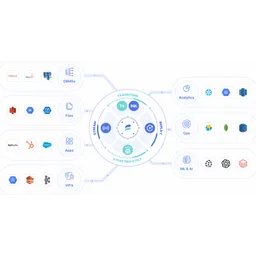
Estuary
Databases
Real-time data integration combining streaming, CDC, and batch
- From
- Free
- Rated
- -
The short version
- Each has a real cost: CosmosDB autoscale provisioned throughput enforces a minimum of 1,000 RU/s, billed hourly whether or not the database is used; Estuary per-GB pricing adds up quickly for high-volume scenarios
- They diverge on capability: CosmosDB covers Global Distribution, Estuary covers Real-time data delivery.
- Prices and features above were last checked on 30 August 2026.
Where they differ
Only the attributes on which CosmosDB and Estuary actually diverge.
Identical on both: starting price (Free), free tier (Yes), user rating (Not yet rated), category (Databases).
What each one covers
Drawn from each product's published feature list. An absence here means we hold no record of it - not that the product lacks it.
Only in CosmosDB
- Global Distribution
- Multi-model APIs
- Elastic Scaling
- Five Consistency Levels
- SLA-backed Latency
- Automatic Indexing
- Serverless
- Azure Functions
Only in Estuary
- Real-time data delivery
- Change data capture
- Batch processing
- Data transformation
- Pre-built connectors
- Multiple deployments
- RBAC and monitoring
What people use each for
The jobs each tool is most often brought in to do.
CosmosDB
- Running a globally distributed multi model database on Azurenot Estuary
- Serving low latency reads and writes from multiple Azure regionsnot Estuary
- Storing document, key value and graph data behind a managed servicenot Estuary
Estuary
- Real-time data replication to data warehousesnot CosmosDB
- Change data capture from operational databasesnot CosmosDB
- Feeding analytics and BI systems with fresh datanot CosmosDB
- Powering real-time AI and ML data pipelinesnot CosmosDB
Where each one falls short
Documented limitations, not opinions. Every one is a constraint you would hit in normal use.
CosmosDB
- Autoscale provisioned throughput enforces a minimum of 1,000 RU/s, billed hourly whether or not the database is used
- Provisioned throughput is charged in every region the account is replicated to, so multi region accounts multiply the RU bill
- Storage charges cover data, indexes and backups in each replicated region
- Egress out of Azure and between regions is charged, though ingress is free
- The free allowance is one account per Azure subscription, limited to 1,000 RU/s and 25 GB
- RU/s rates vary by region and are only shown through the pricing calculator rather than a flat published rate
Estuary
- Per-GB pricing adds up quickly for high-volume scenarios
- No transparent per-connector volume discounts below 6 connectors
- Limited to data movement; transformation capabilities are basic
- BYOC and private deployment requires enterprise plan
- Smaller ecosystem compared to established alternatives
Pricing, plan by plan
CosmosDB
Free- Free TierFree
- 1000 RU/s
- 25GB storage
- First 12 months
- ServerlessFree
- Pay per request
- Auto-scaling
- Event-driven workloads
Estuary
Free- DeveloperFree
- 10 GB per month
- 2 connector instances maximum
- No credit card required
- Cloud$0.5/GB
- $0.50 per GB of data moved
- $100 per connector monthly (6+ connectors $50 each)
- 200+ connectors
- Enterprise$null/custom
- Volume-based discounts
- SOC 2 and HIPAA compliance
- SSO authentication
Which should you pick?
Choose CosmosDB if
- You need global distribution.
- You want to start without paying.
- You work on Web, Azure.
- You also want multi-model apis.
Choose Estuary if
- You need real-time data delivery.
- You want to start without paying.
- You work on Cloud, Private Cloud, BYOC.
- You also want change data capture.
Questions people ask
- Is CosmosDB or Estuary better?
- Neither clearly leads. CosmosDB starts at Free and Estuary at Free, and user ratings are close enough to be indistinguishable. Choose on capability and platform support.
- Which is cheaper, CosmosDB or Estuary?
- CosmosDB starts at Free and Estuary at Free.
- Does CosmosDB or Estuary run on more platforms?
- CosmosDB runs on Web, Azure. Estuary runs on Cloud, Private Cloud, BYOC.
- Can I use CosmosDB for free?
- Both have a free tier, so you can try either at no cost before committing.
- What is CosmosDB best used for?
- CosmosDB is most often used for running a globally distributed multi model database on azure, serving low latency reads and writes from multiple azure regions, storing document, key value and graph data behind a managed service. Of those, running a globally distributed multi model database on azure and serving low latency reads and writes from multiple azure regions are not what Estuary is typically brought in for.
- What can CosmosDB do that Estuary cannot?
- CosmosDB covers Global Distribution, Multi-model APIs, Elastic Scaling, Five Consistency Levels. Estuary covers Real-time data delivery, Change data capture, Batch processing, Data transformation.
Answered from the vendors’ own pages
CosmosDB: Is there a free tier for Azure Cosmos DB?
Yes, Cosmos DB offers a free tier with 1,000 RU/s of throughput and 25 GB of storage per month for the lifetime of the account, available to new accounts.
SourceEstuary: What is included in the free Developer plan?
Developer plan ($0/month) includes 10 GB of data per month and up to 2 connector instances, no credit card required.
SourceCosmosDB: How is Cosmos DB priced after the free tier?
Cosmos DB uses three billing models: provisioned throughput billed per request unit per second, vCore pricing for certain APIs, or serverless consumption pricing where you pay only for requests processed. Reserved capacity offers 20% discount for one year or 30% for three years.
SourceEstuary: How is data pricing calculated on Cloud plan?
Cloud plan charges $0.50 per GB of data moved plus $100/month per connector for the first 6 connectors, then $50/month for additional connectors.
SourceCosmosDB: Can I change my pricing model after choosing one?
No. Once you select a compute pricing model and API, they cannot be changed. This choice is permanent for that database.
SourceEstuary: What discount is available when adding 6+ connectors?
When using 6 or more connectors, the per-connector cost drops to $50/month from $100/month, saving $50 per additional connector.
SourceCosmosDB: Is there a trial period for Cosmos DB beyond the free tier?
Azure offers a 30-day free trial account for all Azure services. Additionally, Azure AI customers may be eligible for a 90-day free Cosmos DB subscription through the Azure AI Advantage program.
SourceRelated pages
Other head to heads
- CosmosDB vs Amazon Aurora
- CosmosDB vs Cockroach Labs
- CosmosDB vs Airtable
- CosmosDB vs PostgreSQL
- CosmosDB vs Google Cloud SQL
- CosmosDB vs ArangoDB
- CosmosDB vs DataStax
- CosmosDB vs FaunaDB
- CosmosDB vs Firebolt
- CosmosDB vs turbopuffer
- CosmosDB vs VerneMQ
- CosmosDB vs Vespa
- CosmosDB vs Xata
- CosmosDB vs YugabyteDB
- CosmosDB vs Zilliz
- CosmosDB vs Amazon Redshift
- CosmosDB vs BigQuery
- CosmosDB vs Amazon RDS
- CosmosDB vs Fivetran HVR
- CosmosDB vs Apache Druid
- CosmosDB vs ClickHouse
- CosmosDB vs Materialize
- CosmosDB vs Firebase Realtime Database
- CosmosDB vs SingleStore
- CosmosDB vs Tinybird
- CosmosDB vs Timeplus
- CosmosDB vs NATS
- CosmosDB vs QuestDB
- CosmosDB vs Vitess
- CosmosDB vs Aiven
- CosmosDB vs Apache Pinot
- CosmosDB vs Apache Flink
- CosmosDB vs Apache Kafka
- Estuary vs Amazon Aurora
- Estuary vs Cockroach Labs
- Estuary vs Airtable
- Estuary vs PostgreSQL
- Estuary vs Google Cloud SQL
- Estuary vs ArangoDB
- Estuary vs DataStax
- Estuary vs FaunaDB
- Estuary vs Firebolt
- Estuary vs turbopuffer
- Estuary vs VerneMQ
- Estuary vs Vespa
- Estuary vs Xata
- Estuary vs YugabyteDB
- Estuary vs Zilliz
- Estuary vs Amazon Redshift
- Estuary vs BigQuery
- Estuary vs Amazon RDS
- Estuary vs Fivetran HVR
- Estuary vs Apache Druid
- Estuary vs ClickHouse
- Estuary vs Materialize
- Estuary vs Firebase Realtime Database
- Estuary vs SingleStore
- Estuary vs Tinybird
- Estuary vs Timeplus
- Estuary vs NATS
- Estuary vs QuestDB
- Estuary vs Vitess
- Estuary vs Aiven
- Estuary vs Apache Pinot
- Estuary vs Apache Flink
- Estuary vs Apache Kafka