
Databases · head to head
Estuary vs Fivetran HVR
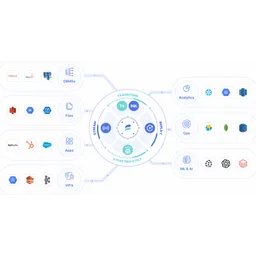
Estuary
Databases
Real-time data integration combining streaming, CDC, and batch
- From
- Free
- Rated
- -

Fivetran HVR
Databases
Log-based change data capture for database replication and synchronization
- From
- On request
- Rated
- -
The short version
- Only Estuary has a free tier, so it costs nothing to try first.
- Each has a real cost: Estuary per-GB pricing adds up quickly for high-volume scenarios; Fivetran HVR pricing not published separately; part of Fivetran's usage model
- They diverge on capability: Estuary covers Real-time data delivery, Fivetran HVR covers Log-based change capture.
- Prices and features above were last checked on 29 August 2026.
Where they differ
Only the attributes on which Estuary and Fivetran HVR actually diverge.
| Attribute | Estuary | Fivetran HVR |
|---|---|---|
| Starting price | Free | On request |
| Pricing model | Usage-based per GB plus per-connector cost | Usage-based, integrated with Fivetran billing |
| Free tier | Yes | No |
| Platforms | Cloud, Private Cloud, BYOC | Data Warehouse, Data Lake, Operational Databases |
| Founded | 2019 | 2012 |
Identical on both: user rating (Not yet rated), category (Databases).
What each one covers
Drawn from each product's published feature list. An absence here means we hold no record of it - not that the product lacks it.
Only in Estuary
- Real-time data delivery
- Change data capture
- Batch processing
- Data transformation
- Pre-built connectors
- Multiple deployments
- RBAC and monitoring
Only in Fivetran HVR
- Log-based change capture
- Real-time replication
- Schema evolution handling
- Multi-table consistency
- Zero-impact monitoring
- Fivetran integration
What people use each for
The jobs each tool is most often brought in to do.
Estuary
- Real-time data replication to data warehousesnot Fivetran HVR
- Change data capture from operational databasesnot Fivetran HVR
- Feeding analytics and BI systems with fresh datanot Fivetran HVR
- Powering real-time AI and ML data pipelinesnot Fivetran HVR
Fivetran HVR
- Real-time database replication to data warehousesnot Estuary
- Maintaining operational copies for analyticsnot Estuary
- Disaster recovery and business continuitynot Estuary
- Feeding AI systems with fresh governed datanot Estuary
Where each one falls short
Documented limitations, not opinions. Every one is a constraint you would hit in normal use.
Estuary
- Per-GB pricing adds up quickly for high-volume scenarios
- No transparent per-connector volume discounts below 6 connectors
- Limited to data movement; transformation capabilities are basic
- BYOC and private deployment requires enterprise plan
- Smaller ecosystem compared to established alternatives
Fivetran HVR
- Pricing not published separately; part of Fivetran's usage model
- Requires Fivetran relationship for implementation
- Limited standalone documentation and community resources
- May be overkill for simple batch replication needs
- Competitive offerings provide more transparent per-connector pricing
Pricing, plan by plan
Estuary
Free- DeveloperFree
- 10 GB per month
- 2 connector instances maximum
- No credit card required
- Cloud$0.5/GB
- $0.50 per GB of data moved
- $100 per connector monthly (6+ connectors $50 each)
- 200+ connectors
- Enterprise$null/custom
- Volume-based discounts
- SOC 2 and HIPAA compliance
- SSO authentication
Fivetran HVR
On requestNo published plan breakdown. See the Fivetran HVR review.
Which should you pick?
Choose Estuary if
- You need real-time data delivery.
- You want to start without paying.
- You work on Cloud, Private Cloud, BYOC.
- You also want change data capture.
Choose Fivetran HVR if
- You need log-based change capture.
- You work on Data Warehouse, Data Lake, Operational Databases.
- You also want real-time replication.
Questions people ask
- Is Estuary or Fivetran HVR better?
- Neither clearly leads. Estuary starts at Free and Fivetran HVR at On request, and user ratings are close enough to be indistinguishable. Choose on capability and platform support.
- Which is cheaper, Estuary or Fivetran HVR?
- Estuary has a free tier; the other does not. Paid plans start at Free for Estuary and On request for Fivetran HVR.
- Does Estuary or Fivetran HVR run on more platforms?
- Estuary runs on Cloud, Private Cloud, BYOC. Fivetran HVR runs on Data Warehouse, Data Lake, Operational Databases.
- Can I use Estuary for free?
- Yes. Estuary has a free tier, so you can try it without paying. Fivetran HVR starts at On request.
- What is Estuary best used for?
- Estuary is most often used for real-time data replication to data warehouses, change data capture from operational databases, feeding analytics and bi systems with fresh data, powering real-time ai and ml data pipelines. Of those, real-time data replication to data warehouses and change data capture from operational databases are not what Fivetran HVR is typically brought in for.
- What can Estuary do that Fivetran HVR cannot?
- Estuary covers Real-time data delivery, Change data capture, Batch processing, Data transformation. Fivetran HVR covers Log-based change capture, Real-time replication, Schema evolution handling, Multi-table consistency.
Answered from the vendors’ own pages
Estuary: What is included in the free Developer plan?
Developer plan ($0/month) includes 10 GB of data per month and up to 2 connector instances, no credit card required.
SourceFivetran HVR: What databases does Fivetran HVR support?
HVR supports major databases including Oracle, SQL Server, PostgreSQL, MySQL, and others that emit transaction logs.
SourceEstuary: How is data pricing calculated on Cloud plan?
Cloud plan charges $0.50 per GB of data moved plus $100/month per connector for the first 6 connectors, then $50/month for additional connectors.
SourceFivetran HVR: Is HVR part of standard Fivetran pricing?
Yes, HVR is integrated into Fivetran's usage-based pricing model with standard per-row-synced and transformation costs.
SourceEstuary: What discount is available when adding 6+ connectors?
When using 6 or more connectors, the per-connector cost drops to $50/month from $100/month, saving $50 per additional connector.
SourceRelated pages
More on Fivetran HVR
Other head to heads
- Estuary vs Apache Druid
- Estuary vs ClickHouse
- Estuary vs Materialize
- Estuary vs Firebase Realtime Database
- Estuary vs SingleStore
- Estuary vs Tinybird
- Estuary vs Timeplus
- Estuary vs NATS
- Estuary vs QuestDB
- Estuary vs Vitess
- Estuary vs Aiven
- Estuary vs BigQuery
- Estuary vs CosmosDB
- Estuary vs DataStax
- Estuary vs Apache Pinot
- Estuary vs Apache Flink
- Estuary vs Apache Kafka
- Estuary vs ScyllaDB
- Estuary vs Solace PubSub+
- Estuary vs SQLite
- Estuary vs StarRocks
- Estuary vs SurrealDB
- Estuary vs Teradata
- Estuary vs Apache Pulsar
- Estuary vs CouchDB
- Fivetran HVR vs Apache Druid
- Fivetran HVR vs ClickHouse
- Fivetran HVR vs Materialize
- Fivetran HVR vs Firebase Realtime Database
- Fivetran HVR vs SingleStore
- Fivetran HVR vs Tinybird
- Fivetran HVR vs Timeplus
- Fivetran HVR vs NATS
- Fivetran HVR vs QuestDB
- Fivetran HVR vs Vitess
- Fivetran HVR vs Aiven
- Fivetran HVR vs BigQuery
- Fivetran HVR vs CosmosDB
- Fivetran HVR vs DataStax
- Fivetran HVR vs Apache Pinot
- Fivetran HVR vs Apache Flink
- Fivetran HVR vs Apache Kafka
- Fivetran HVR vs ScyllaDB
- Fivetran HVR vs Solace PubSub+
- Fivetran HVR vs SQLite
- Fivetran HVR vs StarRocks
- Fivetran HVR vs SurrealDB
- Fivetran HVR vs Teradata
- Fivetran HVR vs Apache Pulsar
- Fivetran HVR vs CouchDB