
Databases · head to head
Cloudinary vs Estuary

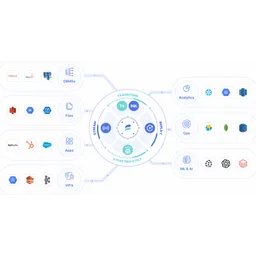
Estuary
Databases
Real-time data integration combining streaming, CDC, and batch
- From
- Free
- Rated
- -
The short version
- Each has a real cost: Cloudinary free plan includes only 25 monthly credits and is limited to 3 users and 1 account; Estuary per-GB pricing adds up quickly for high-volume scenarios
- Prices and features above were last checked on 29 August 2026.
Where they differ
Only the attributes on which Cloudinary and Estuary actually diverge.
| Attribute | Cloudinary | Estuary |
|---|---|---|
| Pricing model | freemium | Usage-based per GB plus per-connector cost |
| Platforms | Web | Cloud, Private Cloud, BYOC |
| Founded | Unknown | 2019 |
Identical on both: starting price (Free), free tier (Yes), user rating (Not yet rated), category (Databases).
What each one covers
Drawn from each product's published feature list. An absence here means we hold no record of it - not that the product lacks it.
Only in Cloudinary
Nothing recorded that Estuary does not also cover.
Only in Estuary
- Real-time data delivery
- Change data capture
- Batch processing
- Data transformation
- Pre-built connectors
- Multiple deployments
- RBAC and monitoring
What people use each for
The jobs each tool is most often brought in to do.
Cloudinary
- Automating image transformations and delivery across multiple devicesnot Estuary
- Generating AI-powered image captions and alternative text at scalenot Estuary
- Transcoding and optimizing video with automatic subtitle generationnot Estuary
- Building workflow automation for content teams without codingnot Estuary
Estuary
- Real-time data replication to data warehousesnot Cloudinary
- Change data capture from operational databasesnot Cloudinary
- Feeding analytics and BI systems with fresh datanot Cloudinary
- Powering real-time AI and ML data pipelinesnot Cloudinary
Where each one falls short
Documented limitations, not opinions. Every one is a constraint you would hit in normal use.
Cloudinary
- Free plan includes only 25 monthly credits and is limited to 3 users and 1 account
- Enterprise plan pricing is custom; rates not published
- Monthly billing is more expensive than annual; yearly plan is $89/month for Plus ($224/month for Advanced)
Estuary
- Per-GB pricing adds up quickly for high-volume scenarios
- No transparent per-connector volume discounts below 6 connectors
- Limited to data movement; transformation capabilities are basic
- BYOC and private deployment requires enterprise plan
- Smaller ecosystem compared to established alternatives
Pricing, plan by plan
Cloudinary
Free- FreeFree
- Upload widget
- API
- Search
- Plus$99/month
- All Free features
- S3 bucket backup
- Auto-tagging search
- Advanced$249/month
- All Plus features
- Custom domain (CNAME)
- Optional HTTPS SSL
- Enterprise$null/custom
- Multi-CDN infrastructure
- Enterprise SLAs
- Designated success manager
Estuary
Free- DeveloperFree
- 10 GB per month
- 2 connector instances maximum
- No credit card required
- Cloud$0.5/GB
- $0.50 per GB of data moved
- $100 per connector monthly (6+ connectors $50 each)
- 200+ connectors
- Enterprise$null/custom
- Volume-based discounts
- SOC 2 and HIPAA compliance
- SSO authentication
Which should you pick?
Choose Estuary if
- You need real-time data delivery.
- You want to start without paying.
- You work on Cloud, Private Cloud, BYOC.
- You also want change data capture.
Questions people ask
- Is Cloudinary or Estuary better?
- Neither clearly leads. Cloudinary starts at Free and Estuary at Free, and user ratings are close enough to be indistinguishable. Choose on capability and platform support.
- Which is cheaper, Cloudinary or Estuary?
- Cloudinary starts at Free and Estuary at Free.
- Does Cloudinary or Estuary run on more platforms?
- Cloudinary runs on Web. Estuary runs on Cloud, Private Cloud, BYOC.
- Can I use Cloudinary for free?
- Both have a free tier, so you can try either at no cost before committing.
- What is Cloudinary best used for?
- Cloudinary is most often used for automating image transformations and delivery across multiple devices, generating ai-powered image captions and alternative text at scale, transcoding and optimizing video with automatic subtitle generation, building workflow automation for content teams without coding. Of those, automating image transformations and delivery across multiple devices and generating ai-powered image captions and alternative text at scale are not what Estuary is typically brought in for.
- What can Cloudinary do that Estuary cannot?
- Estuary covers Real-time data delivery, Change data capture, Batch processing, Data transformation.
Answered from the vendors’ own pages
Cloudinary: What are included in Cloudinary's free plan?
Cloudinary's free plan includes upload widget, API access, search, remote fetch, auto-backup, revision tracking, image and video transformations, video transcoding, and CDN delivery. The free plan includes 25 monthly credits, 3 users, and 1 account with community support.
SourceEstuary: What is included in the free Developer plan?
Developer plan ($0/month) includes 10 GB of data per month and up to 2 connector instances, no credit card required.
SourceCloudinary: How does Cloudinary's credit system work?
Cloudinary credits measure usage: one credit equals 1,000 transformations, or 1 GB managed storage, or 1 GB image bandwidth, or 2 GB video bandwidth. The free plan grants 25 credits per month, Plus plan 225 monthly credits, and Advanced plan 600 monthly credits.
SourceEstuary: How is data pricing calculated on Cloud plan?
Cloud plan charges $0.50 per GB of data moved plus $100/month per connector for the first 6 connectors, then $50/month for additional connectors.
SourceCloudinary: What is the difference between Cloudinary Plus and Advanced plans?
Plus plan costs $99/month (or $89/month annually) and includes S3 backup, auto-tagging, and expedited support for up to 3 users across 2 accounts with 225 credits. Advanced is $249/month ($224/month annually), adds custom domain (CNAME) and SSL options for 5 users across 3 accounts with 600 credits.
SourceEstuary: What discount is available when adding 6+ connectors?
When using 6 or more connectors, the per-connector cost drops to $50/month from $100/month, saving $50 per additional connector.
SourceCloudinary: Does Cloudinary offer annual billing discounts?
Yes. Cloudinary's annual billing provides discounts: Plus plan is $89/month when billed yearly (versus $99/month monthly), and Advanced plan is $224/month when billed yearly (versus $249/month monthly).
SourceRelated pages
Other head to heads
- Cloudinary vs Airtable
- Cloudinary vs Cockroach Labs
- Cloudinary vs PostgreSQL
- Cloudinary vs Amazon Aurora
- Cloudinary vs Marqo
- Cloudinary vs VerneMQ
- Cloudinary vs NATS
- Cloudinary vs Vitess
- Cloudinary vs Tinybird
- Cloudinary vs Dgraph
- Cloudinary vs Apache Kafka
- Cloudinary vs Elasticsearch
- Cloudinary vs Qdrant
- Cloudinary vs SingleStore
- Cloudinary vs TiDB
- Cloudinary vs Typesense
- Cloudinary vs Valkey
- Cloudinary vs Fivetran HVR
- Cloudinary vs Apache Druid
- Cloudinary vs ClickHouse
- Cloudinary vs Materialize
- Cloudinary vs Firebase Realtime Database
- Cloudinary vs Timeplus
- Cloudinary vs QuestDB
- Cloudinary vs Aiven
- Cloudinary vs BigQuery
- Cloudinary vs CosmosDB
- Cloudinary vs DataStax
- Cloudinary vs Apache Pinot
- Cloudinary vs Apache Flink
- Estuary vs Airtable
- Estuary vs Cockroach Labs
- Estuary vs PostgreSQL
- Estuary vs Amazon Aurora
- Estuary vs Marqo
- Estuary vs VerneMQ
- Estuary vs NATS
- Estuary vs Vitess
- Estuary vs Tinybird
- Estuary vs Dgraph
- Estuary vs Apache Kafka
- Estuary vs Elasticsearch
- Estuary vs Qdrant
- Estuary vs SingleStore
- Estuary vs TiDB
- Estuary vs Typesense
- Estuary vs Valkey
- Estuary vs Fivetran HVR
- Estuary vs Apache Druid
- Estuary vs ClickHouse
- Estuary vs Materialize
- Estuary vs Firebase Realtime Database
- Estuary vs Timeplus
- Estuary vs QuestDB
- Estuary vs Aiven
- Estuary vs BigQuery
- Estuary vs CosmosDB
- Estuary vs DataStax
- Estuary vs Apache Pinot
- Estuary vs Apache Flink