 Tinybirdvs
 ClickHouse
ClickHouse: If you want the same engine without the proprietary API layer, and you are willing to build the serving tier yourself

Managed ClickHouse with a workflow that turns SQL queries into hosted HTTP APIs
As of 31 August 2026, Tinybird has a free plan and paid plans start at $25/month. A serverless analytics backend for developers building user-facing dashboards and real-time features. Softwr lists it under Databases. Tinybird is available on Web, Linux, macOS.
Overview
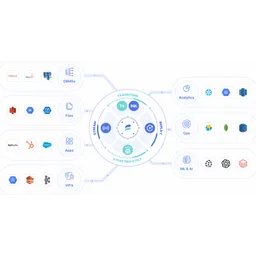
Tinybird gives you managed ClickHouse plus a delivery layer on top. You stream events in over an HTTP events endpoint or connect Kafka, S3, BigQuery or Postgres, write a parameterised SQL file called a Pipe, and Tinybird publishes it as an authenticated, rate-limited, low-latency REST endpoint. The whole project is a directory of .datasource and .pipe files kept in git and deployed with a CLI, so schemas and queries move through pull requests like application code. The distinguishing move is that it sells the last mile rather than the database. Plenty of vendors will host ClickHouse for you; Tinybird collapses the API server, auth tokens, query parameterisation and rate limiting that a team would otherwise build between ClickHouse and its front end. For a product team shipping an in-app analytics page, that is often several sprints of backend work they never write. Buyers are product engineering teams adding real-time analytics to a SaaS product, and data teams serving operational dashboards that Snowflake or BigQuery are too slow and too expensive to power interactively. The trade-offs are ClickHouse trade-offs: joins are awkward at scale, updates and deletes are expensive, and getting acceptable performance depends on choosing the right sorting key up front. On top of that, compute is billed per vCPU-second and storage per gigabyte, so a badly written query is directly a line on the invoice.
The honest half
Concrete and checkable, so you can decide whether any of them matter to you. This is the half of a review a vendor will not write about Tinybird.
Cross-shopped
Each pairing was judged by two reviewers asking whether a buyer would genuinely weigh the two against each other. The ones that failed were deleted rather than published.
ClickHouse: If you want the same engine without the proprietary API layer, and you are willing to build the serving tier yourself

Apache Pinot: If you need high-concurrency, low-latency queries and are prepared to operate a cluster

Materialize: If your workload is incrementally maintained views over streams rather than ad hoc analytical queries
Pricing
Taken from the vendor's own pricing page. Prices move, so check before you buy.
Free
Free
Developer
$25 /mo
SaaS
On request
Enterprise
On request
Capabilities
Managed ClickHouse
Hosted columnar database with vertical and, on Enterprise, horizontal scaling
Pipes as APIs
Parameterised SQL published as an authenticated REST endpoint with rate limits
Events HTTP endpoint
High-throughput ingestion over plain HTTP with no client library required
Streaming connectors
Native ingestion from Kafka, Confluent, S3, GCS, BigQuery, Snowflake and Postgres
Materialized views
Incremental rollups that pre-aggregate at ingest time
Git-based workflow
Datasources and pipes as files, deployed through a CLI and CI
Token-scoped auth
Per-tenant API tokens with row-level filters for multi-tenant dashboards
Observability
Built-in service datasources exposing query latency, errors and cost per endpoint
Answered, with sources
Each answer names the page it came from, so you can check it rather than take our word for it.
No. The database is ClickHouse, but the product is the layer above it: publishing parameterised SQL as authenticated, rate-limited REST endpoints without writing an API server.
Free tier at 1,000 requests a day, Developer from 25 USD a month, then compute at 0.0002 USD per vCPU-second and storage at 0.058 USD per gigabyte. Higher tiers are quoted.
Only on Enterprise, which offers dedicated infrastructure and private regions. Lower tiers are shared multi-tenant cloud.
Poorly, as ClickHouse does. Design for append-only event data; frequent mutation is the wrong workload for this engine.
Keep looking
Fast open-source column-oriented database for real-time analytics
Live context layer for AI agents using real-time SQL transformations
Streaming database that maintains incremental materialised views in SQL instead of Flink jobs
Real-time data integration combining streaming, CDC, and batch
Open-source typo-tolerant search engine as an Algolia alternative
Streaming SQL engine built on ClickHouse internals, shipping as one small binary
The real-time distributed SQL database for data-intensive applications
Multi-model database combining documents, graphs, vectors and time-series
Long-established enterprise MPP data warehouse, rebranded in 2026 as the Autonomous Knowledge Platform, sold for cloud, on-premises and hybrid.
JMS message broker underpinning bank and telecom estates, now maintained rather than expanded
Closed-source vector and full-text search service built directly on object storage, with cold queries measured in seconds rather than milliseconds.
Erlang MQTT broker whose source is Apache 2.0 but whose official binaries need a paid subscription
MPP analytical database with a MySQL wire protocol and sub-second aggregation on wide tables
Streaming SQL engine built on ClickHouse internals, shipping as one small binary
Softwr does not host reviews and shows no star rating for Tinybird, because a rating we did not collect is not ours to publish. What is here is the pricing and platform detail from the vendor’s own pages, limitations we could state concretely, and alternatives a reviewer confirmed people weigh against it. Tell us if any of it is wrong.
What people switch to, and what they give up
Every tier, and where the cost actually lands
Put it head to head with anything we hold
Its rating, and an embed for your own site
Industrial process historian with published per-tag pricing and no client licence fees
Per tag band per yearNetApp-owned managed service for Cassandra, Kafka, OpenSearch, PostgreSQL and Cadence with a bring-your-own-cloud model
quoteErlang MQTT broker for large IoT fleets, relicensed to BSL with production free use limited to one node
Per month by connection and session volumeAttribute-based access control and masking applied inside Snowflake, Databricks and BigQuery
quoteMPP analytical database with a MySQL wire protocol and sub-second aggregation on wide tables
Open source, no licence feeStreaming database that maintains incremental materialised views in SQL instead of Flink jobs
Per RisingWave Unit hourCentralised data access governance from the creators of Apache Ranger, now rebranding as Trust3 AI
quoteThe Meta-lineage distributed SQL query engine, distinct from the Trino fork
Open source, no licence fee