 RisingWavevs
 Materialize
Materialize: If you want the same incremental view model with stronger consistency guarantees and a more mature commercial story

Streaming database that maintains incremental materialised views in SQL instead of Flink jobs
As of 31 August 2026, RisingWave has a free plan and paid plans start at $0.227/hour. A Postgres-compatible streaming database where you define a materialised view in SQL and it stays continuously up to date from Kafka or CDC. Softwr lists it under Databases. RisingWave is made by RisingWave Labs, available on Linux, Self-hosted, Web.
Overview
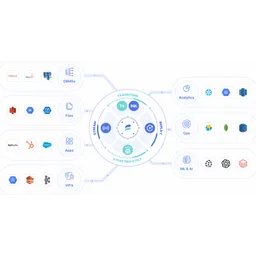
RisingWave is a distributed stream processing system presented as a database. You connect a source such as Kafka, Pulsar, Kinesis or a Postgres CDC stream, write a CREATE MATERIALIZED VIEW statement, and the engine keeps that view incrementally up to date, computing only the delta as events arrive. Results can be queried directly over the Postgres wire protocol or sunk back out to Kafka, Iceberg, ClickHouse or a warehouse. The distinguishing decision is the interface. Apache Flink is the incumbent for this work and requires a Java or Scala codebase, a job manager, checkpointing configuration and a team that understands operator state. RisingWave replaces that with SQL and a Postgres connection, which puts streaming transformations within reach of analytics engineers rather than a dedicated streaming team. State is persisted to object storage rather than local disk, so recovery is a matter of restarting nodes rather than restoring large local checkpoints. The core is Apache 2.0 and self-hostable, but the commercial model puts a set of premium features behind a licence key and the managed cloud is billed per RisingWave Unit hour starting at 0.227 US dollars. Buyers are teams that already have Kafka and want continuously fresh aggregations without hiring streaming engineers. The trade-off is expressiveness: complex event processing, custom windowing and stateful logic that does not fit SQL still belongs in Flink.
The honest half
Concrete and checkable, so you can decide whether any of them matter to you. This is the half of a review a vendor will not write about RisingWave.
Cross-shopped
Each pairing was judged by two reviewers asking whether a buyer would genuinely weigh the two against each other. The ones that failed were deleted rather than published.
Materialize: If you want the same incremental view model with stronger consistency guarantees and a more mature commercial story

Apache Flink: If your logic exceeds SQL and you have or can hire streaming engineers

Tinybird: If you want real-time analytics as an API rather than a streaming database you connect BI tools to
Pricing
Taken from the vendor's own pricing page. Prices move, so check before you buy.
Community Edition
Free
Cloud Basic
$0.227 /hour
Cloud Pro
On request
Self-managed Enterprise
On request
Capabilities
SQL materialised views
Incrementally maintained results defined with standard CREATE MATERIALIZED VIEW
Postgres wire compatibility
Existing psql clients, drivers and BI tools connect directly
Object storage state
Operator state persisted to S3 so recovery does not depend on local disk
Source connectors
Kafka, Pulsar, Kinesis, MQTT and Postgres or MySQL CDC ingestion
Sink connectors
Output to Kafka, Iceberg, ClickHouse, Snowflake, Redis and warehouses
Iceberg tables
Native writing of streaming results into Apache Iceberg
Watermarks and windowing
Event time processing with tumbling, hopping and session windows
User defined functions
Python, Java and JavaScript functions callable from streaming SQL
Answered, with sources
Each answer names the page it came from, so you can check it rather than take our word for it.
The community edition is Apache 2.0 and self-hostable, but a set of premium features requires a paid licence key.
It starts at 0.227 US dollars per RisingWave Unit hour on the Basic tier, which is capped at 64 cores.
For SQL-expressible transformations, often yes. For custom stateful processing and complex event handling, no.
Yes over the Postgres wire protocol, but it is an analytical streaming engine, not a transactional database.
Keep looking
Live context layer for AI agents using real-time SQL transformations
Managed ClickHouse with a workflow that turns SQL queries into hosted HTTP APIs
Streaming SQL engine built on ClickHouse internals, shipping as one small binary
Real-time data integration combining streaming, CDC, and batch
NetApp-owned managed service for Cassandra, Kafka, OpenSearch, PostgreSQL and Cadence with a bring-your-own-cloud model
Log-based change data capture for database replication and synchronization
Apache 2.0 distributed SQL database with MySQL wire compatibility and a separate columnar replica for analytical queries.
Apache 2.0 platform for running many Postgres instances on Kubernetes, with copy-on-write branching and scale-to-zero.
MySQL and PostgreSQL-compatible relational database built for the cloud
Apache 2.0 MPP analytical database built for joins on open table formats
Multi-model database combining documents, graphs, vectors and time-series
Long-established enterprise MPP data warehouse, rebranded in 2026 as the Autonomous Knowledge Platform, sold for cloud, on-premises and hybrid.
JMS message broker underpinning bank and telecom estates, now maintained rather than expanded
Streaming SQL engine built on ClickHouse internals, shipping as one small binary
Softwr does not host reviews and shows no star rating for RisingWave, because a rating we did not collect is not ours to publish. What is here is the pricing and platform detail from the vendor’s own pages, limitations we could state concretely, and alternatives a reviewer confirmed people weigh against it. Tell us if any of it is wrong.
What people switch to, and what they give up
Every tier, and where the cost actually lands
Put it head to head with anything we hold
Its rating, and an embed for your own site
Industrial process historian with published per-tag pricing and no client licence fees
Per tag band per yearNetApp-owned managed service for Cassandra, Kafka, OpenSearch, PostgreSQL and Cadence with a bring-your-own-cloud model
quoteErlang MQTT broker for large IoT fleets, relicensed to BSL with production free use limited to one node
Per month by connection and session volumeAttribute-based access control and masking applied inside Snowflake, Databricks and BigQuery
quoteMPP analytical database with a MySQL wire protocol and sub-second aggregation on wide tables
Open source, no licence feeCentralised data access governance from the creators of Apache Ranger, now rebranding as Trust3 AI
quoteThe Meta-lineage distributed SQL query engine, distinct from the Trino fork
Open source, no licence fee