
E-Commerce · head to head
Contentful vs Estuary

Contentful
E-Commerce
The content platform for the digital-first era
- From
- Free
- Free plan
- Yes
Estuary
Databases
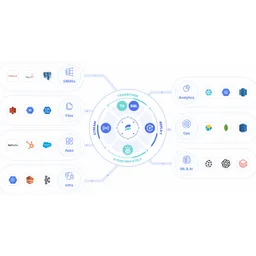
Real-time data integration combining streaming, CDC, and batch
- From
- Free
- Free plan
- Yes
The short version
- Contentful is a flexible and future-friendly content platform.
- Free plans on both; paid from $489/mo and $0.5/mo.
- Only Contentful lists content modeling; only Estuary lists real-time data delivery.
- Where Contentful falls short: pricing model with content type limits (48) forces full tier upgrades.
- Where Estuary falls short: Per-GB pricing adds up quickly for high-volume scenarios.
- Prices and features on this page were last checked on 30 August 2026.
Where they differ
Only the attributes on which Contentful and Estuary actually diverge.
| Attribute | Contentful | Estuary |
|---|---|---|
| Platforms | Web, API | Web, BYOC |
| Category | E-Commerce | Databases |
| Founded | 2013 | 2019 |
Identical on both: starting price (Free), free tier (Yes).
Not yet recorded: pricing model for Contentful.
What each one covers
Drawn from each product's published feature list. An absence here means we hold no record of it - not that the product lacks it.
Only in Contentful
- Content modeling
- RESTful APIs
- GraphQL API
- Webhooks
- Rich text editor
- Asset management
- Multi-language support
- Version control
Only in Estuary
- Real-time data delivery
- Change data capture
- Batch processing
- Data transformation
- Pre-built connectors
- Multiple deployments
- RBAC and monitoring
What people use each for
The jobs each tool is most often brought in to do.
Contentful
- Website content managementnot Estuary
- Mobile app contentnot Estuary
- E-commerce catalogsnot Estuary
- Multi-channel publishingnot Estuary
- Digital experiencesnot Estuary
Estuary
- Real-time data replication to data warehousesnot Contentful
- Change data capture from operational databasesnot Contentful
- Feeding analytics and BI systems with fresh datanot Contentful
- Powering real-time AI and ML data pipelinesnot Contentful
Where each one falls short
Documented limitations, not opinions. Every one is a constraint you would hit in normal use.
Contentful
- Pricing model with content type limits (48) forces full tier upgrades
- Limited GraphQL mutations for content management complexity
- Requires significant technical expertise and developer dependency
- Uncertainty following Salesforce acquisition announcement in June 2026
Estuary
- Per-GB pricing adds up quickly for high-volume scenarios
- No transparent per-connector volume discounts below 6 connectors
- Limited to data movement; transformation capabilities are basic
- BYOC and private deployment requires enterprise plan
- Smaller ecosystem compared to established alternatives
Pricing, plan by plan
Contentful
Free- FreeFree
- 10 users
- 100K API calls per month
- 1 Space
- Team$489/mo
- Higher usage limits
- Additional collaboration features
- Professional support
Estuary
Free- DeveloperFree
- 10 GB per month
- 2 connector instances maximum
- No credit card required
- Cloud$0.5/gb
- $0.50 per GB of data moved
- $100 per connector monthly (6+ connectors $50 each)
- 200+ connectors
- EnterpriseOn request
- Volume-based discounts
- SOC 2 and HIPAA compliance
- SSO authentication
Which should you pick?
Choose Contentful if
- You need content modeling.
- You want to start without paying.
- You work on Web, API.
- You also want restful apis.
Choose Estuary if
- You need real-time data delivery.
- You want to start without paying.
- You work on Web, BYOC.
- You also want change data capture.
Questions people ask
- Is Contentful or Estuary better?
- Neither clearly leads. Contentful starts at Free and Estuary at Free, and user ratings are close enough to be indistinguishable. Choose on capability and platform support.
- Which is cheaper, Contentful or Estuary?
- Contentful starts at Free and Estuary at Free.
- Does Contentful or Estuary run on more platforms?
- Contentful runs on Web, API. Estuary runs on Web, BYOC.
- Can I use Contentful for free?
- Both have a free tier, so you can try either at no cost before committing.
- What is Contentful best used for?
- Contentful is most often used for website content management, mobile app content, e-commerce catalogs, multi-channel publishing. Of those, website content management and mobile app content are not what Estuary is typically brought in for.
- What can Contentful do that Estuary cannot?
- Contentful covers Content modeling, RESTful APIs, GraphQL API, Webhooks. Estuary covers Real-time data delivery, Change data capture, Batch processing, Data transformation.
Answered from the vendors’ own pages
Contentful: Does Contentful offer a free tier?
Yes, Contentful has a Free tier with 10 users, 100K API calls per month, and support for 1 Space. This is suitable for small projects and proof-of-concept work.
SourceEstuary: What is included in the free Developer plan?
Developer plan ($0/month) includes 10 GB of data per month and up to 2 connector instances, no credit card required.
SourceContentful: What is the difference between Contentful and traditional CMS platforms?
Contentful is a headless CMS that decouples content from presentation, allowing you to deliver the same content across websites, mobile apps, IoT devices, and voice assistants without duplication.
SourceEstuary: How is data pricing calculated on Cloud plan?
Cloud plan charges $0.50 per GB of data moved plus $100/month per connector for the first 6 connectors, then $50/month for additional connectors.
SourceContentful: How does Contentful handle multi-locale content?
Contentful supports multi-locale content, though multi-locale costs must be negotiated upfront depending on your pricing tier and requirements.
SourceEstuary: What discount is available when adding 6+ connectors?
When using 6 or more connectors, the per-connector cost drops to $50/month from $100/month, saving $50 per additional connector.
SourceContentful: Does Contentful integrate with e-commerce platforms?
Yes, Contentful partners with Commerce Layer, an API-first commerce platform, to enable enterprise-grade e-commerce experiences alongside headless CMS capabilities.
SourceRelated pages
Other head to heads
- Contentful vs Stripe
- Contentful vs Algolia
- Contentful vs Swell Commerce
- Contentful vs FullStory
- Contentful vs SAP Commerce Cloud
- Contentful vs Magento
- Contentful vs Braze
- Contentful vs Hotjar
- Contentful vs Mailchimp
- Contentful vs commercetools
- Contentful vs Medusa
- Contentful vs Braintree
- Contentful vs Loox
- Contentful vs Memberful
- Contentful vs Mollie
- Contentful vs Namecheap
- Contentful vs OpenCart
- Contentful vs Oracle Commerce
- Contentful vs Fivetran HVR
- Contentful vs Apache Druid
- Contentful vs ClickHouse
- Contentful vs Materialize
- Contentful vs Redis
- Contentful vs Firebase Realtime Database
- Contentful vs SingleStore
- Contentful vs Tinybird
- Contentful vs Timeplus
- Contentful vs Amazon Redshift
- Contentful vs DataGrip
- Contentful vs Firebolt
- Contentful vs Apache Pinot
- Contentful vs Apache Flink
- Contentful vs Apache Kafka
- Contentful vs Apache Pulsar
- Contentful vs Cassandra
- Contentful vs CouchDB
- Estuary vs Stripe
- Estuary vs Algolia
- Estuary vs Swell Commerce
- Estuary vs FullStory
- Estuary vs SAP Commerce Cloud
- Estuary vs Magento
- Estuary vs Braze
- Estuary vs Hotjar
- Estuary vs Mailchimp
- Estuary vs commercetools
- Estuary vs Medusa
- Estuary vs Braintree
- Estuary vs Loox
- Estuary vs Memberful
- Estuary vs Mollie
- Estuary vs Namecheap
- Estuary vs OpenCart
- Estuary vs Oracle Commerce
- Estuary vs Fivetran HVR
- Estuary vs Apache Druid
- Estuary vs ClickHouse
- Estuary vs Materialize
- Estuary vs Redis
- Estuary vs Firebase Realtime Database
- Estuary vs SingleStore
- Estuary vs Tinybird
- Estuary vs Timeplus
- Estuary vs Amazon Redshift
- Estuary vs DataGrip
- Estuary vs Firebolt
- Estuary vs Apache Pinot
- Estuary vs Apache Flink
- Estuary vs Apache Kafka
- Estuary vs Apache Pulsar
- Estuary vs Cassandra
- Estuary vs CouchDB