
Databases · head to head
Canary Labs vs Estuary

Canary Labs
Databases
Industrial process historian with published per-tag pricing and no client licence fees
- From
- $3000/year
- Rated
- -
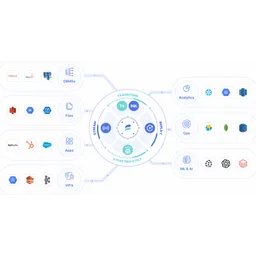
Estuary
Databases
Real-time data integration combining streaming, CDC, and batch
- From
- Free
- Rated
- -
The short version
- Only Estuary has a free tier, so it costs nothing to try first.
- Each has a real cost: Canary Labs pricing steps by tag band rather than actual tags, so a site sitting just above a threshold pays the next band in full; growth from 3,400 to 3,600 tags is a licence purchase, not a rounding error.; Estuary per-GB pricing adds up quickly for high-volume scenarios
- They diverge on capability: Canary Labs covers Loss-less compression, Estuary covers Real-time data delivery.
- Prices and features above were last checked on 1 September 2026.
Where they differ
Only the attributes on which Canary Labs and Estuary actually diverge.
| Attribute | Canary Labs | Estuary |
|---|---|---|
| Starting price | $3000/year | Free |
| Pricing model | Per tag band per year | Usage-based per GB plus per-connector cost |
| Free tier | No | Yes |
| Platforms | Windows, Web | Cloud, Private Cloud, BYOC |
| Founded | Unknown | 2019 |
Identical on both: user rating (Not yet rated), category (Databases).
What each one covers
Drawn from each product's published feature list. An absence here means we hold no record of it - not that the product lacks it.
Only in Canary Labs
- Loss-less compression
- Unlimited clients
- Store and forward
- Views service
- Sparkplug B
- Calculation engine
- Axiom
- ODBC and REST
Only in Estuary
- Real-time data delivery
- Change data capture
- Batch processing
- Data transformation
- Pre-built connectors
- Multiple deployments
- RBAC and monitoring
What people use each for
The jobs each tool is most often brought in to do.
Canary Labs
- A manufacturer that needs a compliant historian but cannot justify a PI System enterprise agreementnot Estuary
- A water utility replacing SCADA-embedded logging with a historian that survives the next SCADA replacementnot Estuary
- An Ignition site that wants long-term storage and trending without paying per-client for dashboardsnot Estuary
- A plant with regulatory data-retention obligations where swinging-door compression would not survive an auditnot Estuary
Estuary
- Real-time data replication to data warehousesnot Canary Labs
- Change data capture from operational databasesnot Canary Labs
- Feeding analytics and BI systems with fresh datanot Canary Labs
- Powering real-time AI and ML data pipelinesnot Canary Labs
Where each one falls short
Documented limitations, not opinions. Every one is a constraint you would hit in normal use.
Canary Labs
- Pricing steps by tag band rather than actual tags, so a site sitting just above a threshold pays the next band in full; growth from 3,400 to 3,600 tags is a licence purchase, not a rounding error.
- CustomerCare at 18 percent of licence cost is effectively mandatory on perpetual licences because lapsing it removes upgrades, so the perpetual option is not really a one-time cost.
- The storage format is proprietary; getting data out at volume means the ODBC connector, an additional 2,500 USD one-time or 1,000 USD a year, or writing against the REST API.
- Canary is a small vendor with a limited partner network outside North America, so support coverage and integrator availability in Europe and Asia are thinner than for AVEVA or Ignition.
- It is a Windows-only server product with no Linux or container deployment, which complicates placing collectors in modern edge estates.
Estuary
- Per-GB pricing adds up quickly for high-volume scenarios
- No transparent per-connector volume discounts below 6 connectors
- Limited to data movement; transformation capabilities are basic
- BYOC and private deployment requires enterprise plan
- Smaller ecosystem compared to established alternatives
Pricing, plan by plan
Canary Labs
$3000/year- Subscription, 3,500 tags$3000/year
- Unlimited Axiom clients
- Unlimited Excel clients
- Support and upgrades included
- Perpetual, 3,500 tags$8730/one-time
- 7,400 USD licence plus 1,330 USD first-year CustomerCare
- CustomerCare renews at 18 percent of licence cost per year
- Unlimited clients
- Private cloud, 3,500 tags$12320/year
- Hosted by Canary
- 1,500 USD one-time setup fee per system
- Scales to around 58,684 USD per year at 60,000 tags
- Enterprise unlimited$undefined/year
- Unlimited tags
- Negotiated licensing terms
- Quoted pricing
Estuary
Free- DeveloperFree
- 10 GB per month
- 2 connector instances maximum
- No credit card required
- Cloud$0.5/GB
- $0.50 per GB of data moved
- $100 per connector monthly (6+ connectors $50 each)
- 200+ connectors
- Enterprise$null/custom
- Volume-based discounts
- SOC 2 and HIPAA compliance
- SSO authentication
Which should you pick?
Choose Canary Labs if
- You need loss-less compression.
- You work on Windows, Web.
- You also want unlimited clients.
Choose Estuary if
- You need real-time data delivery.
- You want to start without paying.
- You work on Cloud, Private Cloud, BYOC.
- You also want change data capture.
Questions people ask
- Is Canary Labs or Estuary better?
- Neither clearly leads. Canary Labs starts at $3000/year and Estuary at Free, and user ratings are close enough to be indistinguishable. Choose on capability and platform support.
- Which is cheaper, Canary Labs or Estuary?
- Estuary has a free tier; the other does not. Paid plans start at $3000/year for Canary Labs and Free for Estuary.
- Does Canary Labs or Estuary run on more platforms?
- Canary Labs runs on Windows, Web. Estuary runs on Cloud, Private Cloud, BYOC.
- Can I use Estuary for free?
- Yes. Estuary has a free tier, so you can try it without paying. Canary Labs starts at $3000/year.
- What is Canary Labs best used for?
- Canary Labs is most often used for a manufacturer that needs a compliant historian but cannot justify a pi system enterprise agreement, a water utility replacing scada-embedded logging with a historian that survives the next scada replacement, an ignition site that wants long-term storage and trending without paying per-client for dashboards, a plant with regulatory data-retention obligations where swinging-door compression would not survive an audit. Of those, a manufacturer that needs a compliant historian but cannot justify a pi system enterprise agreement and a water utility replacing scada-embedded logging with a historian that survives the next scada replacement are not what Estuary is typically brought in for.
- What can Canary Labs do that Estuary cannot?
- Canary Labs covers Loss-less compression, Unlimited clients, Store and forward, Views service. Estuary covers Real-time data delivery, Change data capture, Batch processing, Data transformation.
Answered from the vendors’ own pages
Canary Labs: What does Canary cost?
8,730 USD for a 3,500 tag perpetual system including first-year CustomerCare, or 3,000 USD a year on subscription.
Estuary: What is included in the free Developer plan?
Developer plan ($0/month) includes 10 GB of data per month and up to 2 connector instances, no credit card required.
SourceCanary Labs: Are client licences extra?
No. Unlimited Axiom browser clients and unlimited Excel clients are included on every tier.
Estuary: How is data pricing calculated on Cloud plan?
Cloud plan charges $0.50 per GB of data moved plus $100/month per connector for the first 6 connectors, then $50/month for additional connectors.
SourceCanary Labs: Is perpetual cheaper than subscription?
Canary states perpetual pays off after roughly three years, and after that you still pay 18 percent CustomerCare annually.
Estuary: What discount is available when adding 6+ connectors?
When using 6 or more connectors, the per-connector cost drops to $50/month from $100/month, saving $50 per additional connector.
SourceCanary Labs: Does it use lossy compression?
No. Canary stores every collected value rather than approximating the trend, which matters for regulated data retention.
Related pages
More on Canary Labs
Other head to heads
- Canary Labs vs VerneMQ
- Canary Labs vs EMQX
- Canary Labs vs TimescaleDB
- Canary Labs vs QuestDB
- Canary Labs vs Solace PubSub+
- Canary Labs vs Firebase Realtime Database
- Canary Labs vs Apache Doris
- Canary Labs vs Convex
- Canary Labs vs Instaclustr
- Canary Labs vs Cockroach Labs
- Canary Labs vs Meilisearch
- Canary Labs vs DuckDB
- Canary Labs vs BigQuery
- Canary Labs vs CosmosDB
- Canary Labs vs DataStax
- Canary Labs vs dbt
- Canary Labs vs FaunaDB
- Canary Labs vs Fivetran HVR
- Canary Labs vs Apache Druid
- Canary Labs vs ClickHouse
- Canary Labs vs Materialize
- Canary Labs vs SingleStore
- Canary Labs vs Tinybird
- Canary Labs vs Timeplus
- Canary Labs vs NATS
- Canary Labs vs Vitess
- Canary Labs vs Aiven
- Canary Labs vs Apache Pinot
- Canary Labs vs Apache Flink
- Canary Labs vs Apache Kafka
- Estuary vs VerneMQ
- Estuary vs EMQX
- Estuary vs TimescaleDB
- Estuary vs QuestDB
- Estuary vs Solace PubSub+
- Estuary vs Firebase Realtime Database
- Estuary vs Apache Doris
- Estuary vs Convex
- Estuary vs Instaclustr
- Estuary vs Cockroach Labs
- Estuary vs Meilisearch
- Estuary vs DuckDB
- Estuary vs BigQuery
- Estuary vs CosmosDB
- Estuary vs DataStax
- Estuary vs dbt
- Estuary vs FaunaDB
- Estuary vs Fivetran HVR
- Estuary vs Apache Druid
- Estuary vs ClickHouse
- Estuary vs Materialize
- Estuary vs SingleStore
- Estuary vs Tinybird
- Estuary vs Timeplus
- Estuary vs NATS
- Estuary vs Vitess
- Estuary vs Aiven
- Estuary vs Apache Pinot
- Estuary vs Apache Flink
- Estuary vs Apache Kafka