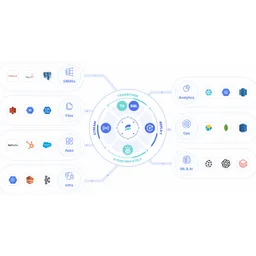
Apache Flink vs Apache Kafka
Apache Kafka: Transports the events Flink processes, and is usually deployed alongside rather than instead


Stateful stream processing at scale
As of 29 August 2026, Apache Flink is free to use. The stream processor for stateful, event-time computation. Softwr lists it under Databases. Apache Flink is made by Apache Software Foundation, available on Linux, Self-hosted.
Overview
Apache Flink is a framework and distributed engine for stateful computations over unbounded and bounded data streams. Where Kafka transports events, Flink is what computes over them: windowed aggregations, joins across streams, and pattern detection, with state that survives failures. Its distinguishing capabilities are event-time processing and exactly-once state consistency. Real event streams arrive late and out of order; Flink reasons about when an event actually happened rather than when it arrived, and checkpoints state so a failure resumes rather than restarts.
The honest half
The limits buyers hit most with Apache Flink: genuinely difficult: event time, watermarks and state backends are a real conceptual load before anything works; and operationally heavy — job managers, task managers, checkpoint storage and state size are all yours to run and tune. Each is concrete and checkable: the half of a review a vendor will not write.
Cross-shopped
The closest alternative to Apache Flink is Apache Kafka. Each is a tool buyers genuinely weigh against it, with the reason why.
Apache Kafka: Transports the events Flink processes, and is usually deployed alongside rather than instead
Pricing
Apache Flink is free to use. Taken from the vendor's own pricing page; prices move, so check before you buy.
Apache Flink
Free
Capabilities
Apache Flink lists 4 features, including event-time processing; exactly-once state; and batch and stream.
Event-time processing
Handles late and out-of-order events using watermarks
Exactly-once state
Checkpointing so failures resume without double-counting
Batch and stream
One engine for bounded and unbounded data
SQL interface
Flink SQL for stream processing without writing Java or Scala
Answered, with sources
Each answer names the page it came from, so you can check it rather than take our word for it.
Yes, open source under the Apache Software Foundation. Managed services such as Amazon Managed Service for Apache Flink are billed separately.
They are complementary rather than alternatives. Kafka moves and stores events; Flink computes over them with windowing, joins and durable state.
Computing based on when an event actually occurred rather than when it arrived. It is what makes results correct when data is late or out of order, and it is the main reason Flink is harder than it looks.
Keep looking
Streaming SQL engine built on ClickHouse internals, shipping as one small binary
Streaming database that maintains incremental materialised views in SQL instead of Flink jobs
Fast open-source column-oriented database for real-time analytics
The real-time distributed SQL database for data-intensive applications
MIT-licensed analytical SQL database that runs inside your process, with no server, no dependencies and one writer at a time.
Fast open source time-series database for high throughput ingestion
Open-source search and analytics suite forked from Elasticsearch
Real-time data integration combining streaming, CDC, and batch
Live context layer for AI agents using real-time SQL transformations
Enterprise-grade relational database management system
Time-series database built on PostgreSQL for real-time analytics
A distributed SQL engine that queries data where it already lives, across object storage, warehouses and operational databases.
SQLite-lineage database platform for running very large numbers of small per-tenant databases, with an MIT-licensed engine.
Softwr does not host reviews and shows no star rating for Apache Flink, because a rating we did not collect is not ours to publish. What is here is the pricing and platform detail from the vendor’s own pages, limitations we could state concretely, and alternatives a reviewer confirmed people weigh against it. Tell us if any of it is wrong.
What people switch to, and what they give up
Every tier, and where the cost actually lands
Put it head to head with anything we hold
Its rating, and an embed for your own site
Industrial process historian with published per-tag pricing and no client licence fees
Per tag band per yearNetApp-owned managed service for Cassandra, Kafka, OpenSearch, PostgreSQL and Cadence with a bring-your-own-cloud model
quoteErlang MQTT broker for large IoT fleets, relicensed to BSL with production free use limited to one node
Per month by connection and session volumeAttribute-based access control and masking applied inside Snowflake, Databricks and BigQuery
quoteMPP analytical database with a MySQL wire protocol and sub-second aggregation on wide tables
Open source, no licence feeStreaming database that maintains incremental materialised views in SQL instead of Flink jobs
Per RisingWave Unit hourCentralised data access governance from the creators of Apache Ranger, now rebranding as Trust3 AI
quoteThe Meta-lineage distributed SQL query engine, distinct from the Trino fork
Open source, no licence fee