
Databases · head to head
Estuary vs Xata
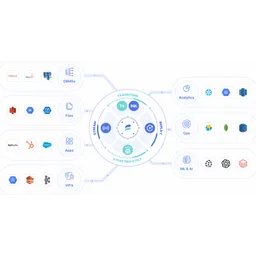
Estuary
Databases
Real-time data integration combining streaming, CDC, and batch
- From
- Free
- Rated
- -

Xata
Databases
Apache 2.0 platform for running many Postgres instances on Kubernetes, with copy-on-write branching and scale-to-zero.
- From
- Free
- Rated
- -
The short version
- Each has a real cost: Estuary per-GB pricing adds up quickly for high-volume scenarios; Xata self-hosting means operating Kubernetes and CloudNativePG, so the Apache 2.0 licence removes the vendor bill but replaces it with a platform team, and a database platform is not something a part-time operator maintains safely.
- They diverge on capability: Estuary covers Real-time data delivery, Xata covers Copy-on-write branching.
- Prices and features above were last checked on 30 August 2026.
Where they differ
Only the attributes on which Estuary and Xata actually diverge.
Identical on both: starting price (Free), free tier (Yes), user rating (Not yet rated), category (Databases).
What each one covers
Drawn from each product's published feature list. An absence here means we hold no record of it - not that the product lacks it.
Only in Estuary
- Real-time data delivery
- Change data capture
- Batch processing
- Data transformation
- Pre-built connectors
- Multiple deployments
- RBAC and monitoring
Only in Xata
- Copy-on-write branching
- Scale-to-zero compute
- Compute autoscaling and bin-packing
- High availability with failover
- Point-in-time recovery
- Serverless driver
- pgroll migrations
- pgstream replication
What people use each for
The jobs each tool is most often brought in to do.
Estuary
- Real-time data replication to data warehousesnot Xata
- Change data capture from operational databasesnot Xata
- Feeding analytics and BI systems with fresh datanot Xata
- Powering real-time AI and ML data pipelinesnot Xata
Xata
- Giving every pull request or coding agent its own branch of the production database, with real data volumes rather than a seeded fixturenot Estuary
- Running managed-Postgres economics in your own cloud account where data residency or compliance rules out a third-party control planenot Estuary
- Consolidating many small, mostly idle Postgres databases onto shared infrastructure where scale-to-zero and bin-packing recover the idle costnot Estuary
- Testing a destructive migration against a copy of production without waiting for a full restore or paying for a duplicate of the storagenot Estuary
Where each one falls short
Documented limitations, not opinions. Every one is a constraint you would hit in normal use.
Estuary
- Per-GB pricing adds up quickly for high-volume scenarios
- No transparent per-connector volume discounts below 6 connectors
- Limited to data movement; transformation capabilities are basic
- BYOC and private deployment requires enterprise plan
- Smaller ecosystem compared to established alternatives
Xata
- Self-hosting means operating Kubernetes and CloudNativePG, so the Apache 2.0 licence removes the vendor bill but replaces it with a platform team, and a database platform is not something a part-time operator maintains safely.
- Copy-on-write branches are cheap to create but diverge as they are written to, so a long-lived branch carrying a heavy backfill quietly accumulates real storage and the cost arrives later than the decision that caused it.
- Scale-to-zero means the first connection after an idle period pays a cold start, which is invisible in a busy production database and very visible in a demo, a staging environment or a cron job that runs once an hour.
- The Xata sold before 2025 was a different product, a proprietary API and SDK layered over Postgres, so tutorials, blog posts and SDK examples from that era describe something that no longer exists and existing users had to migrate.
- As a managed service it competes with RDS, Aurora and Cloud SQL, and it is a much smaller company, so procurement, certification coverage and the depth of the support bench behind a 3am corruption incident are all weaker than the incumbent even though the underlying Postgres is the same.
Pricing, plan by plan
Estuary
Free- DeveloperFree
- 10 GB per month
- 2 connector instances maximum
- No credit card required
- Cloud$0.5/GB
- $0.50 per GB of data moved
- $100 per connector monthly (6+ connectors $50 each)
- 200+ connectors
- Enterprise$null/custom
- Volume-based discounts
- SOC 2 and HIPAA compliance
- SSO authentication
Xata
Free- Free TrialFree
- 14 days free
- No credit card required
- Usage-Based$1/per 1000 branches
- 1,000 branches for $1
- Scale-to-zero compute model
- Branches hibernate when idle
Which should you pick?
Choose Estuary if
- You need real-time data delivery.
- You want to start without paying.
- You work on Cloud, Private Cloud, BYOC.
- You also want change data capture.
Choose Xata if
- You need copy-on-write branching.
- You want to start without paying.
- You also want scale-to-zero compute.
Questions people ask
- Is Estuary or Xata better?
- Neither clearly leads. Estuary starts at Free and Xata at Free, and user ratings are close enough to be indistinguishable. Choose on capability and platform support.
- Which is cheaper, Estuary or Xata?
- Estuary starts at Free and Xata at Free.
- Does Estuary or Xata run on more platforms?
- Estuary runs on Cloud, Private Cloud, BYOC. Xata runs on Web.
- Can I use Estuary for free?
- Both have a free tier, so you can try either at no cost before committing.
- What is Estuary best used for?
- Estuary is most often used for real-time data replication to data warehouses, change data capture from operational databases, feeding analytics and bi systems with fresh data, powering real-time ai and ml data pipelines. Of those, real-time data replication to data warehouses and change data capture from operational databases are not what Xata is typically brought in for.
- What can Estuary do that Xata cannot?
- Estuary covers Real-time data delivery, Change data capture, Batch processing, Data transformation. Xata covers Copy-on-write branching, Scale-to-zero compute, Compute autoscaling and bin-packing, High availability with failover.
Answered from the vendors’ own pages
Estuary: What is included in the free Developer plan?
Developer plan ($0/month) includes 10 GB of data per month and up to 2 connector instances, no credit card required.
SourceXata: Is it real Postgres or a compatible reimplementation?
Real Postgres. It runs upstream Postgres instances on Kubernetes via CloudNativePG, so extensions, the wire protocol and version upgrades behave as they do anywhere else.
Estuary: How is data pricing calculated on Cloud plan?
Cloud plan charges $0.50 per GB of data moved plus $100/month per connector for the first 6 connectors, then $50/month for additional connectors.
SourceXata: Can I self-host the whole thing?
Yes. The platform is Apache 2.0 and designed for self-hosting a large number of Postgres instances on your own Kubernetes. Xata Cloud is the same platform run as a service.
Estuary: What discount is available when adding 6+ connectors?
When using 6 or more connectors, the per-connector cost drops to $50/month from $100/month, saving $50 per additional connector.
SourceXata: Does branching copy my data?
No. Branches are copy-on-write at the storage layer, so creating one is near-instant regardless of database size and storage is only consumed as the branch diverges from its parent.
Xata: Is this the same Xata I used a couple of years ago?
No. The earlier product was a proprietary database API with its own SDK and search layer. The current product is a Postgres platform, and material written for the old one does not apply.
Xata: What happens to a branch when the parent changes?
A branch is a point-in-time fork. Later changes on the parent are not propagated, so long-lived branches drift and need to be recreated rather than refreshed if you want current data.
Related pages
Other head to heads
- Estuary vs Fivetran HVR
- Estuary vs Apache Druid
- Estuary vs ClickHouse
- Estuary vs Materialize
- Estuary vs Firebase Realtime Database
- Estuary vs SingleStore
- Estuary vs Tinybird
- Estuary vs Timeplus
- Estuary vs NATS
- Estuary vs QuestDB
- Estuary vs Vitess
- Estuary vs Aiven
- Estuary vs BigQuery
- Estuary vs CosmosDB
- Estuary vs DataStax
- Estuary vs Apache Pinot
- Estuary vs Apache Flink
- Estuary vs Apache Kafka
- Estuary vs Amazon Aurora
- Estuary vs Airtable
- Estuary vs Cockroach Labs
- Estuary vs PostgreSQL
- Estuary vs DuckDB
- Estuary vs Convex
- Estuary vs turbopuffer
- Estuary vs PlanetScale
- Estuary vs Marqo
- Estuary vs Nile
- Estuary vs Ninox
- Estuary vs Presto
- Estuary vs Privacera
- Estuary vs RavenDB
- Estuary vs DynamoDB
- Estuary vs Apache Pulsar
- Xata vs Fivetran HVR
- Xata vs Apache Druid
- Xata vs ClickHouse
- Xata vs Materialize
- Xata vs Firebase Realtime Database
- Xata vs SingleStore
- Xata vs Tinybird
- Xata vs Timeplus
- Xata vs NATS
- Xata vs QuestDB
- Xata vs Vitess
- Xata vs Aiven
- Xata vs BigQuery
- Xata vs CosmosDB
- Xata vs DataStax
- Xata vs Apache Pinot
- Xata vs Apache Flink
- Xata vs Apache Kafka
- Xata vs Amazon Aurora
- Xata vs Airtable
- Xata vs Cockroach Labs
- Xata vs PostgreSQL
- Xata vs DuckDB
- Xata vs Convex
- Xata vs turbopuffer
- Xata vs PlanetScale
- Xata vs Marqo
- Xata vs Nile
- Xata vs Ninox
- Xata vs Presto
- Xata vs Privacera
- Xata vs RavenDB
- Xata vs DynamoDB
- Xata vs Apache Pulsar