
Databases · head to head
Estuary vs TypeScript
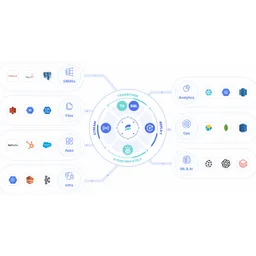
Estuary
Databases
Real-time data integration combining streaming, CDC, and batch
- From
- Free
- Free plan
- Yes

TypeScript
Web Development
JavaScript with syntax for types
- From
- Free
- Free plan
- Yes
The short version
- TypeScript is a strongly typed programming language.
- TypeScript is free; Estuary starts at $0.5/mo.
- Only Estuary lists change data capture; only TypeScript lists static typing.
- Where Estuary falls short: Per-GB pricing adds up quickly for high-volume scenarios.
- Where TypeScript falls short: requires build/compilation step; adds complexity to development workflow.
- Prices and features on this page were last checked on 17 November 2026.
How do Estuary and TypeScript differ?
Estuary and TypeScript differ on platforms (Web, BYOC against API, Web), category (Databases against Web Development) and year founded (2019 against 2012). Only the attributes on which Estuary and TypeScript actually diverge.
| Attribute | Estuary | TypeScript |
|---|---|---|
| Platforms | Web, BYOC | API, Web |
| Category | Databases | Web Development |
| Founded | 2019 | 2012 |
Identical on both: starting price (Free), free tier (Yes).
Not yet recorded: pricing model for TypeScript.
Which features does each one have?
They share no listed features; 7 appear only for Estuary and 20 only for TypeScript. Drawn from each product's published feature list. An absence here means we hold no record of it - not that the product lacks it.
Only in Estuary
- Real-time data delivery
- Change data capture
- Batch processing
- Data transformation
- Pre-built connectors
- Multiple deployments
- RBAC and monitoring
Only in TypeScript
- Static typing
- Type inference
- Compile-time checking
- ES6+ features
- Interface definitions
- Generics
- Decorators
- Module system
What is each one used for?
Estuary is most often brought in for real-time data replication to data warehouses; TypeScript for large-scale applications. The jobs each tool is most often brought in to do.
Estuary
- Real-time data replication to data warehousesnot TypeScript
- Change data capture from operational databasesnot TypeScript
- Feeding analytics and BI systems with fresh datanot TypeScript
- Powering real-time AI and ML data pipelinesnot TypeScript
TypeScript
- Large-scale applicationsnot Estuary
- Enterprise developmentnot Estuary
- Type-safe JavaScriptnot Estuary
- Team collaborationnot Estuary
- API developmentnot Estuary
Where do Estuary and TypeScript fall short?
Estuary's most cited limit: Per-GB pricing adds up quickly for high-volume scenarios. TypeScript's: requires build/compilation step; adds complexity to development workflow. Documented limitations, not opinions. Every one is a constraint you would hit in normal use.
Estuary
- Per-GB pricing adds up quickly for high-volume scenarios
- No transparent per-connector volume discounts below 6 connectors
- Limited to data movement; transformation capabilities are basic
- BYOC and private deployment requires enterprise plan
- Smaller ecosystem compared to established alternatives
TypeScript
- Requires build/compilation step; adds complexity to development workflow
- Performance slower than compiled languages like Rust or Go when running on same hardware
- Type safety only at compile-time; runtime errors still possible if types are misused
- JavaScript ecosystem requires understanding both TypeScript and JavaScript
How much do Estuary and TypeScript cost?
Estuary has a free plan, with paid plans from $0.5/mo; TypeScript is free to use. Plan by plan below, from each vendor's own pricing page.
Estuary
Free- DeveloperFree
- 10 GB per month
- 2 connector instances maximum
- No credit card required
- Cloud$0.5/gb
- $0.50 per GB of data moved
- $100 per connector monthly (6+ connectors $50 each)
- 200+ connectors
- EnterpriseOn request
- Volume-based discounts
- SOC 2 and HIPAA compliance
- SSO authentication
TypeScript
Free- TypeScript (open source, Apache-2.0)Free
Which should you pick?
Choose Estuary if
- You need real-time data delivery.
- You want to start without paying.
- You work on Web, BYOC.
- You also want change data capture.
Choose TypeScript if
- You need static typing.
- You want to start without paying.
- You work on API, Web.
- You also want type inference.
Questions people ask
- Is Estuary or TypeScript better?
- Neither clearly leads. Estuary starts at Free and TypeScript at Free, and user ratings are close enough to be indistinguishable. Choose on capability and platform support.
- Which is cheaper, Estuary or TypeScript?
- Estuary starts at Free and TypeScript at Free.
- Does Estuary or TypeScript run on more platforms?
- Estuary runs on Web, BYOC. TypeScript runs on API, Web.
- Can I use Estuary for free?
- Both have a free tier, so you can try either at no cost before committing.
- What is Estuary best used for?
- Estuary is most often used for real-time data replication to data warehouses, change data capture from operational databases, feeding analytics and bi systems with fresh data, powering real-time ai and ml data pipelines. Of those, real-time data replication to data warehouses and change data capture from operational databases are not what TypeScript is typically brought in for.
- What can Estuary do that TypeScript cannot?
- Estuary covers Real-time data delivery, Change data capture, Batch processing, Data transformation. TypeScript covers Static typing, Type inference, Compile-time checking, ES6+ features.
Answered from the vendors’ own pages
Estuary: What is included in the free Developer plan?
Developer plan ($0/month) includes 10 GB of data per month and up to 2 connector instances, no credit card required.
SourceTypeScript: What is TypeScript?
TypeScript is an open-source programming language developed by Microsoft that adds static type checking and object-oriented features to JavaScript while compiling down to standard JavaScript.
SourceEstuary: How is data pricing calculated on Cloud plan?
Cloud plan charges $0.50 per GB of data moved plus $100/month per connector for the first 6 connectors, then $50/month for additional connectors.
SourceTypeScript: When was TypeScript released?
TypeScript was publicly announced on October 1, 2012, by Microsoft after two years of internal development. Version 0.8 was the first release.
SourceEstuary: What discount is available when adding 6+ connectors?
When using 6 or more connectors, the per-connector cost drops to $50/month from $100/month, saving $50 per additional connector.
SourceTypeScript: Is TypeScript free?
Yes. TypeScript is open-source under the Apache 2.0 license and free to use for commercial and non-commercial purposes.
SourceTypeScript: What is the latest version of TypeScript?
As of February 28, 2025, TypeScript version 5.8 is the latest release.
SourceTypeScript: Does TypeScript require a compilation step?
Yes. TypeScript code must be compiled to JavaScript before execution in browsers or Node.js. This adds a build step to your development workflow.
SourceTypeScript: Can I use TypeScript everywhere JavaScript runs?
After compilation to JavaScript, yes. TypeScript compiles to standard JavaScript that runs in any JavaScript runtime including browsers, Node.js, and Deno.
SourceRelated pages
Other head to heads
- Estuary vs Fivetran HVR
- Estuary vs Apache Druid
- Estuary vs ClickHouse
- Estuary vs Materialize
- Estuary vs Redis
- Estuary vs Firebase Realtime Database
- Estuary vs SingleStore
- Estuary vs Tinybird
- Estuary vs Timeplus
- Estuary vs CosmosDB
- Estuary vs DataStax
- Estuary vs dbt
- Estuary vs EMQX
- Estuary vs FaunaDB
- Estuary vs Apache Pinot
- Estuary vs Firestore
- Estuary vs Apache Flink
- Estuary vs Apache Kafka
- Estuary vs Angular
- Estuary vs Sass
- Estuary vs Next.js
- Estuary vs Docusaurus
- Estuary vs React
- Estuary vs Tailwind CSS
- Estuary vs Svelte
- Estuary vs TanStack Start
- Estuary vs Alpine.js
- Estuary vs .NET
- Estuary vs NestJS
- Estuary vs Vue.js
- Estuary vs MUI
- Estuary vs Remix
- Estuary vs Astro
- Estuary vs MySQL
- Estuary vs Bootstrap
- Estuary vs Vercel
- TypeScript vs Fivetran HVR
- TypeScript vs Apache Druid
- TypeScript vs ClickHouse
- TypeScript vs Materialize
- TypeScript vs Redis
- TypeScript vs Firebase Realtime Database
- TypeScript vs SingleStore
- TypeScript vs Tinybird
- TypeScript vs Timeplus
- TypeScript vs CosmosDB
- TypeScript vs DataStax
- TypeScript vs dbt
- TypeScript vs EMQX
- TypeScript vs FaunaDB
- TypeScript vs Apache Pinot
- TypeScript vs Firestore
- TypeScript vs Apache Flink
- TypeScript vs Apache Kafka
- TypeScript vs Angular
- TypeScript vs Sass
- TypeScript vs Next.js
- TypeScript vs Docusaurus
- TypeScript vs React
- TypeScript vs Tailwind CSS
- TypeScript vs Svelte
- TypeScript vs TanStack Start
- TypeScript vs Alpine.js
- TypeScript vs .NET
- TypeScript vs NestJS
- TypeScript vs Vue.js
- TypeScript vs MUI
- TypeScript vs Remix
- TypeScript vs Astro
- TypeScript vs MySQL
- TypeScript vs Bootstrap
- TypeScript vs Vercel