
Databases · head to head
Estuary vs Knack
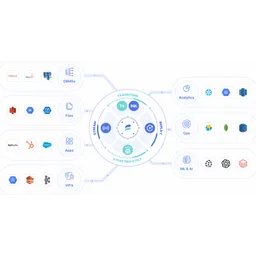
Estuary
Databases
Real-time data integration combining streaming, CDC, and batch
- From
- Free
- Rated
- -

Knack
Databases
Hosted no-code database and web app builder priced by stored records and storage, with unlimited user accounts on every plan.
- From
- $59/month
- Rated
- -
The short version
- Only Estuary has a free tier, so it costs nothing to try first.
- Each has a real cost: Estuary per-GB pricing adds up quickly for high-volume scenarios; Knack plans are capped by stored records, so an application that logs events or keeps history rather than current state climbs tiers on data volume alone, and archiving old records becomes a permanent maintenance chore rather than a one-off.
- They diverge on capability: Estuary covers Real-time data delivery, Knack covers Visual database builder.
- Prices and features above were last checked on 30 August 2026.
Where they differ
Only the attributes on which Estuary and Knack actually diverge.
Identical on both: user rating (Not yet rated), category (Databases).
What each one covers
Drawn from each product's published feature list. An absence here means we hold no record of it - not that the product lacks it.
Only in Estuary
- Real-time data delivery
- Change data capture
- Batch processing
- Data transformation
- Pre-built connectors
- Multiple deployments
- RBAC and monitoring
Only in Knack
- Visual database builder
- User logins and roles
- Page builder
- Unlimited users
- E-commerce
- Automation flows
- Scheduled tasks
- REST API and webhooks
What people use each for
The jobs each tool is most often brought in to do.
Estuary
- Real-time data replication to data warehousesnot Knack
- Change data capture from operational databasesnot Knack
- Feeding analytics and BI systems with fresh datanot Knack
- Powering real-time AI and ML data pipelinesnot Knack
Knack
- A member or client portal where thousands of external people need their own login and see only their own recordsnot Estuary
- Replacing a shared spreadsheet used by a team that has outgrown it but cannot justify a developer to build a bespoke internal toolnot Estuary
- Inventory, asset or case tracking for a small operations team that needs roles, forms and a record of who changed whatnot Estuary
- A registration or booking application for an association, school or non-profit where the user count is large and the record count stays modestnot Estuary
Where each one falls short
Documented limitations, not opinions. Every one is a constraint you would hit in normal use.
Estuary
- Per-GB pricing adds up quickly for high-volume scenarios
- No transparent per-connector volume discounts below 6 connectors
- Limited to data movement; transformation capabilities are basic
- BYOC and private deployment requires enterprise plan
- Smaller ecosystem compared to established alternatives
Knack
- Plans are capped by stored records, so an application that logs events or keeps history rather than current state climbs tiers on data volume alone, and archiving old records becomes a permanent maintenance chore rather than a one-off.
- API access is capped per day, at 1,000 calls on the entry plan and 10,000 at the Corporate tier, so a scheduled sync or a busy automation can exhaust the day's quota before the working day ends and integrations then fail silently.
- The application itself cannot be exported or self-hosted; records can be downloaded but the pages, roles, flows and business logic exist only inside Knack, so outgrowing the platform means rebuilding the app rather than moving it.
- Customisation beyond the builder is limited to injected CSS and JavaScript that Knack's support does not cover, so any non-standard interface behaviour becomes yours to maintain against a DOM the vendor can change without warning.
- Compliance capabilities that regulated buyers assume are baseline, HIPAA and GovCloud options, advanced SSO, IP restrictions and private environments, are gated to the Corporate and Enterprise tiers, so a small regulated pilot cannot legitimately start on an entry plan.
Pricing, plan by plan
Estuary
Free- DeveloperFree
- 10 GB per month
- 2 connector instances maximum
- No credit card required
- Cloud$0.5/GB
- $0.50 per GB of data moved
- $100 per connector monthly (6+ connectors $50 each)
- 200+ connectors
- Enterprise$null/custom
- Volume-based discounts
- SOC 2 and HIPAA compliance
- SSO authentication
Knack
$59/month- Starter$59/month
- 20,000 database records
- Unlimited users, tables, fields
- 25 AI credits
- Pro$130/month
- 50,000 database records
- Remove Knack branding
- E-commerce payments
- Corporate$300/month
- 125,000-2.5M database records
- App restore functionality
- Advanced SSO
- Enterprise$null/month
- Dedicated account manager
- HIPAA/GovCloud-based options
- Custom pricing
Which should you pick?
Choose Estuary if
- You need real-time data delivery.
- You want to start without paying.
- You work on Cloud, Private Cloud, BYOC.
- You also want change data capture.
Questions people ask
- Is Estuary or Knack better?
- Neither clearly leads. Estuary starts at Free and Knack at $59/month, and user ratings are close enough to be indistinguishable. Choose on capability and platform support.
- Which is cheaper, Estuary or Knack?
- Estuary has a free tier; the other does not. Paid plans start at Free for Estuary and $59/month for Knack.
- Does Estuary or Knack run on more platforms?
- Estuary runs on Cloud, Private Cloud, BYOC. Knack runs on Web.
- Can I use Estuary for free?
- Yes. Estuary has a free tier, so you can try it without paying. Knack starts at $59/month.
- What is Estuary best used for?
- Estuary is most often used for real-time data replication to data warehouses, change data capture from operational databases, feeding analytics and bi systems with fresh data, powering real-time ai and ml data pipelines. Of those, real-time data replication to data warehouses and change data capture from operational databases are not what Knack is typically brought in for.
- What can Estuary do that Knack cannot?
- Estuary covers Real-time data delivery, Change data capture, Batch processing, Data transformation. Knack covers Visual database builder, User logins and roles, Page builder, Unlimited users.
Answered from the vendors’ own pages
Estuary: What is included in the free Developer plan?
Developer plan ($0/month) includes 10 GB of data per month and up to 2 connector instances, no credit card required.
SourceKnack: Is Knack charged per user?
No. User accounts are unlimited on all plans. Plans are bounded by stored record count, file storage, API calls per day and automation transactions.
Estuary: How is data pricing calculated on Cloud plan?
Cloud plan charges $0.50 per GB of data moved plus $100/month per connector for the first 6 connectors, then $50/month for additional connectors.
SourceKnack: What happens when I exceed the record limit?
You move to a higher tier or reduce stored records. Because the limit is on data rather than people, apps that accumulate history hit it while apps that track a fixed set of entities generally do not.
Estuary: What discount is available when adding 6+ connectors?
When using 6 or more connectors, the per-connector cost drops to $50/month from $100/month, saving $50 per additional connector.
SourceKnack: Can I export my application or self-host it?
You can export record data. The application itself, its pages, roles, permissions and flows, is not exportable and cannot be self-hosted, so leaving means rebuilding elsewhere.
Knack: Is it suitable for public-facing portals?
That is its strongest case, because logins are unlimited and role-based permissions are built in. The constraint is record volume and API throughput, not audience size.
Knack: Can I use it for regulated data?
HIPAA-aligned and government cloud options exist but only on the Enterprise tier, along with private server environments. Lower tiers should not be used for regulated workloads.
Related pages
Other head to heads
- Estuary vs Fivetran HVR
- Estuary vs Apache Druid
- Estuary vs ClickHouse
- Estuary vs Materialize
- Estuary vs Firebase Realtime Database
- Estuary vs SingleStore
- Estuary vs Tinybird
- Estuary vs Timeplus
- Estuary vs NATS
- Estuary vs QuestDB
- Estuary vs Vitess
- Estuary vs Aiven
- Estuary vs BigQuery
- Estuary vs CosmosDB
- Estuary vs DataStax
- Estuary vs Apache Pinot
- Estuary vs Apache Flink
- Estuary vs Apache Kafka
- Estuary vs Airtable
- Estuary vs Cockroach Labs
- Estuary vs PostgreSQL
- Estuary vs Amazon Aurora
- Estuary vs Dremio
- Estuary vs DuckDB
- Estuary vs Immuta
- Estuary vs Turso
- Estuary vs FaunaDB
- Estuary vs Ninox
- Estuary vs TimescaleDB
- Estuary vs Amazon RDS
- Estuary vs Apache Pulsar
- Estuary vs Amazon Redshift
- Knack vs Fivetran HVR
- Knack vs Apache Druid
- Knack vs ClickHouse
- Knack vs Materialize
- Knack vs Firebase Realtime Database
- Knack vs SingleStore
- Knack vs Tinybird
- Knack vs Timeplus
- Knack vs NATS
- Knack vs QuestDB
- Knack vs Vitess
- Knack vs Aiven
- Knack vs BigQuery
- Knack vs CosmosDB
- Knack vs DataStax
- Knack vs Apache Pinot
- Knack vs Apache Flink
- Knack vs Apache Kafka
- Knack vs Airtable
- Knack vs Cockroach Labs
- Knack vs PostgreSQL
- Knack vs Amazon Aurora
- Knack vs Dremio
- Knack vs DuckDB
- Knack vs Immuta
- Knack vs Turso
- Knack vs FaunaDB
- Knack vs Ninox
- Knack vs TimescaleDB
- Knack vs Amazon RDS
- Knack vs Apache Pulsar
- Knack vs Amazon Redshift