
Databases · head to head
Estuary vs Immuta
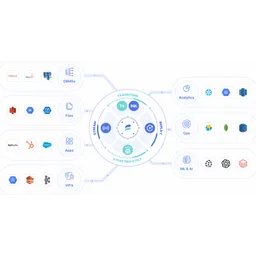
Estuary
Databases
Real-time data integration combining streaming, CDC, and batch
- From
- Free
- Rated
- -

Immuta
Databases
Attribute-based access control and masking applied inside Snowflake, Databricks and BigQuery
- From
- On request
- Rated
- -
The short version
- Only Estuary has a free tier, so it costs nothing to try first.
- Each has a real cost: Estuary per-GB pricing adds up quickly for high-volume scenarios; Immuta contracts commonly start around one hundred to two hundred thousand US dollars a year for mid-market deployments and exceed five hundred thousand at enterprise scale, which excludes most data teams without a regulatory mandate.
- They diverge on capability: Estuary covers Real-time data delivery, Immuta covers Attribute-based policy.
- Prices and features above were last checked on 31 August 2026.
Where they differ
Only the attributes on which Estuary and Immuta actually diverge.
Identical on both: user rating (Not yet rated), category (Databases).
What each one covers
Drawn from each product's published feature list. An absence here means we hold no record of it - not that the product lacks it.
Only in Estuary
- Real-time data delivery
- Change data capture
- Batch processing
- Data transformation
- Pre-built connectors
- Multiple deployments
- RBAC and monitoring
Only in Immuta
- Attribute-based policy
- Native enforcement
- Dynamic masking
- Row-level filtering
- Purpose-based access
- Sensitive data tagging
- Audit logging
- Multi-platform
What people use each for
The jobs each tool is most often brought in to do.
Estuary
- Real-time data replication to data warehousesnot Immuta
- Change data capture from operational databasesnot Immuta
- Feeding analytics and BI systems with fresh datanot Immuta
- Powering real-time AI and ML data pipelinesnot Immuta
Immuta
- A bank whose Snowflake estate has grown to tens of thousands of roles that no one can review before an auditnot Estuary
- A healthcare analytics team that must let researchers query patient data with identifiers masked unless a specific purpose is recordednot Estuary
- A multinational applying different residency and access rules per jurisdiction to the same tables without duplicating datasetsnot Estuary
- An organisation running both Snowflake and Databricks that wants one policy set rather than two divergent implementationsnot Estuary
Where each one falls short
Documented limitations, not opinions. Every one is a constraint you would hit in normal use.
Estuary
- Per-GB pricing adds up quickly for high-volume scenarios
- No transparent per-connector volume discounts below 6 connectors
- Limited to data movement; transformation capabilities are basic
- BYOC and private deployment requires enterprise plan
- Smaller ecosystem compared to established alternatives
Immuta
- Contracts commonly start around one hundred to two hundred thousand US dollars a year for mid-market deployments and exceed five hundred thousand at enterprise scale, which excludes most data teams without a regulatory mandate.
- Policy is only as good as the data classification underneath it, so an organisation with poorly tagged columns will spend months on classification before Immuta enforces anything useful.
- Native enforcement means capability varies by platform, and a feature available on Snowflake may be absent or behave differently on BigQuery, which undermines the promise of one policy set everywhere.
- Adding an access governance layer creates a new dependency in the path to data: a misconfigured policy silently returns fewer rows rather than erroring, and analysts can act on incomplete results without noticing.
- It governs cloud data platforms, so personal data in operational databases, files and SaaS applications sits outside its scope and needs separate controls, meaning Immuta is rarely the whole answer.
Pricing, plan by plan
Estuary
Free- DeveloperFree
- 10 GB per month
- 2 connector instances maximum
- No credit card required
- Cloud$0.5/GB
- $0.50 per GB of data moved
- $100 per connector monthly (6+ connectors $50 each)
- 200+ connectors
- Enterprise$null/custom
- Volume-based discounts
- SOC 2 and HIPAA compliance
- SSO authentication
Immuta
On request- Immuta Platform$undefined/year
- Attribute-based policy authoring
- Native enforcement in supported data platforms
- Dynamic masking and row-level security
Which should you pick?
Choose Estuary if
- You need real-time data delivery.
- You want to start without paying.
- You work on Cloud, Private Cloud, BYOC.
- You also want change data capture.
Choose Immuta if
- You need attribute-based policy.
- You work on Web, API, Cloud.
- You also want native enforcement.
Questions people ask
- Is Estuary or Immuta better?
- Neither clearly leads. Estuary starts at Free and Immuta at On request, and user ratings are close enough to be indistinguishable. Choose on capability and platform support.
- Which is cheaper, Estuary or Immuta?
- Estuary has a free tier; the other does not. Paid plans start at Free for Estuary and On request for Immuta.
- Does Estuary or Immuta run on more platforms?
- Estuary runs on Cloud, Private Cloud, BYOC. Immuta runs on Web, API, Cloud.
- Can I use Estuary for free?
- Yes. Estuary has a free tier, so you can try it without paying. Immuta starts at On request.
- What is Estuary best used for?
- Estuary is most often used for real-time data replication to data warehouses, change data capture from operational databases, feeding analytics and bi systems with fresh data, powering real-time ai and ml data pipelines. Of those, real-time data replication to data warehouses and change data capture from operational databases are not what Immuta is typically brought in for.
- What can Estuary do that Immuta cannot?
- Estuary covers Real-time data delivery, Change data capture, Batch processing, Data transformation. Immuta covers Attribute-based policy, Native enforcement, Dynamic masking, Row-level filtering.
Answered from the vendors’ own pages
Estuary: What is included in the free Developer plan?
Developer plan ($0/month) includes 10 GB of data per month and up to 2 connector instances, no credit card required.
SourceImmuta: Does Immuta sit in the query path?
No. It compiles policies into the data platform's own native controls, so queries run at normal speed through your existing tools.
Estuary: How is data pricing calculated on Cloud plan?
Cloud plan charges $0.50 per GB of data moved plus $100/month per connector for the first 6 connectors, then $50/month for additional connectors.
SourceImmuta: What does it cost?
Not published. Market data suggests roughly 100,000 to 200,000 US dollars a year for mid-market deployments and considerably more at enterprise scale.
Estuary: What discount is available when adding 6+ connectors?
When using 6 or more connectors, the per-connector cost drops to $50/month from $100/month, saving $50 per additional connector.
SourceImmuta: Is Immuta still independent?
Yes. It remains independently owned, unlike several competitors in data access governance that have been acquired.
Immuta: Does it work across more than one warehouse?
Yes, one policy set can target Snowflake, Databricks, BigQuery and Starburst, though enforcement capability varies by platform.
Related pages
Other head to heads
- Estuary vs Fivetran HVR
- Estuary vs Apache Druid
- Estuary vs ClickHouse
- Estuary vs Materialize
- Estuary vs Firebase Realtime Database
- Estuary vs SingleStore
- Estuary vs Tinybird
- Estuary vs Timeplus
- Estuary vs NATS
- Estuary vs QuestDB
- Estuary vs Vitess
- Estuary vs Aiven
- Estuary vs BigQuery
- Estuary vs CosmosDB
- Estuary vs DataStax
- Estuary vs Apache Pinot
- Estuary vs Apache Flink
- Estuary vs Apache Kafka
- Estuary vs Privacera
- Estuary vs Teradata
- Estuary vs Dgraph
- Estuary vs Knack
- Estuary vs Elasticsearch
- Estuary vs DuckDB
- Estuary vs DynamoDB
- Estuary vs Oracle Database
- Estuary vs dbt
- Estuary vs EMQX
- Estuary vs FaunaDB
- Estuary vs Cassandra
- Estuary vs Amazon Redshift
- Immuta vs Fivetran HVR
- Immuta vs Apache Druid
- Immuta vs ClickHouse
- Immuta vs Materialize
- Immuta vs Firebase Realtime Database
- Immuta vs SingleStore
- Immuta vs Tinybird
- Immuta vs Timeplus
- Immuta vs NATS
- Immuta vs QuestDB
- Immuta vs Vitess
- Immuta vs Aiven
- Immuta vs BigQuery
- Immuta vs CosmosDB
- Immuta vs DataStax
- Immuta vs Apache Pinot
- Immuta vs Apache Flink
- Immuta vs Apache Kafka
- Immuta vs Privacera
- Immuta vs Teradata
- Immuta vs Dgraph
- Immuta vs Knack
- Immuta vs Elasticsearch
- Immuta vs DuckDB
- Immuta vs DynamoDB
- Immuta vs Oracle Database
- Immuta vs dbt
- Immuta vs EMQX
- Immuta vs FaunaDB
- Immuta vs Cassandra
- Immuta vs Amazon Redshift