
Business Intelligence · head to head
Deepnote vs Distroless
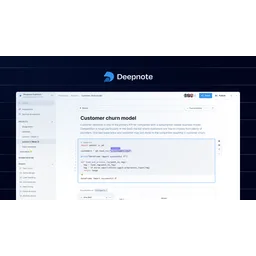
Deepnote
Business Intelligence
Collaborative cloud workspace for data analytics and machine learning
- From
- Free
- Free plan
- Yes

Distroless
Developer Tools
Minimal container base images from Google that hold only an app and its runtime
- From
- Free
- Free plan
- Yes
The short version
- Deepnote is a collaborative cloud-based workspace.
- Distroless is free; Deepnote starts at $39/mo.
- Only Deepnote lists collaborative notebooks; only Distroless lists debian 13 based images.
- Where Deepnote falls short: free plan limited to 3 editors, restricting team usage.
- Where Distroless falls short: no shell or package manager, so installing packages or debugging inside the image is harder.
- Prices and features on this page were last checked on 20 November 2026.
How do Deepnote and Distroless differ?
Deepnote and Distroless differ on pricing model, platforms (Web, API against Linux) and category. Only the attributes on which Deepnote and Distroless actually diverge.
| Attribute | Deepnote | Distroless |
|---|---|---|
| Pricing model | Subscription with free tier | Open-source |
| Platforms | Web, API | Linux |
| Category | Business Intelligence | Developer Tools |
Identical on both: starting price (Free), free tier (Yes).
Not yet recorded: founded for Distroless.
Which features does each one have?
They share no listed features; 8 appear only for Deepnote and 8 only for Distroless. Drawn from each product's published feature list. An absence here means we hold no record of it - not that the product lacks it.
Only in Deepnote
- Collaborative notebooks
- Interactive dashboards
- Data agent building
- Scheduled pipelines
- Model management
- 100+ integrations
- GPU support
- API deployment
Only in Distroless
- No package manager or shell in runtime images
- Debian 13 based images
- Static, base and cc images for compiled apps
- Java, Node.js and Python 3 runtime images
- Nonroot and debug tag variants
- Cosign keyless image signing
- Multi architecture builds including amd64, arm64 and s390x
- Bazel based build tooling
What is each one used for?
Deepnote is most often brought in for data exploration and analysis workflows; Distroless for production base images for Go or Rust binaries. The jobs each tool is most often brought in to do.
Deepnote
- Data exploration and analysis workflowsnot Distroless
- Building interactive business intelligence dashboardsnot Distroless
- Collaborative machine learning model developmentnot Distroless
- Automating ETL and data pipeline orchestrationnot Distroless
- Creating shareable reports without exportsnot Distroless
Distroless
- Production base images for Go or Rust binariesnot Deepnote
- Reducing vulnerability scanner findingsnot Deepnote
- Smaller Java and Node.js container imagesnot Deepnote
- Running containers as a non root usernot Deepnote
- Verifying image provenance with cosignnot Deepnote
Where do Deepnote and Distroless fall short?
Deepnote's most cited limit: free plan limited to 3 editors, restricting team usage. Distroless's: no shell or package manager, so installing packages or debugging inside the image is harder. Documented limitations, not opinions. Every one is a constraint you would hit in normal use.
Deepnote
- Free plan limited to 3 editors, restricting team usage
- Limited revision history on free plan compared to competitors
- Requires Team plan or higher for automated scheduling
- GPU support incurs additional charges beyond base subscription
- No mentioned offline capability
Distroless
- No shell or package manager, so installing packages or debugging inside the image is harder
- Language images cover only Java, Node.js and Python 3, with other runtimes built by the user
- Architecture support differs by image, and python3 lists only amd64, arm64 and riscv64
- Tags without a distro suffix may change which Debian release they resolve to
How much do Deepnote and Distroless cost?
Deepnote has a free plan, with paid plans from $39/mo; Distroless is free to use. Plan by plan below, from each vendor's own pricing page.
Deepnote
Free- FreeFree
- Up to 3 editors
- Up to 5 projects
- Limited Deepnote AI
- Team$39/mo
- Unlimited viewers and notebooks
- Full Deepnote AI access
- Premium integrations
- EnterpriseOn request
- Everything in Team plan
- Custom contracts
- Priority support
Distroless
FreeNo published plan breakdown. See the Distroless review.
Which should you pick?
Choose Deepnote if
- You need collaborative notebooks.
- You want to start without paying.
- You work on Web, API.
- You also want interactive dashboards.
Choose Distroless if
- You need no package manager or shell in runtime images.
- You want to start without paying.
- You work on Linux.
- You also want debian 13 based images.
Questions people ask
- Is Deepnote or Distroless better?
- Neither clearly leads. Deepnote starts at Free and Distroless at Free, and user ratings are close enough to be indistinguishable. Choose on capability and platform support.
- Which is cheaper, Deepnote or Distroless?
- Deepnote starts at Free and Distroless at Free.
- Does Deepnote or Distroless run on more platforms?
- Deepnote runs on Web, API. Distroless runs on Linux.
- Can I use Deepnote for free?
- Both have a free tier, so you can try either at no cost before committing.
- What is Deepnote best used for?
- Deepnote is most often used for data exploration and analysis workflows, building interactive business intelligence dashboards, collaborative machine learning model development, automating etl and data pipeline orchestration. Of those, data exploration and analysis workflows and building interactive business intelligence dashboards are not what Distroless is typically brought in for.
- What can Deepnote do that Distroless cannot?
- Deepnote covers Collaborative notebooks, Interactive dashboards, Data agent building, Scheduled pipelines. Distroless covers No package manager or shell in runtime images, Debian 13 based images, Static, base and cc images for compiled apps, Java, Node.js and Python 3 runtime images.
Answered from the vendors’ own pages
Deepnote: What is included in the free Deepnote plan?
The free plan includes up to 3 editors, up to 5 projects, limited Deepnote AI, basic machines with 5 GB RAM, and 7-day revision history.
SourceDistroless: What is in a distroless image?
According to the project, an image holds only your application and its runtime dependencies. Package managers, shells and other standard Linux distribution programs are omitted.
SourceDeepnote: What data sources can Deepnote integrate with?
Deepnote integrates with 100+ data sources including major data warehouses like Snowflake, BigQuery, and Redshift, as well as BI platforms like Looker, Tableau, and Power BI.
SourceDistroless: How can I debug a distroless container?
The project publishes debug and debug-nonroot tags that add a BusyBox shell. The standard tags have no shell.
SourceDeepnote: Does Deepnote support collaboration?
Yes, Deepnote provides real-time collaborative notebooks where multiple team members can work simultaneously. The Team plan allows unlimited viewers and notebooks.
SourceDistroless: Are distroless images signed?
Yes. Images are signed with cosign keyless signing, and the project provides a cosign verify command that checks the certificate issuer and identity.
SourceDeepnote: What compliance certifications does Deepnote have?
Deepnote is SOC 2, HIPAA, GDPR, and CCPA compliant and offers role-based access control, single sign-on, and directory synchronization.
SourceDistroless: Which licence does Distroless use?
GitHub's repository data lists the Apache 2.0 licence. The images are free to use.
SourceRelated pages
Other head to heads
- Deepnote vs Hex
- Deepnote vs Mode
- Deepnote vs Fabi
- Deepnote vs Yellowfin
- Deepnote vs TIBCO Spotfire
- Deepnote vs Databox
- Deepnote vs Klipfolio
- Deepnote vs DashThis
- Deepnote vs Domo
- Deepnote vs Luzmo
- Deepnote vs Rill Data
- Deepnote vs Grow
- Deepnote vs Cyfe
- Deepnote vs Exa
- Deepnote vs Glassbox
- Deepnote vs Oracle Analytics Cloud
- Deepnote vs Quantum Metric
- Deepnote vs Stripe Dashboard
- Deepnote vs Cloud Native Buildpacks
- Deepnote vs Docker
- Deepnote vs Neovim
- Deepnote vs Nixpacks
- Deepnote vs Frappe
- Deepnote vs Gitea
- Deepnote vs Jenkins
- Deepnote vs Depot
- Deepnote vs Helix
- Deepnote vs Pants Build
- Deepnote vs GitHub Copilot
- Deepnote vs Terraform
- Deepnote vs Postman
- Deepnote vs GitHub
- Deepnote vs GitLab
- Deepnote vs Buildkite
- Deepnote vs Kubernetes
- Deepnote vs Tilt
- Distroless vs Hex
- Distroless vs Mode
- Distroless vs Fabi
- Distroless vs Yellowfin
- Distroless vs TIBCO Spotfire
- Distroless vs Databox
- Distroless vs Klipfolio
- Distroless vs DashThis
- Distroless vs Domo
- Distroless vs Luzmo
- Distroless vs Rill Data
- Distroless vs Grow
- Distroless vs Cyfe
- Distroless vs Exa
- Distroless vs Glassbox
- Distroless vs Oracle Analytics Cloud
- Distroless vs Quantum Metric
- Distroless vs Stripe Dashboard
- Distroless vs Cloud Native Buildpacks
- Distroless vs Docker
- Distroless vs Neovim
- Distroless vs Nixpacks
- Distroless vs Frappe
- Distroless vs Gitea
- Distroless vs Jenkins
- Distroless vs Depot
- Distroless vs Helix
- Distroless vs Pants Build
- Distroless vs GitHub Copilot
- Distroless vs Terraform
- Distroless vs Postman
- Distroless vs GitHub
- Distroless vs GitLab
- Distroless vs Buildkite
- Distroless vs Kubernetes
- Distroless vs Tilt