
Developer Tools · head to head
Buildkite vs Deepnote

Buildkite
Developer Tools
CI/CD pipelines that run on your own compute
- From
- Free
- Free plan
- Yes
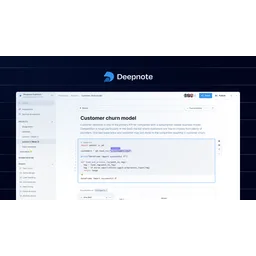
Deepnote
Business Intelligence
Collaborative cloud workspace for data analytics and machine learning
- From
- Free
- Free plan
- Yes
The short version
- Buildkite is a CI/CD platform for build, test and deploy pipelines; Deepnote is a collaborative cloud-based workspace.
- Free plans on both; paid from $30/mo and $39/mo.
- Where Buildkite falls short: free plan caps at 5 users and 10 concurrent jobs, with 2,000 Linux vCPU minutes per month and 30 day build retention.
- Where Deepnote falls short: free plan limited to 3 editors, restricting team usage.
- Prices and features on this page were last checked on 13 November 2026.
Where they differ
Only the attributes on which Buildkite and Deepnote actually diverge.
Identical on both: starting price (Free), free tier (Yes).
What each one covers
Drawn from each product's published feature list. An absence here means we hold no record of it - not that the product lacks it.
Only in Buildkite
Nothing recorded that Deepnote does not also cover.
Only in Deepnote
- Collaborative notebooks
- Interactive dashboards
- Data agent building
- Scheduled pipelines
- Model management
- 100+ integrations
- GPU support
- API deployment
What people use each for
The jobs each tool is most often brought in to do.
Buildkite
- CI/CD pipeline automationnot Deepnote
- Test execution at scalenot Deepnote
- Deployment automationnot Deepnote
Deepnote
- Data exploration and analysis workflowsnot Buildkite
- Building interactive business intelligence dashboardsnot Buildkite
- Collaborative machine learning model developmentnot Buildkite
- Automating ETL and data pipeline orchestrationnot Buildkite
- Creating shareable reports without exportsnot Buildkite
Where each one falls short
Documented limitations, not opinions. Every one is a constraint you would hit in normal use.
Buildkite
- Free plan caps at 5 users and 10 concurrent jobs, with 2,000 Linux vCPU minutes per month and 30 day build retention
- Pro plan is $30 per active user per month, capped at 50 users, with only 10 of the up to 250 concurrent agents included before extra usage
- Enterprise plan enforces a 30 user minimum even though pricing itself is custom
- Hosted compute beyond included minutes is metered at $0.004 per vCPU minute on Linux and $0.02 per vCPU minute on Mac
Deepnote
- Free plan limited to 3 editors, restricting team usage
- Limited revision history on free plan compared to competitors
- Requires Team plan or higher for automated scheduling
- GPU support incurs additional charges beyond base subscription
- No mentioned offline capability
Pricing, plan by plan
Buildkite
Free- FreeFree
- Up to 5 users
- 10 concurrent jobs
- 2000 Linux vCPU minutes monthly
- Pro$30/mo
- Up to 50 users
- 250 concurrent agents (10 included)
- 4000 Linux vCPU minutes monthly
- EnterpriseOn request
- Unlimited users (30 minimum)
- Custom usage limits
- Full platform access
Deepnote
Free- FreeFree
- Up to 3 editors
- Up to 5 projects
- Limited Deepnote AI
- Team$39/mo
- Unlimited viewers and notebooks
- Full Deepnote AI access
- Premium integrations
- EnterpriseOn request
- Everything in Team plan
- Custom contracts
- Priority support
Which should you pick?
Choose Deepnote if
- You need collaborative notebooks.
- You want to start without paying.
- You work on Web, API.
- You also want interactive dashboards.
Questions people ask
- Is Buildkite or Deepnote better?
- Neither clearly leads. Buildkite starts at Free and Deepnote at Free, and user ratings are close enough to be indistinguishable. Choose on capability and platform support.
- Which is cheaper, Buildkite or Deepnote?
- Buildkite starts at Free and Deepnote at Free.
- Does Buildkite or Deepnote run on more platforms?
- Buildkite runs on Web. Deepnote runs on Web, API.
- Can I use Buildkite for free?
- Both have a free tier, so you can try either at no cost before committing.
- What is Buildkite best used for?
- Buildkite is most often used for ci/cd pipeline automation, test execution at scale, deployment automation. Of those, ci/cd pipeline automation and test execution at scale are not what Deepnote is typically brought in for.
- What can Buildkite do that Deepnote cannot?
- Deepnote covers Collaborative notebooks, Interactive dashboards, Data agent building, Scheduled pipelines.
Answered from the vendors’ own pages
Buildkite: Can I use Buildkite without paying?
Yes, Buildkite offers a free plan that includes up to 5 users, 10 concurrent jobs, 2000 Linux vCPU minutes monthly, and 250k test executions per month at no cost.
SourceDeepnote: What is included in the free Deepnote plan?
The free plan includes up to 3 editors, up to 5 projects, limited Deepnote AI, basic machines with 5 GB RAM, and 7-day revision history.
SourceBuildkite: What happens if I exceed my included compute minutes on Buildkite?
Hosted agent compute is charged separately at $0.004 per Linux vCPU minute and $0.02 per Mac vCPU minute, billed to the second with no minimums.
SourceDeepnote: What data sources can Deepnote integrate with?
Deepnote integrates with 100+ data sources including major data warehouses like Snowflake, BigQuery, and Redshift, as well as BI platforms like Looker, Tableau, and Power BI.
SourceBuildkite: Do I need an annual commitment for Buildkite's Pro plan?
No, Buildkite's Pro plan is billed monthly at $30 per active user with no long-term contract required. All tiers include a 30-day all-access trial.
SourceDeepnote: Does Deepnote support collaboration?
Yes, Deepnote provides real-time collaborative notebooks where multiple team members can work simultaneously. The Team plan allows unlimited viewers and notebooks.
SourceBuildkite: What user limits apply to each Buildkite plan?
Free plan supports up to 5 users, Pro plan supports up to 50 users, and Enterprise plan provides unlimited users with a 30-user minimum.
SourceDeepnote: What compliance certifications does Deepnote have?
Deepnote is SOC 2, HIPAA, GDPR, and CCPA compliant and offers role-based access control, single sign-on, and directory synchronization.
SourceRelated pages
Other head to heads
- Buildkite vs Depot
- Buildkite vs Dagger
- Buildkite vs GitLab CI/CD
- Buildkite vs Jenkins
- Buildkite vs Keycloak
- Buildkite vs Nx Cloud
- Buildkite vs Yarn
- Buildkite vs Atlantis
- Buildkite vs Coder
- Buildkite vs Tilt
- Buildkite vs Azure DevOps
- Buildkite vs PartyKit
- Buildkite vs GitHub Copilot
- Buildkite vs LaunchDarkly
- Buildkite vs Terraform
- Buildkite vs Visual Studio Code
- Buildkite vs CodeSandbox
- Buildkite vs GitLab
- Buildkite vs Fabi
- Buildkite vs Hex
- Buildkite vs Mode
- Buildkite vs Yellowfin
- Buildkite vs TIBCO Spotfire
- Buildkite vs Klipfolio
- Buildkite vs Databox
- Buildkite vs Domo
- Buildkite vs DashThis
- Buildkite vs Grow
- Buildkite vs Periscope Data
- Buildkite vs Luzmo
- Buildkite vs Phocas
- Buildkite vs Preset
- Buildkite vs ProfitWell
- Buildkite vs Quantum Metric
- Buildkite vs Quid
- Buildkite vs Reportz
- Deepnote vs Depot
- Deepnote vs Dagger
- Deepnote vs GitLab CI/CD
- Deepnote vs Jenkins
- Deepnote vs Keycloak
- Deepnote vs Nx Cloud
- Deepnote vs Yarn
- Deepnote vs Atlantis
- Deepnote vs Coder
- Deepnote vs Tilt
- Deepnote vs Azure DevOps
- Deepnote vs PartyKit
- Deepnote vs GitHub Copilot
- Deepnote vs LaunchDarkly
- Deepnote vs Terraform
- Deepnote vs Visual Studio Code
- Deepnote vs CodeSandbox
- Deepnote vs GitLab
- Deepnote vs Fabi
- Deepnote vs Hex
- Deepnote vs Mode
- Deepnote vs Yellowfin
- Deepnote vs TIBCO Spotfire
- Deepnote vs Klipfolio
- Deepnote vs Databox
- Deepnote vs Domo
- Deepnote vs DashThis
- Deepnote vs Grow
- Deepnote vs Periscope Data
- Deepnote vs Luzmo
- Deepnote vs Phocas
- Deepnote vs Preset
- Deepnote vs ProfitWell
- Deepnote vs Quantum Metric
- Deepnote vs Quid
- Deepnote vs Reportz