MIT-licensed analytical SQL database that runs inside your process, with no server, no dependencies and one writer at a time.
Free plan10 researched notes

Apache 2.0 vector and full-text search engine that runs as an embedded library, a single server or a distributed cloud service.
As of 13 November 2026, Chroma is free to use. Chroma is the vector database most AI prototypes start with because it is a pip install away and needs no infrastructure. Softwr lists it under Databases.
Overview
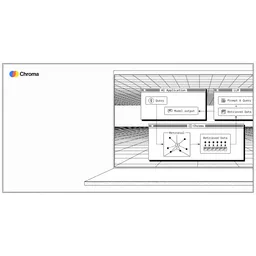
Chroma is an open source search engine for AI applications, licensed Apache 2.0. It stores documents, their embeddings and their metadata in collections and retrieves them by vector similarity, by keyword, or by both combined, with metadata filters applied alongside the search. It runs in three shapes with a consistent API: as an embedded library inside a Python, TypeScript or Rust process for prototyping; as a single server started with one command, intended for small and medium workloads, which the project characterises as fewer than about ten million records across a handful of collections; and as a distributed deployment of independent services over object storage with SSD caches and a shared system database, which is what Chroma Cloud runs. What distinguishes it is the on-ramp. Almost every competing vector database asks you to run something before you can index your first document; Chroma asks for an import statement, and the code you write against it in a notebook is the code that runs against the cloud. Commercially that has made it the default in tutorials, framework integrations and agent toolkits, which is a real advantage because it means the retrieval layer is rarely the part of a prototype that needs explaining. The permissive licence reinforces this: there is no source-available clause to review before embedding it in a product. The buyers are application teams building retrieval-augmented generation and agent memory, usually starting embedded and deciding later whether to move to the server or the cloud. The trade-off is that the easy mode has a physical ceiling. On a single node the amount of system memory bounds collection size directly, roughly a quarter of a million records per gigabyte of RAM at 1024 dimensions, and query throughput parallelises only up to the number of vCPUs before latency rises linearly with concurrency. The distributed deployment is a genuinely different architecture, with different latency and consistency behaviour, so the thing you tested locally is not the thing you eventually run. Planning for that transition early is the difference between a smooth migration and a rewrite under load.
The honest half
Concrete and checkable, so you can decide whether any of them matter to you. This is the half of a review a vendor will not write about Chroma.
Pricing
Taken from the vendor's own pricing page. Prices move, so check before you buy.
Starter
Free
Team
$250 /mo
Enterprise
On request
Capabilities
Embedded mode
Runs in-process with persistence to a local directory, so a prototype needs no server
Single-node server
One command starts an HTTP server for small and medium production workloads
Distributed architecture
Independent services over object storage with SSD caching for large deployments and many collections
Vector search
Approximate nearest neighbour retrieval over embeddings stored per collection
Full-text search
Keyword retrieval alongside vector search so hybrid strategies do not need a second system
Metadata filtering
Predicates on document metadata evaluated as part of the query rather than as a post-filter
Consistent API across modes
The same client interface covers embedded, server and cloud deployments
Multi-language clients
Python, TypeScript and Rust clients, plus a thin HTTP-only client for constrained environments
Embedding function integrations
Pluggable embedding providers so documents can be embedded on write
Apache 2.0 licence
Permissive open source with no competing-use restriction on self-hosting
Answered, with sources
Each answer names the page it came from, so you can check it rather than take our word for it.
No. Chroma runs embedded in your process with persistence to a local directory, which is how most projects start. The server and distributed modes exist for when multiple clients or larger collections require them.
The project puts single-node deployments at fewer than about ten million records across a handful of collections, with collection size bounded by system memory at roughly 245,000 records per gigabyte at 1024 dimensions.
It is the same API and project, but the distributed deployment is a different architecture, using independent services, object storage and SSD caches rather than a single process. Behaviour under load differs accordingly.
pgvector keeps vectors in a Postgres database you already operate, with SQL, joins and transactions. Chroma is a dedicated retrieval engine with a lower setup cost and a retrieval-shaped API. If you already run Postgres, pgvector removes a system; if you do not, Chroma removes a decision.
Apache 2.0, which permits self-hosting and embedding in commercial products without a competing-use restriction.
Keep looking
MIT-licensed analytical SQL database that runs inside your process, with no server, no dependencies and one writer at a time.
Closed-source vector and full-text search service built directly on object storage, with cold queries measured in seconds rather than milliseconds.
Distributed AI search platform for retrieval, ranking, and inference
High-performance vector database for similarity search and embedding-based retrieval
Streaming SQL engine built on ClickHouse internals, shipping as one small binary
Erlang MQTT broker for large IoT fleets, relicensed to BSL with production free use limited to one node
Embedded retrieval library over the Apache 2.0 Lance columnar format, with proprietary Cloud and Enterprise tiers for serving at scale.
The Meta-lineage distributed SQL query engine, distinct from the Trino fork
The heart of the Elastic Stack for search and analytics
Cross-platform database IDE from JetBrains for SQL and NoSQL databases
Real-time data integration combining streaming, CDC, and batch
Cloud-native messaging and streaming with separated storage
Softwr does not host reviews and shows no star rating for Chroma, because a rating we did not collect is not ours to publish. What is here is the pricing and platform detail from the vendor’s own pages, limitations we could state concretely, and alternatives a reviewer confirmed people weigh against it. Tell us if any of it is wrong.
What people switch to, and what they give up
Every tier, and where the cost actually lands
Put it head to head with anything we hold
Its rating, and an embed for your own site
Industrial process historian with published per-tag pricing and no client licence fees
Per tag band per yearNetApp-owned managed service for Cassandra, Kafka, OpenSearch, PostgreSQL and Cadence with a bring-your-own-cloud model
quoteErlang MQTT broker for large IoT fleets, relicensed to BSL with production free use limited to one node
Per month by connection and session volumeAttribute-based access control and masking applied inside Snowflake, Databricks and BigQuery
quoteMPP analytical database with a MySQL wire protocol and sub-second aggregation on wide tables
Open source, no licence feeStreaming database that maintains incremental materialised views in SQL instead of Flink jobs
Per RisingWave Unit hourCentralised data access governance from the creators of Apache Ranger, now rebranding as Trust3 AI
quoteThe Meta-lineage distributed SQL query engine, distinct from the Trino fork
Open source, no licence fee