
Software Development · head to head
Braintrust vs Cronitor

Braintrust
Software Development
The active observability platform for agents
- From
- Free
- Rated
- -
Cronitor
Logging
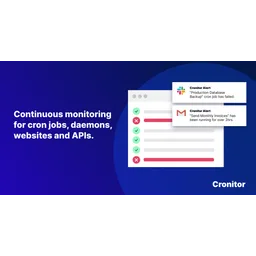
Monitoring for cron jobs, websites, and background tasks
- From
- Free
- Rated
- -
The short version
- Each has a real cost: Braintrust enterprise plan pricing not published, requires custom quote; Cronitor free tier limited to 5 monitors, limiting viability for small teams
Where they differ
Only the attributes on which Braintrust and Cronitor actually diverge.
| Attribute | Braintrust | Cronitor |
|---|---|---|
| Pricing model | freemium | Pay-per-monitor plus user seats |
| Platforms | Web | Web, API |
| Category | Software Development | Logging |
| Founded | Unknown | 2014 |
Identical on both: starting price (Free), free tier (Yes), user rating (Not yet rated).
What each one covers
Drawn from each product's published feature list. An absence here means we hold no record of it - not that the product lacks it.
Only in Braintrust
Nothing recorded that Cronitor does not also cover.
Only in Cronitor
- Cron job monitoring
- Uptime and performance checks
- Heartbeat monitoring
- Status pages
- Real-user monitoring
- Alert integrations
- Email reports
What people use each for
The jobs each tool is most often brought in to do.
Braintrust
- Monitoring production AI agents for qualitynot Cronitor
- Detecting patterns in agent failuresnot Cronitor
- Defining quality expectations before shipping agentsnot Cronitor
- Tracking prompts and tool calls in productionnot Cronitor
Cronitor
- Monitoring scheduled cron jobs and background tasksnot Braintrust
- Tracking website and API uptime with global checksnot Braintrust
- Alerting teams when critical jobs fail to executenot Braintrust
- Communicating service status to customersnot Braintrust
Where each one falls short
Documented limitations, not opinions. Every one is a constraint you would hit in normal use.
Braintrust
- Enterprise plan pricing not published, requires custom quote
- Pro plan includes 6-12 months free discount for startups only
Cronitor
- Free tier limited to 5 monitors, limiting viability for small teams
- Pay-per-monitor pricing scales quickly with infrastructure size
- Requires integrating ping calls into existing jobs
- Limited to monitoring jobs that can send pings
- No built-in workflow orchestration or task scheduling
Pricing, plan by plan
Braintrust
Free- StarterFree
- $10 model credits monthly included
- 1 GB processed data monthly
- 10000 scores monthly
- Pro$249/month
- $249 model credits monthly included
- 5 GB processed data monthly
- 50000 scores monthly
- Enterprise$null/month
- Custom data retention and export capabilities
- RBAC and premium support
- On-premises or hosted solutions available
Cronitor
Free- HackerFree
- 5 monitors
- Email and Slack alerts
- Basic status page
- Business$2/monitor/month
- Unlimited monitors
- 30-second check frequency
- 10 alert integrations
- Enterprise$6000/year
- Custom features and integrations
- 5-second check frequency
- Dedicated engineer
Which should you pick?
Choose Cronitor if
- You need cron job monitoring.
- You want to start without paying.
- You work on Web, API.
- You also want uptime and performance checks.
Questions people ask
- Is Braintrust or Cronitor better?
- Neither clearly leads. Braintrust starts at Free and Cronitor at Free, and user ratings are close enough to be indistinguishable. Choose on capability and platform support.
- Which is cheaper, Braintrust or Cronitor?
- Braintrust starts at Free and Cronitor at Free.
- Does Braintrust or Cronitor run on more platforms?
- Braintrust runs on Web. Cronitor runs on Web, API.
- Can I use Braintrust for free?
- Both have a free tier, so you can try either at no cost before committing.
- What is Braintrust best used for?
- Braintrust is most often used for monitoring production ai agents for quality, detecting patterns in agent failures, defining quality expectations before shipping agents, tracking prompts and tool calls in production. Of those, monitoring production ai agents for quality and detecting patterns in agent failures are not what Cronitor is typically brought in for.
- What can Braintrust do that Cronitor cannot?
- Cronitor covers Cron job monitoring, Uptime and performance checks, Heartbeat monitoring, Status pages.
Answered from the vendors’ own pages
Braintrust: Does Braintrust have a free plan?
Braintrust Starter plan is free and includes $10 model credits monthly, 1 GB processed data, 10000 scores monthly, and 14-day data retention with unlimited users and projects. No credit card required.
SourceCronitor: How does Cronitor billing work for the Business plan?
Business plan costs $2 per monitor per month plus $5 per user per month, billed monthly based on actual usage.
SourceBraintrust: How much does the Braintrust Pro plan cost?
Braintrust Pro plan costs $249 per month and includes $249 model credits, 5 GB processed data, 50000 scores monthly, and 30-day data retention. Qualifying startups receive 6-12 months free.
SourceCronitor: What is the difference between Hacker and Business plans?
Hacker plan ($0/month) includes 5 monitors and basic Slack/email alerts. Business plan ($2/monitor/month) offers unlimited monitors, 30-second checks, 10 integrations, 12-month retention, and email reports.
SourceBraintrust: What are Braintrust's overage charges?
Braintrust charges overage rates after monthly allocations: model credits beyond monthly allotment are charged at token rates, data overage is $4 per GB on Starter or $3 per GB on Pro, scores overage is $2.50 per 1000 on Starter or $1.50 per 1000 on Pro. Extended data retention beyond the included period costs $0.50 per GB per month.
SourceCronitor: Does Cronitor offer a free trial?
Yes, Cronitor provides a 14-day free trial on the Business plan without requiring a credit card.
SourceRelated pages
Other head to heads
- Braintrust vs Cursor
- Braintrust vs Windsurf
- Braintrust vs Zed
- Braintrust vs Amp
- Braintrust vs Codacy
- Braintrust vs DeepSource
- Braintrust vs Devin
- Braintrust vs SonarQube Cloud
- Braintrust vs Augment Code
- Braintrust vs Baseten
- Braintrust vs Drizzle ORM
- Braintrust vs Flagsmith
- Braintrust vs Unleash
- Braintrust vs Bun
- Braintrust vs Cline
- Braintrust vs Factory
- Braintrust vs Humanloop
- Braintrust vs Langfuse
- Braintrust vs Elastic Stack
- Braintrust vs New Relic
- Braintrust vs Datadog Logs
- Braintrust vs Coralogix
- Braintrust vs Grafana Loki
- Braintrust vs incident.io
- Braintrust vs FireHydrant
- Braintrust vs Healthchecks
- Braintrust vs Openstatus
- Braintrust vs Rootly
- Braintrust vs Checkly
- Braintrust vs CloudWatch
- Braintrust vs Dynatrace
- Braintrust vs InfluxDB
- Braintrust vs Airbrake
- Braintrust vs AppDynamics
- Braintrust vs Axiom
- Braintrust vs Azure Monitor
- Cronitor vs Cursor
- Cronitor vs Windsurf
- Cronitor vs Zed
- Cronitor vs Amp
- Cronitor vs Codacy
- Cronitor vs DeepSource
- Cronitor vs Devin
- Cronitor vs SonarQube Cloud
- Cronitor vs Augment Code
- Cronitor vs Baseten
- Cronitor vs Drizzle ORM
- Cronitor vs Flagsmith
- Cronitor vs Unleash
- Cronitor vs Bun
- Cronitor vs Cline
- Cronitor vs Factory
- Cronitor vs Humanloop
- Cronitor vs Langfuse
- Cronitor vs Elastic Stack
- Cronitor vs New Relic
- Cronitor vs Datadog Logs
- Cronitor vs Coralogix
- Cronitor vs Grafana Loki
- Cronitor vs incident.io
- Cronitor vs FireHydrant
- Cronitor vs Healthchecks
- Cronitor vs Openstatus
- Cronitor vs Rootly
- Cronitor vs Checkly
- Cronitor vs CloudWatch
- Cronitor vs Dynatrace
- Cronitor vs InfluxDB
- Cronitor vs Airbrake
- Cronitor vs AppDynamics
- Cronitor vs Axiom
- Cronitor vs Azure Monitor