
Developer Tools · head to head
Apache Maven vs Deepnote

Apache Maven
Developer Tools
Open source build and dependency management tool for Java projects
- From
- Free
- Free plan
- Yes
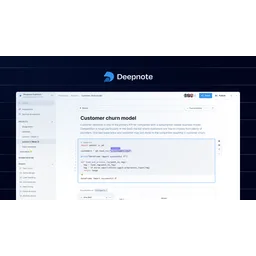
Deepnote
Business Intelligence
Collaborative cloud workspace for data analytics and machine learning
- From
- Free
- Free plan
- Yes
The short version
- Deepnote is a collaborative cloud-based workspace.
- Apache Maven is free; Deepnote starts at $39/mo.
- Only Apache Maven lists build extensions such as caches; only Deepnote lists collaborative notebooks.
- Where Apache Maven falls short: configuration lives in verbose XML, which can be long for large builds.
- Where Deepnote falls short: free plan limited to 3 editors, restricting team usage.
- Prices and features on this page were last checked on 20 November 2026.
How do Apache Maven and Deepnote differ?
Apache Maven and Deepnote differ on pricing model, platforms and category. Only the attributes on which Apache Maven and Deepnote actually diverge.
| Attribute | Apache Maven | Deepnote |
|---|---|---|
| Pricing model | Open-source | Subscription with free tier |
| Platforms | Windows, macOS, Linux | Web, API |
| Category | Developer Tools | Business Intelligence |
Identical on both: starting price (Free), free tier (Yes).
Not yet recorded: founded for Apache Maven.
Which features does each one have?
They share no listed features; 8 appear only for Apache Maven and 8 only for Deepnote. Drawn from each product's published feature list. An absence here means we hold no record of it - not that the product lacks it.
Only in Apache Maven
- Project object model driven builds
- Plugin-based lifecycle for compile, test, package and deploy
- Dependency management through Maven Central
- Build extensions such as caches
- Maven Wrapper for pinned versions
- Maven Daemon for faster builds
- Documentation and site generation
- Apache License 2.0 open source
Only in Deepnote
- Collaborative notebooks
- Interactive dashboards
- Data agent building
- Scheduled pipelines
- Model management
- 100+ integrations
- GPU support
- API deployment
What is each one used for?
Apache Maven is most often brought in for building and packaging Java libraries and applications; Deepnote for data exploration and analysis workflows. The jobs each tool is most often brought in to do.
Apache Maven
- Building and packaging Java libraries and applicationsnot Deepnote
- Managing dependencies from Maven Centralnot Deepnote
- Publishing artefacts to a repositorynot Deepnote
- Standardising builds across a teamnot Deepnote
Deepnote
- Data exploration and analysis workflowsnot Apache Maven
- Building interactive business intelligence dashboardsnot Apache Maven
- Collaborative machine learning model developmentnot Apache Maven
- Automating ETL and data pipeline orchestrationnot Apache Maven
- Creating shareable reports without exportsnot Apache Maven
Where do Apache Maven and Deepnote fall short?
Apache Maven's most cited limit: configuration lives in verbose XML, which can be long for large builds. Deepnote's: free plan limited to 3 editors, restricting team usage. Documented limitations, not opinions. Every one is a constraint you would hit in normal use.
Apache Maven
- Configuration lives in verbose XML, which can be long for large builds
- Convention over configuration can be rigid for unusual project layouts
- Maven 4 is still a release candidate on the vendor site
- Does not run builds on a schedule or on commits without a separate CI server
Deepnote
- Free plan limited to 3 editors, restricting team usage
- Limited revision history on free plan compared to competitors
- Requires Team plan or higher for automated scheduling
- GPU support incurs additional charges beyond base subscription
- No mentioned offline capability
How much do Apache Maven and Deepnote cost?
Apache Maven is free to use; Deepnote has a free plan, with paid plans from $39/mo. Plan by plan below, from each vendor's own pricing page.
Apache Maven
FreeNo published plan breakdown. See the Apache Maven review.
Deepnote
Free- FreeFree
- Up to 3 editors
- Up to 5 projects
- Limited Deepnote AI
- Team$39/mo
- Unlimited viewers and notebooks
- Full Deepnote AI access
- Premium integrations
- EnterpriseOn request
- Everything in Team plan
- Custom contracts
- Priority support
Which should you pick?
Choose Apache Maven if
- You need project object model driven builds.
- You want to start without paying.
- You work on Windows, macOS, Linux.
- You also want plugin-based lifecycle for compile, test, package and deploy.
Choose Deepnote if
- You need collaborative notebooks.
- You want to start without paying.
- You work on Web, API.
- You also want interactive dashboards.
Questions people ask
- Is Apache Maven or Deepnote better?
- Neither clearly leads. Apache Maven starts at Free and Deepnote at Free, and user ratings are close enough to be indistinguishable. Choose on capability and platform support.
- Which is cheaper, Apache Maven or Deepnote?
- Apache Maven starts at Free and Deepnote at Free.
- Does Apache Maven or Deepnote run on more platforms?
- Apache Maven runs on Windows, macOS, Linux. Deepnote runs on Web, API.
- Can I use Apache Maven for free?
- Both have a free tier, so you can try either at no cost before committing.
- What is Apache Maven best used for?
- Apache Maven is most often used for building and packaging java libraries and applications, managing dependencies from maven central, publishing artefacts to a repository, standardising builds across a team. Of those, building and packaging java libraries and applications and managing dependencies from maven central are not what Deepnote is typically brought in for.
- What can Apache Maven do that Deepnote cannot?
- Apache Maven covers Project object model driven builds, Plugin-based lifecycle for compile, test, package and deploy, Dependency management through Maven Central, Build extensions such as caches. Deepnote covers Collaborative notebooks, Interactive dashboards, Data agent building, Scheduled pipelines.
Answered from the vendors’ own pages
Apache Maven: Is Apache Maven free?
Yes, it is open source under the Apache License 2.0 and has no licence fee.
SourceDeepnote: What is included in the free Deepnote plan?
The free plan includes up to 3 editors, up to 5 projects, limited Deepnote AI, basic machines with 5 GB RAM, and 7-day revision history.
SourceApache Maven: What does Maven do?
It builds, tests and documents Java projects from a single project object model, using plugins to do the work.
SourceDeepnote: What data sources can Deepnote integrate with?
Deepnote integrates with 100+ data sources including major data warehouses like Snowflake, BigQuery, and Redshift, as well as BI platforms like Looker, Tableau, and Power BI.
SourceApache Maven: When was Maven released?
Its first release was on 13 July 2004, and it was created by Jason van Zyl starting in 2002 as a sub-project of Apache Turbine.
SourceDeepnote: Does Deepnote support collaboration?
Yes, Deepnote provides real-time collaborative notebooks where multiple team members can work simultaneously. The Team plan allows unlimited viewers and notebooks.
SourceApache Maven: Which version is current?
The vendor site's download button refers to Maven 3.10.1, and Maven 4 is announced as a release candidate.
SourceDeepnote: What compliance certifications does Deepnote have?
Deepnote is SOC 2, HIPAA, GDPR, and CCPA compliant and offers role-based access control, single sign-on, and directory synchronization.
SourceRelated pages
More on Apache Maven
Other head to heads
- Apache Maven vs JetBrains IntelliJ IDEA
- Apache Maven vs Bazel
- Apache Maven vs Jenkins
- Apache Maven vs Gradle
- Apache Maven vs Eclipse
- Apache Maven vs Yarn
- Apache Maven vs GitHub
- Apache Maven vs Keycloak
- Apache Maven vs Depot
- Apache Maven vs Nx Cloud
- Apache Maven vs Pants Build
- Apache Maven vs Webpack
- Apache Maven vs Dagger
- Apache Maven vs Dependabot
- Apache Maven vs Distroless
- Apache Maven vs Nixpacks
- Apache Maven vs Notepad++
- Apache Maven vs GitHub Codespaces
- Apache Maven vs Hex
- Apache Maven vs Mode
- Apache Maven vs Fabi
- Apache Maven vs Yellowfin
- Apache Maven vs TIBCO Spotfire
- Apache Maven vs Databox
- Apache Maven vs Klipfolio
- Apache Maven vs DashThis
- Apache Maven vs Domo
- Apache Maven vs Luzmo
- Apache Maven vs Rill Data
- Apache Maven vs Grow
- Apache Maven vs Cyfe
- Apache Maven vs Exa
- Apache Maven vs Glassbox
- Apache Maven vs Oracle Analytics Cloud
- Apache Maven vs Quantum Metric
- Apache Maven vs Stripe Dashboard
- Deepnote vs JetBrains IntelliJ IDEA
- Deepnote vs Bazel
- Deepnote vs Jenkins
- Deepnote vs Gradle
- Deepnote vs Eclipse
- Deepnote vs Yarn
- Deepnote vs GitHub
- Deepnote vs Keycloak
- Deepnote vs Depot
- Deepnote vs Nx Cloud
- Deepnote vs Pants Build
- Deepnote vs Webpack
- Deepnote vs Dagger
- Deepnote vs Dependabot
- Deepnote vs Distroless
- Deepnote vs Nixpacks
- Deepnote vs Notepad++
- Deepnote vs GitHub Codespaces
- Deepnote vs Hex
- Deepnote vs Mode
- Deepnote vs Fabi
- Deepnote vs Yellowfin
- Deepnote vs TIBCO Spotfire
- Deepnote vs Databox
- Deepnote vs Klipfolio
- Deepnote vs DashThis
- Deepnote vs Domo
- Deepnote vs Luzmo
- Deepnote vs Rill Data
- Deepnote vs Grow
- Deepnote vs Cyfe
- Deepnote vs Exa
- Deepnote vs Glassbox
- Deepnote vs Oracle Analytics Cloud
- Deepnote vs Quantum Metric
- Deepnote vs Stripe Dashboard