
Productivity · head to head
Memberstack vs Pl@ntNet
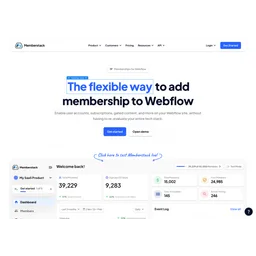
Memberstack
Productivity
Add memberships and logins to any website
- From
- Free
- Free plan
- Yes

Pl@ntNet
Education
Free plant identification app run by a consortium of French public research institutes
- From
- Free
- Free plan
- Yes
The short version
- Pl@ntNet is free; Memberstack starts at $29/mo.
- Where Memberstack falls short: basic and Professional tiers include transaction fees of 4% and 2% respectively.
- Where Pl@ntNet falls short: it offers no plant care guidance, watering reminders or disease diagnosis, unlike commercial apps built around ongoing plant care.
- Prices and features on this page were last checked on 20 November 2026.
How do Memberstack and Pl@ntNet differ?
Memberstack and Pl@ntNet differ on pricing model, platforms (Web against iOS, Android, Web) and category (Productivity against Education). Only the attributes on which Memberstack and Pl@ntNet actually diverge.
| Attribute | Memberstack | Pl@ntNet |
|---|---|---|
| Pricing model | Subscription | Free, no ads and no in-app purchases |
| Platforms | Web | iOS, Android, Web |
| Category | Productivity | Education |
| Founded | 2018 | 2009 |
Identical on both: starting price (Free), free tier (Yes).
Which features does each one have?
They share no listed features; 6 only for Pl@ntNet. Drawn from each product's published feature list. An absence here means we hold no record of it - not that the product lacks it.
Only in Memberstack
Nothing recorded that Pl@ntNet does not also cover.
Only in Pl@ntNet
- Photo identification
- Large species coverage
- Multi-language support
- Community-sourced database
- Regional flora filtering
- Contribution to research
What is each one used for?
Memberstack is most often brought in for launching course platforms without custom backend; Pl@ntNet for A gardener or hiker who wants free plant identification without a subscription. The jobs each tool is most often brought in to do.
Memberstack
- Launching course platforms without custom backendnot Pl@ntNet
- Building subscription services with Webflow and paymentnot Pl@ntNet
- Gating content without writing codenot Pl@ntNet
- Managing password resets and two-factor authenticationnot Pl@ntNet
- Processing Stripe billing automaticallynot Pl@ntNet
Pl@ntNet
- A gardener or hiker who wants free plant identification without a subscriptionnot Memberstack
- A student or researcher wanting a citation-friendly, institutionally-run identification toolnot Memberstack
- Someone identifying plants outside English-speaking regions who needs one of its 50-plus languagesnot Memberstack
- A forager wanting a second opinion on a plant before relying solely on one sourcenot Memberstack
Where do Memberstack and Pl@ntNet fall short?
Memberstack's most cited limit: basic and Professional tiers include transaction fees of 4% and 2% respectively. Documented limitations, not opinions. Every one is a constraint you would hit in normal use.
Memberstack
- Basic and Professional tiers include transaction fees of 4% and 2% respectively
- Annual billing required for discounts; monthly pricing is higher
- Webflow community builders receive Basic plan free but locked to that tier
Pl@ntNet
- It offers no plant care guidance, watering reminders or disease diagnosis, unlike commercial apps built around ongoing plant care
- Identification accuracy varies by region depending on how well local flora is represented in the community-submitted training data
- The interface is more utilitarian than a commercial app, reflecting its research origins rather than consumer product design
- It should never be relied on alone to determine whether a wild plant or fungus is safe to eat, and the project itself does not claim otherwise
- Because it is run by a nonprofit research consortium rather than a company, feature development and interface updates move more slowly than a funded commercial competitor
How much do Memberstack and Pl@ntNet cost?
Memberstack has a free plan, with paid plans from $29/mo; Pl@ntNet is free to use. Plan by plan below, from each vendor's own pricing page.
Memberstack
Free- Basic$29/mo
- Up to 1,000 members
- 4% transaction fee
- $25/month with annual billing
- Professional$49/mo
- Up to 5,000 members
- 2% transaction fee
- $39/month with annual billing
- Business$99/mo
- 10,000+ members
- 0.9% transaction fee
- $79/month with annual billing
- Established$499/mo
- 10,000+ members
- Zero transaction fees
- $399/month with annual billing
Pl@ntNet
Free- Pl@ntNetFree
- Full identification for over 80,000 species
- Available in over 50 languages
- No account required for basic identification
Which should you pick?
Choose Pl@ntNet if
- You need photo identification.
- You want to start without paying.
- You work on iOS, Android, Web.
- You also want large species coverage.
Questions people ask
- Is Memberstack or Pl@ntNet better?
- Neither clearly leads. Memberstack starts at Free and Pl@ntNet at Free, and user ratings are close enough to be indistinguishable. Choose on capability and platform support.
- Which is cheaper, Memberstack or Pl@ntNet?
- Memberstack starts at Free and Pl@ntNet at Free.
- Does Memberstack or Pl@ntNet run on more platforms?
- Memberstack runs on Web. Pl@ntNet runs on iOS, Android, Web.
- Can I use Memberstack for free?
- Both have a free tier, so you can try either at no cost before committing.
- What is Memberstack best used for?
- Memberstack is most often used for launching course platforms without custom backend, building subscription services with webflow and payment, gating content without writing code, managing password resets and two-factor authentication. Of those, launching course platforms without custom backend and building subscription services with webflow and payment are not what Pl@ntNet is typically brought in for.
- What can Memberstack do that Pl@ntNet cannot?
- Pl@ntNet covers Photo identification, Large species coverage, Multi-language support, Community-sourced database.
Answered from the vendors’ own pages
Memberstack: What are Memberstack's transaction fees?
Memberstack's transaction fee varies by tier: Basic plan charges 4% per transaction, Professional charges 2%, Business charges 0.9%, and Established tier charges zero transaction fees.
SourcePl@ntNet: Is Pl@ntNet free?
Yes, entirely free with no ads or in-app purchases, run by a consortium of French public research institutes.
Memberstack: Does Memberstack offer a free trial or testing mode?
Yes, Memberstack offers an unlimited free trial in test mode requiring no credit card. Users maintain full feature access at no cost until their site launches with real members.
SourcePl@ntNet: How accurate is it?
Accuracy varies by region and species depending on how much community-submitted photo data exists for that flora, but it is generally strong for well-represented regions.
Memberstack: What discounts does Memberstack offer?
Memberstack offers 50% discount for non-profits, special pricing for young professionals (4% fees), and $249/month with zero fees for startups under $1M raised. Webflow community builders receive the Basic plan free. 30-day money-back guarantee available with full refund.
SourcePl@ntNet: Can I use it to check if a plant is safe to eat?
No. It is an identification aid, not a safety tool, and should not be relied on alone for foraging decisions.
Related pages
More on Memberstack
Other head to heads
- Memberstack vs Notion
- Memberstack vs Todoist
- Memberstack vs Tana
- Memberstack vs Gamma
- Memberstack vs Hubstaff
- Memberstack vs Paprika Recipe Manager
- Memberstack vs Remember The Milk
- Memberstack vs Lazy
- Memberstack vs Standard Notes
- Memberstack vs TickTick
- Memberstack vs FigJam
- Memberstack vs Bear Notes
- Memberstack vs WPS Office
- Memberstack vs Bluemail
- Memberstack vs Bring!
- Memberstack vs Day One
- Memberstack vs DeskTime
- Memberstack vs Focus@Will
- Memberstack vs Merlin Bird ID
- Memberstack vs Seek by iNaturalist
- Memberstack vs PictureThis
- Memberstack vs Khan Academy
- Memberstack vs Stellarium
- Memberstack vs Codecademy
- Memberstack vs Quizizz
- Memberstack vs Duolingo
- Memberstack vs Flip
- Memberstack vs Flowkey
- Memberstack vs Memrise
- Memberstack vs Busuu
- Memberstack vs Gaggle
- Memberstack vs Jackrabbit Class
- Memberstack vs Rosetta Stone
- Memberstack vs Skyward
- Memberstack vs Star Walk 2
- Memberstack vs eBird
- Pl@ntNet vs Notion
- Pl@ntNet vs Todoist
- Pl@ntNet vs Tana
- Pl@ntNet vs Gamma
- Pl@ntNet vs Hubstaff
- Pl@ntNet vs Paprika Recipe Manager
- Pl@ntNet vs Remember The Milk
- Pl@ntNet vs Lazy
- Pl@ntNet vs Standard Notes
- Pl@ntNet vs TickTick
- Pl@ntNet vs FigJam
- Pl@ntNet vs Bear Notes
- Pl@ntNet vs WPS Office
- Pl@ntNet vs Bluemail
- Pl@ntNet vs Bring!
- Pl@ntNet vs Day One
- Pl@ntNet vs DeskTime
- Pl@ntNet vs Focus@Will
- Pl@ntNet vs Merlin Bird ID
- Pl@ntNet vs Seek by iNaturalist
- Pl@ntNet vs PictureThis
- Pl@ntNet vs Khan Academy
- Pl@ntNet vs Stellarium
- Pl@ntNet vs Codecademy
- Pl@ntNet vs Quizizz
- Pl@ntNet vs Duolingo
- Pl@ntNet vs Flip
- Pl@ntNet vs Flowkey
- Pl@ntNet vs Memrise
- Pl@ntNet vs Busuu
- Pl@ntNet vs Gaggle
- Pl@ntNet vs Jackrabbit Class
- Pl@ntNet vs Rosetta Stone
- Pl@ntNet vs Skyward
- Pl@ntNet vs Star Walk 2
- Pl@ntNet vs eBird