
Productivity · head to head
DeskTime vs Memberstack

DeskTime
Productivity
Automatic computer activity tracking and productivity analytics
- From
- Free
- Rated
- -
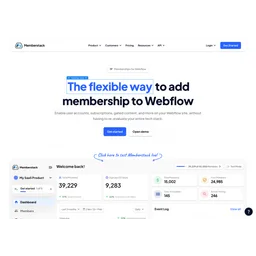
The short version
- Each has a real cost: DeskTime screenshots are excluded from the Pro plan and start at Premium; Memberstack basic and Professional tiers include transaction fees of 4% and 2% respectively
- Prices and features above were last checked on 30 August 2026.
Where they differ
Only the attributes on which DeskTime and Memberstack actually diverge.
| Attribute | DeskTime | Memberstack |
|---|---|---|
| Pricing model | freemium | subscription |
| Platforms | Web, IOS, Android, MacOS, Windows, Linux | Web |
| Founded | 2013 | Unknown |
Identical on both: starting price (Free), free tier (Yes), user rating (Not yet rated), category (Productivity).
What each one covers
Drawn from each product's published feature list. An absence here means we hold no record of it - not that the product lacks it.
Only in DeskTime
- Automatic activity tracking
- Application and website tracking
- Daily reports
- Weekly summaries
- Privacy-first design
- Detailed analytics
- Goal setting
- Mobile apps
Only in Memberstack
Nothing recorded that DeskTime does not also cover.
What people use each for
The jobs each tool is most often brought in to do.
DeskTime
- Automatic time tracking of desktop app and website usagenot Memberstack
- Measuring team productivity and idle timenot Memberstack
- Scheduling shifts and tracking absencesnot Memberstack
Memberstack
- Launching course platforms without custom backendnot DeskTime
- Building subscription services with Webflow and paymentnot DeskTime
- Gating content without writing codenot DeskTime
- Managing password resets and two-factor authenticationnot DeskTime
- Processing Stripe billing automaticallynot DeskTime
Where each one falls short
Documented limitations, not opinions. Every one is a constraint you would hit in normal use.
DeskTime
- Screenshots are excluded from the Pro plan and start at Premium
- Integrations and API access require the Premium plan
- Shift scheduling requires the Premium plan
- Enterprise is aimed at 200+ users and is priced by quote with no published rate
- The advertised $6.42 and $9.17 per user rates require annual billing; monthly billing costs more
- The trial lasts 14 days
Memberstack
- Basic and Professional tiers include transaction fees of 4% and 2% respectively
- Annual billing required for discounts; monthly pricing is higher
- Webflow community builders receive Basic plan free but locked to that tier
Pricing, plan by plan
DeskTime
Free- FreeFree
- Activity tracking
- Basic reports
- Weekly emails
- Pro$9/month
- Everything in Free
- Advanced reports
- Detailed analytics
Memberstack
Free- Basic$29/month
- Up to 1,000 members
- 4% transaction fee
- $25/month with annual billing
- Professional$49/month
- Up to 5,000 members
- 2% transaction fee
- $39/month with annual billing
- Business$99/month
- 10,000+ members
- 0.9% transaction fee
- $79/month with annual billing
- Established$499/month
- 10,000+ members
- Zero transaction fees
- $399/month with annual billing
Which should you pick?
Choose DeskTime if
- You need automatic activity tracking.
- You want to start without paying.
- You work on Web, IOS, Android, MacOS, Windows, Linux.
- You also want application and website tracking.
Questions people ask
- Is DeskTime or Memberstack better?
- Neither clearly leads. DeskTime starts at Free and Memberstack at Free, and user ratings are close enough to be indistinguishable. Choose on capability and platform support.
- Which is cheaper, DeskTime or Memberstack?
- DeskTime starts at Free and Memberstack at Free.
- Does DeskTime or Memberstack run on more platforms?
- DeskTime runs on Web, IOS, Android, MacOS, Windows, Linux. Memberstack runs on Web.
- Can I use DeskTime for free?
- Both have a free tier, so you can try either at no cost before committing.
- What is DeskTime best used for?
- DeskTime is most often used for automatic time tracking of desktop app and website usage, measuring team productivity and idle time, scheduling shifts and tracking absences. Of those, automatic time tracking of desktop app and website usage and measuring team productivity and idle time are not what Memberstack is typically brought in for.
- What can DeskTime do that Memberstack cannot?
- DeskTime covers Automatic activity tracking, Application and website tracking, Daily reports, Weekly summaries.
Answered from the vendors’ own pages
DeskTime: What are DeskTime's subscription tiers?
DeskTime offers Pro at $6.42/user/month (annual billing) for small teams and startups, Premium at $9.17/user/month (marked Most Popular) for hybrid and growing teams, and Enterprise with custom pricing for 200+ users.
SourceMemberstack: What are Memberstack's transaction fees?
Memberstack's transaction fee varies by tier: Basic plan charges 4% per transaction, Professional charges 2%, Business charges 0.9%, and Established tier charges zero transaction fees.
SourceDeskTime: What features differentiate the Premium tier from Pro?
Premium adds screenshots, integrations & API, and shift scheduling compared to Pro's document title tracking and calendar integrations.
SourceMemberstack: Does Memberstack offer a free trial or testing mode?
Yes, Memberstack offers an unlimited free trial in test mode requiring no credit card. Users maintain full feature access at no cost until their site launches with real members.
SourceDeskTime: How long is the DeskTime free trial?
DeskTime offers a 14-day free trial. No credit card is required to start.
SourceMemberstack: What discounts does Memberstack offer?
Memberstack offers 50% discount for non-profits, special pricing for young professionals (4% fees), and $249/month with zero fees for startups under $1M raised. Webflow community builders receive the Basic plan free. 30-day money-back guarantee available with full refund.
SourceDeskTime: What billing options does DeskTime offer?
DeskTime offers monthly or annual billing. Annual subscriptions include one complimentary month compared to monthly plan pricing. You can pay by credit card or PayPal.
SourceRelated pages
More on Memberstack
Other head to heads
- DeskTime vs Brain.fm
- DeskTime vs Todoist
- DeskTime vs Things 3
- DeskTime vs OmniFocus 3
- DeskTime vs Memtime
- DeskTime vs Fastmail
- DeskTime vs LibreOffice
- DeskTime vs Reflect
- DeskTime vs Hubstaff
- DeskTime vs Time Doctor
- DeskTime vs Streaks
- DeskTime vs tldraw
- DeskTime vs Ulysses
- DeskTime vs Anvil
- DeskTime vs WPS Office
- DeskTime vs Xmind
- DeskTime vs Kami
- DeskTime vs Mimestream
- DeskTime vs Paprika Recipe Manager
- DeskTime vs Remember The Milk
- DeskTime vs Tana
- DeskTime vs Gamma
- DeskTime vs Lazy
- DeskTime vs FigJam
- DeskTime vs Alfred
- DeskTime vs Nitro PDF
- DeskTime vs Beautiful.ai
- DeskTime vs MindMeister
- DeskTime vs PDF Expert
- Memberstack vs Brain.fm
- Memberstack vs Todoist
- Memberstack vs Things 3
- Memberstack vs OmniFocus 3
- Memberstack vs Memtime
- Memberstack vs Fastmail
- Memberstack vs LibreOffice
- Memberstack vs Reflect
- Memberstack vs Hubstaff
- Memberstack vs Time Doctor
- Memberstack vs Streaks
- Memberstack vs tldraw
- Memberstack vs Ulysses
- Memberstack vs Anvil
- Memberstack vs WPS Office
- Memberstack vs Xmind
- Memberstack vs Kami
- Memberstack vs Mimestream
- Memberstack vs Paprika Recipe Manager
- Memberstack vs Remember The Milk
- Memberstack vs Tana
- Memberstack vs Gamma
- Memberstack vs Lazy
- Memberstack vs FigJam
- Memberstack vs Alfred
- Memberstack vs Nitro PDF
- Memberstack vs Beautiful.ai
- Memberstack vs MindMeister
- Memberstack vs PDF Expert