
Databases · head to head
Estuary vs Vite
Estuary
Databases
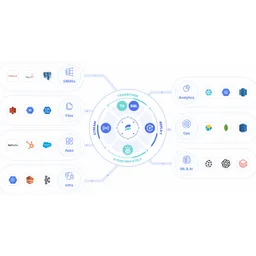
Real-time data integration combining streaming, CDC, and batch
- From
- Free
- Free plan
- Yes

The short version
- Vite is a next generation frontend build tool.
- Vite is free; Estuary starts at $0.5/mo.
- Where Estuary falls short: Per-GB pricing adds up quickly for high-volume scenarios.
- Where Vite falls short: does not support Node.js built-in polyfills, requiring manual configuration for CommonJS libraries.
- Prices and features on this page were last checked on 29 August 2026.
Where they differ
Only the attributes on which Estuary and Vite actually diverge.
Identical on both: starting price (Free), free tier (Yes).
Not yet recorded: pricing model for Vite.
What each one covers
Drawn from each product's published feature list. An absence here means we hold no record of it - not that the product lacks it.
Only in Estuary
- Real-time data delivery
- Change data capture
- Batch processing
- Data transformation
- Pre-built connectors
- Multiple deployments
- RBAC and monitoring
Only in Vite
Nothing recorded that Estuary does not also cover.
What people use each for
The jobs each tool is most often brought in to do.
Estuary
- Real-time data replication to data warehousesnot Vite
- Change data capture from operational databasesnot Vite
- Feeding analytics and BI systems with fresh datanot Vite
- Powering real-time AI and ML data pipelinesnot Vite
Vite
- Developers speeding up hot module replacement during React developmentnot Estuary
- Vue.js teams reducing rebuild times in large monorepo codebasesnot Estuary
- Teams building with TypeScript without additional tooling configurationnot Estuary
- Open-source contributors testing code changes in sub-second feedbacknot Estuary
Where each one falls short
Documented limitations, not opinions. Every one is a constraint you would hit in normal use.
Estuary
- Per-GB pricing adds up quickly for high-volume scenarios
- No transparent per-connector volume discounts below 6 connectors
- Limited to data movement; transformation capabilities are basic
- BYOC and private deployment requires enterprise plan
- Smaller ecosystem compared to established alternatives
Vite
- Does not support Node.js built-in polyfills, requiring manual configuration for CommonJS libraries
- File watching fails on Windows Subsystem for Linux 2 in certain conditions
- Smaller ecosystem and community compared to webpack
- Ampersands in Windows project paths cause module resolution failures
Pricing, plan by plan
Estuary
Free- DeveloperFree
- 10 GB per month
- 2 connector instances maximum
- No credit card required
- Cloud$0.5/gb
- $0.50 per GB of data moved
- $100 per connector monthly (6+ connectors $50 each)
- 200+ connectors
- EnterpriseOn request
- Volume-based discounts
- SOC 2 and HIPAA compliance
- SSO authentication
Vite
FreeNo published plan breakdown. See the Vite review.
Which should you pick?
Choose Estuary if
- You need real-time data delivery.
- You want to start without paying.
- You work on Web, BYOC.
- You also want change data capture.
Questions people ask
- Is Estuary or Vite better?
- Neither clearly leads. Estuary starts at Free and Vite at Free, and user ratings are close enough to be indistinguishable. Choose on capability and platform support.
- Which is cheaper, Estuary or Vite?
- Estuary starts at Free and Vite at Free.
- Does Estuary or Vite run on more platforms?
- Estuary runs on Web, BYOC. Vite runs on API.
- Can I use Estuary for free?
- Both have a free tier, so you can try either at no cost before committing.
- What is Estuary best used for?
- Estuary is most often used for real-time data replication to data warehouses, change data capture from operational databases, feeding analytics and bi systems with fresh data, powering real-time ai and ml data pipelines. Of those, real-time data replication to data warehouses and change data capture from operational databases are not what Vite is typically brought in for.
- What can Estuary do that Vite cannot?
- Estuary covers Real-time data delivery, Change data capture, Batch processing, Data transformation.
Answered from the vendors’ own pages
Estuary: What is included in the free Developer plan?
Developer plan ($0/month) includes 10 GB of data per month and up to 2 connector instances, no credit card required.
SourceVite: Does Vite support CommonJS dependencies?
Vite automatically converts CommonJS dependencies to ES modules during pre-bundling using esbuild, but it does not support Node.js built-in polyfills. For projects requiring Node builtins, additional configuration may be needed.
SourceEstuary: How is data pricing calculated on Cloud plan?
Cloud plan charges $0.50 per GB of data moved plus $100/month per connector for the first 6 connectors, then $50/month for additional connectors.
SourceVite: Can Vite work offline?
Vite requires internet for initial dependency pre-bundling with esbuild. Once dependencies are pre-bundled and cached, development can continue with local file serving, but full offline development is not supported.
SourceEstuary: What discount is available when adding 6+ connectors?
When using 6 or more connectors, the per-connector cost drops to $50/month from $100/month, saving $50 per additional connector.
SourceVite: What are Vite's system requirements on Windows?
Vite can run on Windows, but WSL2 users may experience file watching issues where Vite cannot detect file changes in certain conditions. Windows users with project paths containing ampersands may encounter module resolution failures with npm.
SourceVite: Does Vite support TypeScript, JSX, and CSS out of the box?
Yes. Vite natively supports TypeScript, JSX, CSS, and WebAssembly without additional configuration needed for basic use.
SourceRelated pages
Other head to heads
- Estuary vs Fivetran HVR
- Estuary vs Apache Druid
- Estuary vs ClickHouse
- Estuary vs Materialize
- Estuary vs Redis
- Estuary vs Firebase Realtime Database
- Estuary vs SingleStore
- Estuary vs Tinybird
- Estuary vs Timeplus
- Estuary vs Amazon Redshift
- Estuary vs DataGrip
- Estuary vs Firebolt
- Estuary vs Apache Pinot
- Estuary vs Apache Flink
- Estuary vs Apache Kafka
- Estuary vs Apache Pulsar
- Estuary vs Cassandra
- Estuary vs CouchDB
- Estuary vs Turborepo
- Estuary vs ESLint
- Estuary vs Webpack
- Estuary vs Namespace
- Estuary vs Keycloak
- Estuary vs Bazel
- Estuary vs Depot
- Estuary vs Moonrepo
- Estuary vs Pants Build
- Estuary vs Yarn
- Estuary vs Jenkins
- Estuary vs Cloud Native Buildpacks
- Estuary vs WebStorm
- Estuary vs Xlinesoft
- Estuary vs Docker
- Estuary vs GitHub Copilot
- Estuary vs LaunchDarkly
- Estuary vs Kubernetes
- Vite vs Fivetran HVR
- Vite vs Apache Druid
- Vite vs ClickHouse
- Vite vs Materialize
- Vite vs Redis
- Vite vs Firebase Realtime Database
- Vite vs SingleStore
- Vite vs Tinybird
- Vite vs Timeplus
- Vite vs Amazon Redshift
- Vite vs DataGrip
- Vite vs Firebolt
- Vite vs Apache Pinot
- Vite vs Apache Flink
- Vite vs Apache Kafka
- Vite vs Apache Pulsar
- Vite vs Cassandra
- Vite vs CouchDB
- Vite vs Turborepo
- Vite vs ESLint
- Vite vs Webpack
- Vite vs Namespace
- Vite vs Keycloak
- Vite vs Bazel
- Vite vs Depot
- Vite vs Moonrepo
- Vite vs Pants Build
- Vite vs Yarn
- Vite vs Jenkins
- Vite vs Cloud Native Buildpacks
- Vite vs WebStorm
- Vite vs Xlinesoft
- Vite vs Docker
- Vite vs GitHub Copilot
- Vite vs LaunchDarkly
- Vite vs Kubernetes