
Databases · head to head
Estuary vs Rust
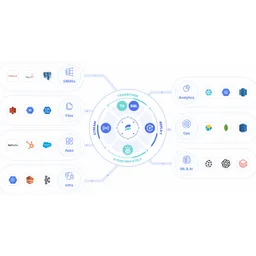
Estuary
Databases
Real-time data integration combining streaming, CDC, and batch
- From
- Free
- Free plan
- Yes

Rust
Developer Tools
A language empowering everyone to build reliable and efficient software
- From
- Free
- Free plan
- Yes
The short version
- Rust is a systems programming language.
- Rust is free; Estuary starts at $0.5/mo.
- Only Estuary lists real-time data delivery; only Rust lists memory safety.
- Where Estuary falls short: Per-GB pricing adds up quickly for high-volume scenarios.
- Where Rust falls short: compile times significantly longer than languages like Go or C.
- Prices and features on this page were last checked on 13 November 2026.
Where they differ
Only the attributes on which Estuary and Rust actually diverge.
Identical on both: starting price (Free), free tier (Yes).
What each one covers
Drawn from each product's published feature list. An absence here means we hold no record of it - not that the product lacks it.
Only in Estuary
- Real-time data delivery
- Change data capture
- Batch processing
- Data transformation
- Pre-built connectors
- Multiple deployments
- RBAC and monitoring
Only in Rust
- Memory safety
- Zero-cost abstractions
- Ownership system
- Pattern matching
- Type inference
- Cargo package manager
- Cross compilation
- Fearless concurrency
What people use each for
The jobs each tool is most often brought in to do.
Estuary
- Real-time data replication to data warehousesnot Rust
- Change data capture from operational databasesnot Rust
- Feeding analytics and BI systems with fresh datanot Rust
- Powering real-time AI and ML data pipelinesnot Rust
Rust
- Systems programming and operating system developmentnot Estuary
- Performance-critical applicationsnot Estuary
- Embedded systems and firmwarenot Estuary
- Network services and concurrent applicationsnot Estuary
Where each one falls short
Documented limitations, not opinions. Every one is a constraint you would hit in normal use.
Estuary
- Per-GB pricing adds up quickly for high-volume scenarios
- No transparent per-connector volume discounts below 6 connectors
- Limited to data movement; transformation capabilities are basic
- BYOC and private deployment requires enterprise plan
- Smaller ecosystem compared to established alternatives
Rust
- Compile times significantly longer than languages like Go or C
- Smaller ecosystem of libraries and frameworks compared to Python or JavaScript
- Community still smaller than mainstream languages, reducing available third-party resources
Pricing, plan by plan
Estuary
Free- DeveloperFree
- 10 GB per month
- 2 connector instances maximum
- No credit card required
- Cloud$0.5/gb
- $0.50 per GB of data moved
- $100 per connector monthly (6+ connectors $50 each)
- 200+ connectors
- EnterpriseOn request
- Volume-based discounts
- SOC 2 and HIPAA compliance
- SSO authentication
Rust
FreeNo published plan breakdown. See the Rust review.
Which should you pick?
Choose Estuary if
- You need real-time data delivery.
- You want to start without paying.
- You work on Web, BYOC.
- You also want change data capture.
Choose Rust if
- You need memory safety.
- You want to start without paying.
- You work on Windows, Linux, macOS.
- You also want zero-cost abstractions.
Questions people ask
- Is Estuary or Rust better?
- Neither clearly leads. Estuary starts at Free and Rust at Free, and user ratings are close enough to be indistinguishable. Choose on capability and platform support.
- Which is cheaper, Estuary or Rust?
- Estuary starts at Free and Rust at Free.
- Does Estuary or Rust run on more platforms?
- Estuary runs on Web, BYOC. Rust runs on Windows, Linux, macOS.
- Can I use Estuary for free?
- Both have a free tier, so you can try either at no cost before committing.
- What is Estuary best used for?
- Estuary is most often used for real-time data replication to data warehouses, change data capture from operational databases, feeding analytics and bi systems with fresh data, powering real-time ai and ml data pipelines. Of those, real-time data replication to data warehouses and change data capture from operational databases are not what Rust is typically brought in for.
- What can Estuary do that Rust cannot?
- Estuary covers Real-time data delivery, Change data capture, Batch processing, Data transformation. Rust covers Memory safety, Zero-cost abstractions, Ownership system, Pattern matching.
Answered from the vendors’ own pages
Estuary: What is included in the free Developer plan?
Developer plan ($0/month) includes 10 GB of data per month and up to 2 connector instances, no credit card required.
SourceRust: Is Rust free?
Yes, Rust is free and open-source. The Rust Foundation provides institutional support for this community-driven project, and there are no costs associated with using the programming language.
SourceEstuary: How is data pricing calculated on Cloud plan?
Cloud plan charges $0.50 per GB of data moved plus $100/month per connector for the first 6 connectors, then $50/month for additional connectors.
SourceRust: What license does Rust use?
Rust is open-source and operated under an open-source license. Full license details are available in the policies section of the Rust website.
SourceEstuary: What discount is available when adding 6+ connectors?
When using 6 or more connectors, the per-connector cost drops to $50/month from $100/month, saving $50 per additional connector.
SourceRelated pages
Other head to heads
- Estuary vs Fivetran HVR
- Estuary vs Apache Druid
- Estuary vs ClickHouse
- Estuary vs Materialize
- Estuary vs Redis
- Estuary vs Firebase Realtime Database
- Estuary vs SingleStore
- Estuary vs Tinybird
- Estuary vs Timeplus
- Estuary vs Amazon Redshift
- Estuary vs DataGrip
- Estuary vs Firebolt
- Estuary vs Apache Pinot
- Estuary vs Apache Flink
- Estuary vs Apache Kafka
- Estuary vs Apache Pulsar
- Estuary vs Cassandra
- Estuary vs CouchDB
- Estuary vs GNAT Pro
- Estuary vs Helix
- Estuary vs Restate
- Estuary vs Blacksmith
- Estuary vs WarpBuild
- Estuary vs Bazel
- Estuary vs Moonrepo
- Estuary vs Nixpacks
- Estuary vs Nx Cloud
- Estuary vs Pants Build
- Estuary vs Turborepo
- Estuary vs Yarn
- Estuary vs Bitbucket
- Estuary vs Claude Code
- Estuary vs Cloud Native Buildpacks
- Estuary vs Cody
- Estuary vs ConfigCat
- Estuary vs Cortex
- Rust vs Fivetran HVR
- Rust vs Apache Druid
- Rust vs ClickHouse
- Rust vs Materialize
- Rust vs Redis
- Rust vs Firebase Realtime Database
- Rust vs SingleStore
- Rust vs Tinybird
- Rust vs Timeplus
- Rust vs Amazon Redshift
- Rust vs DataGrip
- Rust vs Firebolt
- Rust vs Apache Pinot
- Rust vs Apache Flink
- Rust vs Apache Kafka
- Rust vs Apache Pulsar
- Rust vs Cassandra
- Rust vs CouchDB
- Rust vs GNAT Pro
- Rust vs Helix
- Rust vs Restate
- Rust vs Blacksmith
- Rust vs WarpBuild
- Rust vs Bazel
- Rust vs Moonrepo
- Rust vs Nixpacks
- Rust vs Nx Cloud
- Rust vs Pants Build
- Rust vs Turborepo
- Rust vs Yarn
- Rust vs Bitbucket
- Rust vs Claude Code
- Rust vs Cloud Native Buildpacks
- Rust vs Cody
- Rust vs ConfigCat
- Rust vs Cortex