
Databases · head to head
Estuary vs MuleSoft
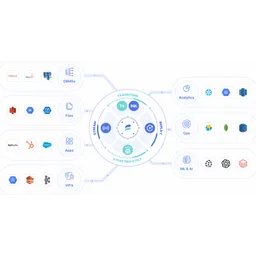
Estuary
Databases
Real-time data integration combining streaming, CDC, and batch
- From
- Free
- Rated
- -

MuleSoft
Automation Integration
Integration platform as a service (iPaaS) with robust API management
- From
- $1500/monthly
- Rated
- -
The short version
- Only Estuary has a free tier, so it costs nothing to try first.
- Each has a real cost: Estuary per-GB pricing adds up quickly for high-volume scenarios; MuleSoft pricing for MuleSoft solutions not published on vendor website; enterprise integration platform requires custom quote
- They diverge on capability: Estuary covers Real-time data delivery, MuleSoft covers API Gateway.
Where they differ
Only the attributes on which Estuary and MuleSoft actually diverge.
Identical on both: user rating (Not yet rated).
What each one covers
Drawn from each product's published feature list. An absence here means we hold no record of it - not that the product lacks it.
Only in Estuary
- Real-time data delivery
- Change data capture
- Batch processing
- Data transformation
- Pre-built connectors
- Multiple deployments
- RBAC and monitoring
Only in MuleSoft
- API Gateway
- API Design
- Integration Platform
- Salesforce
- SAP
- Oracle
- AWS
- ServiceNow
What people use each for
The jobs each tool is most often brought in to do.
Estuary
- Real-time data replication to data warehousesnot MuleSoft
- Change data capture from operational databasesnot MuleSoft
- Feeding analytics and BI systems with fresh datanot MuleSoft
- Powering real-time AI and ML data pipelinesnot MuleSoft
MuleSoft
- API Developmentnot Estuary
- API Gatewaynot Estuary
- API Testingnot Estuary
- API Documentationnot Estuary
- Microservicesnot Estuary
Where each one falls short
Documented limitations, not opinions. Every one is a constraint you would hit in normal use.
Estuary
- Per-GB pricing adds up quickly for high-volume scenarios
- No transparent per-connector volume discounts below 6 connectors
- Limited to data movement; transformation capabilities are basic
- BYOC and private deployment requires enterprise plan
- Smaller ecosystem compared to established alternatives
MuleSoft
- Pricing for MuleSoft solutions not published on vendor website; enterprise integration platform requires custom quote
Pricing, plan by plan
Estuary
Free- DeveloperFree
- 10 GB per month
- 2 connector instances maximum
- No credit card required
- Cloud$0.5/GB
- $0.50 per GB of data moved
- $100 per connector monthly (6+ connectors $50 each)
- 200+ connectors
- Enterprise$null/custom
- Volume-based discounts
- SOC 2 and HIPAA compliance
- SSO authentication
MuleSoft
$1500/monthly- Starter$1500/monthly
- API gateway
- Design center
- Basic integration
- Professional$3500/monthly
- Advanced integration
- Analytics
- Team collaboration
- Enterprise$undefined/monthly
- Full Anypoint platform
- Custom SLA
- Advanced security
Which should you pick?
Choose Estuary if
- You need real-time data delivery.
- You want to start without paying.
- You work on Cloud, Private Cloud, BYOC.
- You also want change data capture.
Choose MuleSoft if
- You need api gateway.
- You work on Cloud, On-premises, Hybrid.
- You also want api design.
Questions people ask
- Is Estuary or MuleSoft better?
- Neither clearly leads. Estuary starts at Free and MuleSoft at $1500/monthly, and user ratings are close enough to be indistinguishable. Choose on capability and platform support.
- Which is cheaper, Estuary or MuleSoft?
- Estuary has a free tier; the other does not. Paid plans start at Free for Estuary and $1500/monthly for MuleSoft.
- Does Estuary or MuleSoft run on more platforms?
- Estuary runs on Cloud, Private Cloud, BYOC. MuleSoft runs on Cloud, On-premises, Hybrid.
- Can I use Estuary for free?
- Yes. Estuary has a free tier, so you can try it without paying. MuleSoft starts at $1500/monthly.
- What is Estuary best used for?
- Estuary is most often used for real-time data replication to data warehouses, change data capture from operational databases, feeding analytics and bi systems with fresh data, powering real-time ai and ml data pipelines. Of those, real-time data replication to data warehouses and change data capture from operational databases are not what MuleSoft is typically brought in for.
- What can Estuary do that MuleSoft cannot?
- Estuary covers Real-time data delivery, Change data capture, Batch processing, Data transformation. MuleSoft covers API Gateway, API Design, Integration Platform, Salesforce.
Answered from the vendors’ own pages
Estuary: What is included in the free Developer plan?
Developer plan ($0/month) includes 10 GB of data per month and up to 2 connector instances, no credit card required.
SourceMuleSoft: What does MuleSoft cost?
MuleSoft does not publish pricing on its website. The vendor markets its Anypoint Platform to enterprises with custom licensing quotes.
SourceEstuary: How is data pricing calculated on Cloud plan?
Cloud plan charges $0.50 per GB of data moved plus $100/month per connector for the first 6 connectors, then $50/month for additional connectors.
SourceMuleSoft: How much does the MuleSoft Anypoint Platform cost per user?
MuleSoft does not disclose per-user, per-month, or per-API pricing on its website. Licensing models vary by customer requirements and deployment size.
SourceEstuary: What discount is available when adding 6+ connectors?
When using 6 or more connectors, the per-connector cost drops to $50/month from $100/month, saving $50 per additional connector.
SourceMuleSoft: Does MuleSoft offer a free trial?
MuleSoft encourages users to watch demos or contact sales to explore the platform. No free trial offer is mentioned on the website.
SourceRelated pages
Other head to heads
- Estuary vs Cockroach Labs
- Estuary vs PostgreSQL
- Estuary vs Airtable
- Estuary vs Amazon Aurora
- Estuary vs Elasticsearch
- Estuary vs Apache Kafka
- Estuary vs PlanetScale
- Estuary vs Meilisearch
- Estuary vs Turso
- Estuary vs Azure SQL
- Estuary vs ClickHouse
- Estuary vs Couchbase
- Estuary vs DuckDB
- Estuary vs MariaDB
- Estuary vs Oracle Database
- Estuary vs DataGrip
- Estuary vs Firebolt
- Estuary vs Google Cloud SQL
- Estuary vs n8n
- Estuary vs Zapier
- Estuary vs Microsoft Power Automate
- Estuary vs Parabola
- Estuary vs Airbyte
- Estuary vs Dagster
- Estuary vs Prefect
- Estuary vs Automation Anywhere
- Estuary vs Blue Prism
- Estuary vs CrewAI
- Estuary vs Fivetran
- Estuary vs Mage AI
- Estuary vs Temporal
- Estuary vs UiPath
- Estuary vs Workato
- Estuary vs Jitterbit
- Estuary vs mParticle
- Estuary vs Paragon
- MuleSoft vs Cockroach Labs
- MuleSoft vs PostgreSQL
- MuleSoft vs Airtable
- MuleSoft vs Amazon Aurora
- MuleSoft vs Elasticsearch
- MuleSoft vs Apache Kafka
- MuleSoft vs PlanetScale
- MuleSoft vs Meilisearch
- MuleSoft vs Turso
- MuleSoft vs Azure SQL
- MuleSoft vs ClickHouse
- MuleSoft vs Couchbase
- MuleSoft vs DuckDB
- MuleSoft vs MariaDB
- MuleSoft vs Oracle Database
- MuleSoft vs DataGrip
- MuleSoft vs Firebolt
- MuleSoft vs Google Cloud SQL
- MuleSoft vs n8n
- MuleSoft vs Zapier
- MuleSoft vs Microsoft Power Automate
- MuleSoft vs Parabola
- MuleSoft vs Airbyte
- MuleSoft vs Dagster
- MuleSoft vs Prefect
- MuleSoft vs Automation Anywhere
- MuleSoft vs Blue Prism
- MuleSoft vs CrewAI
- MuleSoft vs Fivetran
- MuleSoft vs Mage AI
- MuleSoft vs Temporal
- MuleSoft vs UiPath
- MuleSoft vs Workato
- MuleSoft vs Jitterbit
- MuleSoft vs mParticle
- MuleSoft vs Paragon