
Logging · head to head
Cronitor vs D-ID
Cronitor
Logging
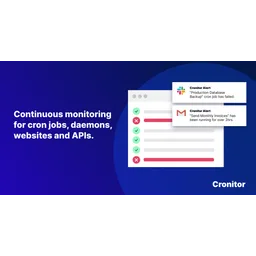
Monitoring for cron jobs, websites, and background tasks
- From
- Free
- Rated
- -

The short version
- Each has a real cost: Cronitor free tier limited to 5 monitors, limiting viability for small teams; D-ID pricing details are not published on the main pricing page; specific costs for Trial, Lite, Pro, Advanced, or Enterprise plans are not disclosed
- They diverge on capability: Cronitor covers Cron job monitoring, D-ID covers Photo-to-video.
Where they differ
Only the attributes on which Cronitor and D-ID actually diverge.
Identical on both: starting price (Free), free tier (Yes), user rating (Not yet rated).
What each one covers
Drawn from each product's published feature list. An absence here means we hold no record of it - not that the product lacks it.
Only in Cronitor
- Cron job monitoring
- Uptime and performance checks
- Heartbeat monitoring
- Status pages
- Real-user monitoring
- Alert integrations
- Email reports
Only in D-ID
- Photo-to-video
- Talking avatars
- Voice cloning
- API access
- API access
- ChatGPT integration
- Web SDK
- Web support
What people use each for
The jobs each tool is most often brought in to do.
Cronitor
- Monitoring scheduled cron jobs and background tasksnot D-ID
- Tracking website and API uptime with global checksnot D-ID
- Alerting teams when critical jobs fail to executenot D-ID
- Communicating service status to customersnot D-ID
D-ID
- AI video generation with digital avatarsnot Cronitor
- Multilingual video creation in 120+ languagesnot Cronitor
- API-driven video automationnot Cronitor
Where each one falls short
Documented limitations, not opinions. Every one is a constraint you would hit in normal use.
Cronitor
- Free tier limited to 5 monitors, limiting viability for small teams
- Pay-per-monitor pricing scales quickly with infrastructure size
- Requires integrating ping calls into existing jobs
- Limited to monitoring jobs that can send pings
- No built-in workflow orchestration or task scheduling
D-ID
- Pricing details are not published on the main pricing page; specific costs for Trial, Lite, Pro, Advanced, or Enterprise plans are not disclosed
- Multiple pricing sections (Studio vs API) exist but neither displays actual dollar amounts or feature breakdowns
- Enterprise pricing requires contacting sales directly
Pricing, plan by plan
Cronitor
Free- HackerFree
- 5 monitors
- Email and Slack alerts
- Basic status page
- Business$2/monitor/month
- Unlimited monitors
- 30-second check frequency
- 10 alert integrations
- Enterprise$6000/year
- Custom features and integrations
- 5-second check frequency
- Dedicated engineer
D-ID
FreeNo published plan breakdown. See the D-ID review.
Which should you pick?
Choose Cronitor if
- You need cron job monitoring.
- You want to start without paying.
- You work on Web, API.
- You also want uptime and performance checks.
Choose D-ID if
- You need photo-to-video.
- You want to start without paying.
- You also want talking avatars.
Questions people ask
- Is Cronitor or D-ID better?
- Neither clearly leads. Cronitor starts at Free and D-ID at Free, and user ratings are close enough to be indistinguishable. Choose on capability and platform support.
- Which is cheaper, Cronitor or D-ID?
- Cronitor starts at Free and D-ID at Free.
- Does Cronitor or D-ID run on more platforms?
- Cronitor runs on Web, API. D-ID runs on Web.
- Can I use Cronitor for free?
- Both have a free tier, so you can try either at no cost before committing.
- What is Cronitor best used for?
- Cronitor is most often used for monitoring scheduled cron jobs and background tasks, tracking website and api uptime with global checks, alerting teams when critical jobs fail to execute, communicating service status to customers. Of those, monitoring scheduled cron jobs and background tasks and tracking website and api uptime with global checks are not what D-ID is typically brought in for.
- What can Cronitor do that D-ID cannot?
- Cronitor covers Cron job monitoring, Uptime and performance checks, Heartbeat monitoring, Status pages. D-ID covers Photo-to-video, Talking avatars, Voice cloning, API access.
Answered from the vendors’ own pages
Cronitor: How does Cronitor billing work for the Business plan?
Business plan costs $2 per monitor per month plus $5 per user per month, billed monthly based on actual usage.
SourceD-ID: How much does D-ID cost?
D-ID pricing is not publicly displayed. The platform offers Trial, Lite, Pro, Advanced, and Enterprise plans, but specific costs are not published. Users must try the free trial or contact sales for pricing information.
SourceCronitor: What is the difference between Hacker and Business plans?
Hacker plan ($0/month) includes 5 monitors and basic Slack/email alerts. Business plan ($2/monitor/month) offers unlimited monitors, 30-second checks, 10 integrations, 12-month retention, and email reports.
SourceD-ID: Does D-ID offer a free trial?
Yes, D-ID offers a free trial that users can start at studio.d-id.com. Trial users have access to the platform before committing to a paid plan.
SourceCronitor: Does Cronitor offer a free trial?
Yes, Cronitor provides a 14-day free trial on the Business plan without requiring a credit card.
SourceD-ID: What are D-ID's video rendering limits?
D-ID measures usage in minutes for video creation. Minutes deducted from your plan round up to the nearest 15-second interval. Unused minutes do not carry over monthly and are renewed each billing period.
SourceD-ID: Can I upgrade from monthly to annual billing on D-ID?
Yes, D-ID supports both monthly and annual billing options, and users can switch between them anytime. Subscription cancellations remain active through the current billing period.
SourceRelated pages
Other head to heads
- Cronitor vs Elastic Stack
- Cronitor vs New Relic
- Cronitor vs Datadog Logs
- Cronitor vs Coralogix
- Cronitor vs Grafana Loki
- Cronitor vs incident.io
- Cronitor vs FireHydrant
- Cronitor vs Healthchecks
- Cronitor vs Openstatus
- Cronitor vs Rootly
- Cronitor vs Checkly
- Cronitor vs CloudWatch
- Cronitor vs Dynatrace
- Cronitor vs InfluxDB
- Cronitor vs Airbrake
- Cronitor vs AppDynamics
- Cronitor vs Axiom
- Cronitor vs Azure Monitor
- Cronitor vs Pika
- Cronitor vs Anthropic API
- Cronitor vs Fathom
- Cronitor vs Together AI
- Cronitor vs Stable Diffusion
- Cronitor vs Arize AI
- Cronitor vs ChatGPT
- Cronitor vs Perplexity
- Cronitor vs AutoGen
- Cronitor vs Black Forest Labs
- Cronitor vs Cartesia
- Cronitor vs Deepgram
- Cronitor vs Galileo
- Cronitor vs Helicone
- Cronitor vs Ideogram
- Cronitor vs Jasper
- Cronitor vs LangGraph
- Cronitor vs Lindy
- D-ID vs Elastic Stack
- D-ID vs New Relic
- D-ID vs Datadog Logs
- D-ID vs Coralogix
- D-ID vs Grafana Loki
- D-ID vs incident.io
- D-ID vs FireHydrant
- D-ID vs Healthchecks
- D-ID vs Openstatus
- D-ID vs Rootly
- D-ID vs Checkly
- D-ID vs CloudWatch
- D-ID vs Dynatrace
- D-ID vs InfluxDB
- D-ID vs Airbrake
- D-ID vs AppDynamics
- D-ID vs Axiom
- D-ID vs Azure Monitor
- D-ID vs Pika
- D-ID vs Anthropic API
- D-ID vs Fathom
- D-ID vs Together AI
- D-ID vs Stable Diffusion
- D-ID vs Arize AI
- D-ID vs ChatGPT
- D-ID vs Perplexity
- D-ID vs AutoGen
- D-ID vs Black Forest Labs
- D-ID vs Cartesia
- D-ID vs Deepgram
- D-ID vs Galileo
- D-ID vs Helicone
- D-ID vs Ideogram
- D-ID vs Jasper
- D-ID vs LangGraph
- D-ID vs Lindy