
Developer Tools · head to head
ConfigCat vs Earthly

ConfigCat
Developer Tools
Feature flag service priced per flag and environment with unlimited seats and unlimited monthly active users
- From
- Free
- Rated
- -
The short version
- Each has a real cost: ConfigCat there is no experimentation or statistical analysis engine, so teams wanting real A/B tests with significance testing must buy and integrate a separate analytics or experimentation product.; Earthly pricing model not published; requires sales contact
- They diverge on capability: ConfigCat covers Feature flags and configuration, Earthly covers Policy as code.
- Prices and features above were last checked on 31 August 2026.
Where they differ
Only the attributes on which ConfigCat and Earthly actually diverge.
Identical on both: starting price (Free), free tier (Yes), user rating (Not yet rated), category (Developer Tools).
What each one covers
Drawn from each product's published feature list. An absence here means we hold no record of it - not that the product lacks it.
Only in ConfigCat
- Feature flags and configuration
- Percentage rollouts
- Targeting rules and segments
- Unlimited seats
- Global CDN delivery
- Audit log
- Public API and webhooks
- SDKs across languages
Only in Earthly
- Policy as code
- Multi-stage enforcement
- AI agent governance
- Repository-wide policies
- Incident response automation
- Compliance management
- Earthfiles build tool
- Satellites
What people use each for
The jobs each tool is most often brought in to do.
ConfigCat
- A consumer or mobile app with millions of users where per-MAU flag pricing would cost more than the flags are worthnot Earthly
- A team that wants every engineer, product manager and support agent to have a login without paying per seatnot Earthly
- Decoupling deployment from release with percentage rollouts and a kill switch, without buying an experimentation platformnot Earthly
- A small team that needs ten flags permanently and can run indefinitely on the free tiernot Earthly
Earthly
- Enforcing engineering standards across AI and human developersnot ConfigCat
- Automating incident response procedures across all repositoriesnot ConfigCat
- Embedding compliance requirements into development workflowsnot ConfigCat
- Standardizing build processes with Earthfilesnot ConfigCat
Where each one falls short
Documented limitations, not opinions. Every one is a constraint you would hit in normal use.
ConfigCat
- There is no experimentation or statistical analysis engine, so teams wanting real A/B tests with significance testing must buy and integrate a separate analytics or experimentation product.
- Pricing by flag count punishes exactly the hygiene you want: the Pro tier caps at 100 flags, so teams that do not aggressively retire stale flags are pushed to the 325 dollar Smart tier for housekeeping reasons rather than growth.
- The free tier allows only 2 environments, which does not cover the common development, staging and production split, so almost any real deployment starts on a paid plan.
- It is a smaller vendor than the category incumbents, so enterprise procurement teams will find less depth in compliance attestations, contractual terms and reference architecture than LaunchDarkly offers.
- Flag evaluation relies on SDK-side caching of a CDN-delivered config, which is fast but means propagation of a change is eventually consistent rather than instant, something to understand before relying on it as an emergency kill switch.
Earthly
- Pricing model not published; requires sales contact
- Earthly Lunar is a recent launch (2025) with limited track record
- Primarily GitHub-focused; limited integration with other platforms
- No public documentation on pricing or feature tiers
Pricing, plan by plan
ConfigCat
Free- Forever FreeFree
- 10 feature flags
- 2 environments and 2 products
- 2 segments
- Pro$110/month
- 100 feature flags
- 3 environments and 3 products
- Unlimited seats and MAUs
- Smart$325/month
- Unlimited feature flags
- Unlimited environments, products and segments
- Unlimited seats and MAUs
- Enterprise$900/month
- Everything in Smart
- Enterprise support and controls
- Unlimited everything on flag counts
Earthly
FreeNo published plan breakdown. See the Earthly review.
Which should you pick?
Choose ConfigCat if
- You need feature flags and configuration.
- You want to start without paying.
- You work on Web, API, iOS, Android, Node.js, .NET, Java, Python, Go.
- You also want percentage rollouts.
Choose Earthly if
- You need policy as code.
- You want to start without paying.
- You work on Web, CLI.
- You also want multi-stage enforcement.
Questions people ask
- Is ConfigCat or Earthly better?
- Neither clearly leads. ConfigCat starts at Free and Earthly at Free, and user ratings are close enough to be indistinguishable. Choose on capability and platform support.
- Which is cheaper, ConfigCat or Earthly?
- ConfigCat starts at Free and Earthly at Free.
- Does ConfigCat or Earthly run on more platforms?
- ConfigCat runs on Web, API, iOS, Android, Node.js, .NET, Java, Python, Go. Earthly runs on Web, CLI.
- Can I use ConfigCat for free?
- Both have a free tier, so you can try either at no cost before committing.
- What is ConfigCat best used for?
- ConfigCat is most often used for a consumer or mobile app with millions of users where per-mau flag pricing would cost more than the flags are worth, a team that wants every engineer, product manager and support agent to have a login without paying per seat, decoupling deployment from release with percentage rollouts and a kill switch, without buying an experimentation platform, a small team that needs ten flags permanently and can run indefinitely on the free tier. Of those, a consumer or mobile app with millions of users where per-mau flag pricing would cost more than the flags are worth and a team that wants every engineer, product manager and support agent to have a login without paying per seat are not what Earthly is typically brought in for.
- What can ConfigCat do that Earthly cannot?
- ConfigCat covers Feature flags and configuration, Percentage rollouts, Targeting rules and segments, Unlimited seats. Earthly covers Policy as code, Multi-stage enforcement, AI agent governance, Repository-wide policies.
Answered from the vendors’ own pages
ConfigCat: How is ConfigCat priced?
By feature flag, environment and product count. Seats, monthly active users and flag reads are unlimited on every plan.
Earthly: What is the difference between Earthfiles and Earthly Lunar?
Earthfiles is an open-source build tool that reached 12,000 GitHub stars and is used by companies like NVIDIA, Intel, and Databricks. Earthly Lunar is a separate governance platform launched in 2025 for enforcing standards across development workflows.
SourceConfigCat: Is the free tier usable?
For small projects yes, but at 10 flags and 2 environments it will not cover a dev, staging and production setup.
Earthly: How does Earthly Lunar enforce standards?
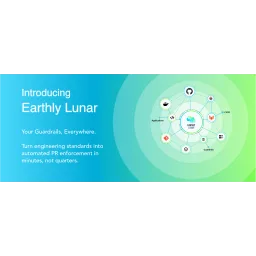
Lunar converts engineering standards, compliance requirements, and processes documented in AGENTS.md files, wikis, and incident postmortems into enforceable guardrails that apply consistently across repositories and development stages.
SourceConfigCat: Can it run A/B tests?
It can split traffic, but there is no statistics engine. You need a separate analytics tool to decide a winner.
Earthly: What is the pricing for Earthly Lunar?
Pricing is not published on the website. Interested customers should contact Earthly's sales team for current pricing and feature tiers.
SourceConfigCat: How fast does a flag change take effect?
SDKs poll and cache, so changes propagate on the polling interval rather than instantly.
Related pages
Other head to heads
- ConfigCat vs Nix
- ConfigCat vs Depot
- ConfigCat vs Blacksmith
- ConfigCat vs WarpBuild
- ConfigCat vs Namespace
- ConfigCat vs OpsLevel
- ConfigCat vs Ansible
- ConfigCat vs Garden
- ConfigCat vs Okteto
- ConfigCat vs Ona (formerly Gitpod)
- ConfigCat vs Bazel
- ConfigCat vs Cody
- ConfigCat vs Cortex
- ConfigCat vs Dagger
- ConfigCat vs Deep Code
- ConfigCat vs Deno
- ConfigCat vs Fig
- ConfigCat vs Spacelift
- ConfigCat vs Nixpacks
- ConfigCat vs Cloud Native Buildpacks
- ConfigCat vs Nx Cloud
- Earthly vs Nix
- Earthly vs Depot
- Earthly vs Blacksmith
- Earthly vs WarpBuild
- Earthly vs Namespace
- Earthly vs OpsLevel
- Earthly vs Ansible
- Earthly vs Garden
- Earthly vs Okteto
- Earthly vs Ona (formerly Gitpod)
- Earthly vs Bazel
- Earthly vs Cody
- Earthly vs Cortex
- Earthly vs Dagger
- Earthly vs Deep Code
- Earthly vs Deno
- Earthly vs Fig
- Earthly vs Spacelift
- Earthly vs Nixpacks
- Earthly vs Cloud Native Buildpacks
- Earthly vs Nx Cloud