
Cybersecurity · head to head
Clerk vs Memberstack

Clerk
Cybersecurity
Drop-in user authentication and management for developers
- From
- Free
- Free plan
- Yes
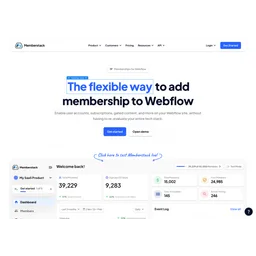
Memberstack
Productivity
Add memberships and logins to any website
- From
- Free
- Free plan
- Yes
The short version
- Free plans on both; paid from $25/mo and $29/mo.
- Where Clerk falls short: pricing scales with monthly retained users, which can grow expensive quickly for consumer apps with large user bases.
- Where Memberstack falls short: basic and Professional tiers include transaction fees of 4% and 2% respectively.
- Prices and features on this page were last checked on 20 November 2026.
How do Clerk and Memberstack differ?
Clerk and Memberstack differ on pricing model (Freemium against Subscription), platforms and category (Cybersecurity against Productivity). Only the attributes on which Clerk and Memberstack actually diverge.
| Attribute | Clerk | Memberstack |
|---|---|---|
| Pricing model | Freemium | Subscription |
| Platforms | Web, iOS, Android, API | Web |
| Category | Cybersecurity | Productivity |
Identical on both: starting price (Free), free tier (Yes).
Not yet recorded: founded for Clerk.
Which features does each one have?
They share no listed features; 6 appear only for Clerk. Drawn from each product's published feature list. An absence here means we hold no record of it - not that the product lacks it.
Only in Clerk
- Prebuilt UI components
- Organization management
- Multi-factor authentication
- Social sign-on
- Billing
- Enterprise connections
Only in Memberstack
Nothing recorded that Clerk does not also cover.
What is each one used for?
Clerk is most often brought in for adding sign-in and user profiles to a web or mobile app quickly; Memberstack for launching course platforms without custom backend. The jobs each tool is most often brought in to do.
Clerk
- Adding sign-in and user profiles to a web or mobile app quicklynot Memberstack
- B2B SaaS apps needing organizations and role-based accessnot Memberstack
- Startups wanting prebuilt UI instead of building auth in-housenot Memberstack
- Apps needing MFA and fraud detection out of the boxnot Memberstack
Memberstack
- Launching course platforms without custom backendnot Clerk
- Building subscription services with Webflow and paymentnot Clerk
- Gating content without writing codenot Clerk
- Managing password resets and two-factor authenticationnot Clerk
- Processing Stripe billing automaticallynot Clerk
Where do Clerk and Memberstack fall short?
Clerk's most cited limit: pricing scales with monthly retained users, which can grow expensive quickly for consumer apps with large user bases. Memberstack's: basic and Professional tiers include transaction fees of 4% and 2% respectively. Documented limitations, not opinions. Every one is a constraint you would hit in normal use.
Clerk
- Pricing scales with monthly retained users, which can grow expensive quickly for consumer apps with large user bases
- Enterprise SSO connections beyond the first are billed as add-ons, adding cost for larger organizations
- The Business tier's extra dashboard seats cost $20/month each, which adds up for larger teams
- Enterprise-tier features like the 99.99% uptime SLA require annual contracts rather than flexible monthly billing
Memberstack
- Basic and Professional tiers include transaction fees of 4% and 2% respectively
- Annual billing required for discounts; monthly pricing is higher
- Webflow community builders receive Basic plan free but locked to that tier
How much do Clerk and Memberstack cost?
Clerk has a free plan, with paid plans from $25/mo; Memberstack has a free plan, with paid plans from $29/mo. Plan by plan below, from each vendor's own pricing page.
Clerk
Free- HobbyFree
- 50,000 MRU limit per app
- Up to 3 dashboard seats
- Unlimited applications
- Pro$25/mo
- 50,000 MRUs included, $0.02/MRU overage
- Up to 3 dashboard seats
- 1 Enterprise Connection included
- Business$300/mo
- 50,000 MRUs included with volume pricing
- 10 dashboard seats included
- SOC2 report and priority support
- EnterpriseOn request
- Custom pricing, annual billing
- 99.99% uptime SLA
- HIPAA available, dedicated Slack channel
Memberstack
Free- Basic$29/mo
- Up to 1,000 members
- 4% transaction fee
- $25/month with annual billing
- Professional$49/mo
- Up to 5,000 members
- 2% transaction fee
- $39/month with annual billing
- Business$99/mo
- 10,000+ members
- 0.9% transaction fee
- $79/month with annual billing
- Established$499/mo
- 10,000+ members
- Zero transaction fees
- $399/month with annual billing
Which should you pick?
Choose Clerk if
- You need prebuilt ui components.
- You want to start without paying.
- You work on Web, iOS, Android, API.
- You also want organization management.
Questions people ask
- Is Clerk or Memberstack better?
- Neither clearly leads. Clerk starts at Free and Memberstack at Free, and user ratings are close enough to be indistinguishable. Choose on capability and platform support.
- Which is cheaper, Clerk or Memberstack?
- Clerk starts at Free and Memberstack at Free.
- Does Clerk or Memberstack run on more platforms?
- Clerk runs on Web, iOS, Android, API. Memberstack runs on Web.
- Can I use Clerk for free?
- Both have a free tier, so you can try either at no cost before committing.
- What is Clerk best used for?
- Clerk is most often used for adding sign-in and user profiles to a web or mobile app quickly, b2b saas apps needing organizations and role-based access, startups wanting prebuilt ui instead of building auth in-house, apps needing mfa and fraud detection out of the box. Of those, adding sign-in and user profiles to a web or mobile app quickly and b2b saas apps needing organizations and role-based access are not what Memberstack is typically brought in for.
- What can Clerk do that Memberstack cannot?
- Clerk covers Prebuilt UI components, Organization management, Multi-factor authentication, Social sign-on.
Answered from the vendors’ own pages
Clerk: What does Clerk cost?
Clerk's Hobby plan is free with a 50,000 MRU limit; Pro is $25/month ($20/month billed annually), Business is $300/month ($250 annually), and Enterprise uses custom annual pricing.
SourceMemberstack: What are Memberstack's transaction fees?
Memberstack's transaction fee varies by tier: Basic plan charges 4% per transaction, Professional charges 2%, Business charges 0.9%, and Established tier charges zero transaction fees.
SourceClerk: Is there a free plan and what are its limits?
Yes, the Hobby plan is free with a 50,000 monthly retained user (MRU) limit per app, up to 3 dashboard seats, and unlimited applications, with no credit card required.
SourceMemberstack: Does Memberstack offer a free trial or testing mode?
Yes, Memberstack offers an unlimited free trial in test mode requiring no credit card. Users maintain full feature access at no cost until their site launches with real members.
SourceClerk: How is usage metered?
Clerk meters by monthly retained users (MRUs) — users who return to the app at least a day after signing up — with overage billed at $0.02 per MRU beyond the included 50,000 on paid plans.
SourceMemberstack: What discounts does Memberstack offer?
Memberstack offers 50% discount for non-profits, special pricing for young professionals (4% fees), and $249/month with zero fees for startups under $1M raised. Webflow community builders receive the Basic plan free. 30-day money-back guarantee available with full refund.
SourceRelated pages
More on Memberstack
Other head to heads
- Clerk vs Auth0
- Clerk vs Ory
- Clerk vs Logto
- Clerk vs Frontegg
- Clerk vs Descope
- Clerk vs WorkOS
- Clerk vs Stytch
- Clerk vs Okta
- Clerk vs authentik
- Clerk vs 1Password
- Clerk vs Beyond Identity
- Clerk vs McAfee Total Protection
- Clerk vs Private Internet Access
- Clerk vs Proton Mail
- Clerk vs Qualys VMDR
- Clerk vs Trend Micro Vision One
- Clerk vs Trulioo
- Clerk vs Ory Kratos
- Clerk vs Notion
- Clerk vs Todoist
- Clerk vs Tana
- Clerk vs Gamma
- Clerk vs Hubstaff
- Clerk vs Paprika Recipe Manager
- Clerk vs Remember The Milk
- Clerk vs Lazy
- Clerk vs Standard Notes
- Clerk vs TickTick
- Clerk vs FigJam
- Clerk vs Bear Notes
- Clerk vs WPS Office
- Clerk vs Bluemail
- Clerk vs Bring!
- Clerk vs Day One
- Clerk vs DeskTime
- Clerk vs Focus@Will
- Memberstack vs Auth0
- Memberstack vs Ory
- Memberstack vs Logto
- Memberstack vs Frontegg
- Memberstack vs Descope
- Memberstack vs WorkOS
- Memberstack vs Stytch
- Memberstack vs Okta
- Memberstack vs authentik
- Memberstack vs 1Password
- Memberstack vs Beyond Identity
- Memberstack vs McAfee Total Protection
- Memberstack vs Private Internet Access
- Memberstack vs Proton Mail
- Memberstack vs Qualys VMDR
- Memberstack vs Trend Micro Vision One
- Memberstack vs Trulioo
- Memberstack vs Ory Kratos
- Memberstack vs Notion
- Memberstack vs Todoist
- Memberstack vs Tana
- Memberstack vs Gamma
- Memberstack vs Hubstaff
- Memberstack vs Paprika Recipe Manager
- Memberstack vs Remember The Milk
- Memberstack vs Lazy
- Memberstack vs Standard Notes
- Memberstack vs TickTick
- Memberstack vs FigJam
- Memberstack vs Bear Notes
- Memberstack vs WPS Office
- Memberstack vs Bluemail
- Memberstack vs Bring!
- Memberstack vs Day One
- Memberstack vs DeskTime
- Memberstack vs Focus@Will