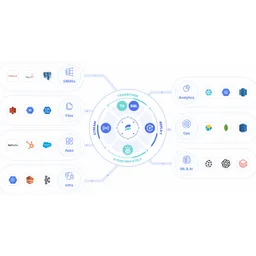
Apache Pulsar vs Apache Kafka
Apache Kafka: The dominant alternative, with a larger ecosystem and fewer moving parts to operate


Cloud-native messaging and streaming with separated storage
As of 20 November 2026, Apache Pulsar is free to use. Messaging and streaming in one system, with compute and storage separated so they scale independently. Softwr lists it under Databases. Apache Pulsar is made by Apache Software Foundation, available on Linux, Self-hosted.
Overview
Apache Pulsar is a distributed messaging and streaming platform that separates serving from storage: brokers handle traffic while Apache BookKeeper holds the data. That separation is its central architectural claim, because it lets storage and compute scale independently, and makes adding brokers cheap since they hold no state to rebalance. It also covers both models in one system — queuing with per-message acknowledgement and streaming with replay — where Kafka and RabbitMQ each favour one. Multi-tenancy and geo-replication are built in rather than bolted on.
The honest half
The limits buyers hit most with Apache Pulsar: more components than Kafka: brokers, BookKeeper and ZooKeeper each need operating; and correspondingly harder to run well, and the expertise is rarer than Kafka expertise. Each is concrete and checkable: the half of a review a vendor will not write.
Cross-shopped
The closest alternatives to Apache Pulsar are Apache Kafka, RabbitMQ and NATS. Each is a tool buyers genuinely weigh against it, with the reason why.
Apache Kafka: The dominant alternative, with a larger ecosystem and fewer moving parts to operate
RabbitMQ: Simpler still when the requirement is queuing rather than a replayable log
NATS: Much lighter, for latency-sensitive messaging that does not need Pulsar’s guarantees
Redpanda: Kafka-compatible streaming platform with a single-binary deployment
Solace PubSub+: Event broker for enterprise messaging with commercial support and multiple protocols
Pricing
Apache Pulsar is free to use. Taken from the vendor's own pricing page; prices move, so check before you buy.
Apache Pulsar
Free
Capabilities
Apache Pulsar lists 4 features, including separated storage; queuing and streaming; and built-in multi-tenancy.
Separated storage
Brokers are stateless; BookKeeper holds data, so each scales independently
Queuing and streaming
Per-message acknowledgement and replayable streams in one system
Built-in multi-tenancy
Tenants, namespaces and isolation as first-class concepts
Geo-replication
Cross-region replication configured rather than engineered
Answered, with sources
Each answer names the page it came from, so you can check it rather than take our word for it.
Yes, open source under the Apache Software Foundation.
Pulsar separates storage from compute and covers queuing and streaming in one system. Kafka has a far larger ecosystem and hiring pool. Most teams should have a specific reason before choosing Pulsar.
Brokers hold no data, so adding or replacing one requires no rebalancing, and storage can grow without adding serving capacity.
Checked against
The pages the facts above were read from. Prices and limits change, so the vendor's own page is the final word.
Keep looking
Open-source message broker supporting AMQP and other protocols
Multi-protocol event broker sold as software, cloud service or a hardware appliance
JMS message broker underpinning bank and telecom estates, now maintained rather than expanded
Streaming SQL engine built on ClickHouse internals, shipping as one small binary
Fast open-source column-oriented database for real-time analytics
The real-time distributed SQL database for data-intensive applications
MIT-licensed analytical SQL database that runs inside your process, with no server, no dependencies and one writer at a time.
Real-time data integration combining streaming, CDC, and batch
A distributed SQL engine that queries data where it already lives, across object storage, warehouses and operational databases.
A distributed engine for batch, SQL, streaming and machine learning workloads over data that does not fit on one machine.
Google Cloud's serverless analytical warehouse, billed either by bytes scanned per query or by reserved compute slots.
Live context layer for AI agents using real-time SQL transformations
Softwr does not host reviews and shows no star rating for Apache Pulsar, because a rating we did not collect is not ours to publish. What is here is the pricing and platform detail from the vendor’s own pages, limitations we could state concretely, and alternatives a reviewer confirmed people weigh against it. Tell us if any of it is wrong.
What people switch to, and what they give up
Every tier, and where the cost actually lands
Put it head to head with anything we hold
Its rating, and an embed for your own site
Industrial process historian with published per-tag pricing and no client licence fees
Per tag band per yearErlang MQTT broker for large IoT fleets, relicensed to BSL with production free use limited to one node
Per month by connection and session volumeNetApp-owned managed service for Cassandra, Kafka, OpenSearch, PostgreSQL and Cadence with a bring-your-own-cloud model
quoteAttribute-based access control and masking applied inside Snowflake, Databricks and BigQuery
quoteMPP analytical database with a MySQL wire protocol and sub-second aggregation on wide tables
Open source, no licence feeStreaming database that maintains incremental materialised views in SQL instead of Flink jobs
Per RisingWave Unit hourCentralised data access governance from the creators of Apache Ranger, now rebranding as Trust3 AI
quote