
Education · head to head
Anki vs Memberstack

Anki
Education
Free open source spaced repetition flashcard app, free everywhere except iOS where it is a paid one-time purchase
- From
- Free
- Free plan
- Yes
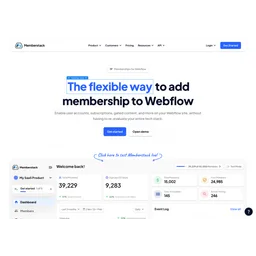
Memberstack
Productivity
Add memberships and logins to any website
- From
- Free
- Free plan
- Yes
The short version
- Anki is free; Memberstack starts at $29/mo.
- Where Memberstack falls short: basic and Professional tiers include transaction fees of 4% and 2% respectively.
- Prices and features on this page were last checked on 20 November 2026.
How do Anki and Memberstack differ?
Anki and Memberstack differ on pricing model, platforms and category (Education against Productivity). Only the attributes on which Anki and Memberstack actually diverge.
| Attribute | Anki | Memberstack |
|---|---|---|
| Pricing model | Open source, no licence fee except a paid iOS app | Subscription |
| Platforms | Windows, macOS, Linux, iOS, Android, Web | Web |
| Category | Education | Productivity |
| Founded | 2006 | 2018 |
Identical on both: starting price (Free), free tier (Yes).
Which features does each one have?
They share no listed features; 6 appear only for Anki. Drawn from each product's published feature list. An absence here means we hold no record of it - not that the product lacks it.
Only in Anki
- Spaced repetition scheduling
- Cross-platform sync
- Shared deck library
- Custom card types
- Add-ons
- Open file format
Only in Memberstack
Nothing recorded that Anki does not also cover.
What is each one used for?
Memberstack is most often brought in for launching course platforms without custom backend. The jobs each tool is most often brought in to do.
Anki
- A medical student using a large shared deck to memorise anatomy or pharmacology facts on a fixed exam timelinenot Memberstack
- A language learner building custom vocabulary decks with audio and images tailored to their own study materialnot Memberstack
- A self-directed learner who wants full control over the scheduling algorithm and does not want a subscriptionnot Memberstack
- An iPhone-only user deciding whether the one-time AnkiMobile price is worth it versus using the free web interface insteadnot Memberstack
Memberstack
- Launching course platforms without custom backendnot Anki
- Building subscription services with Webflow and paymentnot Anki
- Gating content without writing codenot Anki
- Managing password resets and two-factor authenticationnot Anki
- Processing Stripe billing automaticallynot Anki
Where do Anki and Memberstack fall short?
Memberstack's most cited limit: basic and Professional tiers include transaction fees of 4% and 2% respectively. Documented limitations, not opinions. Every one is a constraint you would hit in normal use.
Anki
- The interface is functional rather than polished, and new users often find the initial setup, deck creation and add-on ecosystem confusing compared with a guided app like Memrise
- iOS users pay a one-time fee of around $24.99 to $29.99 for AnkiMobile while every other platform is free, which is an unusual asymmetry that surprises new users comparing app store prices before they understand it funds development
- Anki has no content of its own; a new user gets an empty deck and either has to build cards manually or trust the quality of a community-shared deck of unknown accuracy
- The default scheduling algorithm requires understanding concepts like ease factor and interval to tune effectively, and default settings are not optimal for every subject or workload
- Shared decks, especially large medical school decks, can carry factual errors or become outdated, and there is no editorial review process verifying their accuracy
Memberstack
- Basic and Professional tiers include transaction fees of 4% and 2% respectively
- Annual billing required for discounts; monthly pricing is higher
- Webflow community builders receive Basic plan free but locked to that tier
How much do Anki and Memberstack cost?
Anki is free to use; Memberstack has a free plan, with paid plans from $29/mo. Plan by plan below, from each vendor's own pricing page.
Anki
Free- AnkiFree
- Desktop apps for Windows, Mac and Linux are free and open source
- AnkiDroid on Android is free and open source, built by a separate volunteer team
- AnkiMobile on iOS is a one-time purchase, commonly $24.99 to $29.99, funding development
Memberstack
Free- Basic$29/mo
- Up to 1,000 members
- 4% transaction fee
- $25/month with annual billing
- Professional$49/mo
- Up to 5,000 members
- 2% transaction fee
- $39/month with annual billing
- Business$99/mo
- 10,000+ members
- 0.9% transaction fee
- $79/month with annual billing
- Established$499/mo
- 10,000+ members
- Zero transaction fees
- $399/month with annual billing
Which should you pick?
Choose Anki if
- You need spaced repetition scheduling.
- You want to start without paying.
- You work on Windows, macOS, Linux, iOS, Android, Web.
- You also want cross-platform sync.
Questions people ask
- Is Anki or Memberstack better?
- Neither clearly leads. Anki starts at Free and Memberstack at Free, and user ratings are close enough to be indistinguishable. Choose on capability and platform support.
- Which is cheaper, Anki or Memberstack?
- Anki starts at Free and Memberstack at Free.
- Does Anki or Memberstack run on more platforms?
- Anki runs on Windows, macOS, Linux, iOS, Android, Web. Memberstack runs on Web.
- Can I use Anki for free?
- Both have a free tier, so you can try either at no cost before committing.
- What is Anki best used for?
- Anki is most often used for a medical student using a large shared deck to memorise anatomy or pharmacology facts on a fixed exam timeline, a language learner building custom vocabulary decks with audio and images tailored to their own study material, a self-directed learner who wants full control over the scheduling algorithm and does not want a subscription, an iphone-only user deciding whether the one-time ankimobile price is worth it versus using the free web interface instead. Of those, a medical student using a large shared deck to memorise anatomy or pharmacology facts on a fixed exam timeline and a language learner building custom vocabulary decks with audio and images tailored to their own study material are not what Memberstack is typically brought in for.
- What can Anki do that Memberstack cannot?
- Anki covers Spaced repetition scheduling, Cross-platform sync, Shared deck library, Custom card types.
Answered from the vendors’ own pages
Anki: Why is the iOS app not free when everything else is?
AnkiMobile is a paid one-time purchase, commonly around $24.99 to $29.99, that the developer states directly funds ongoing development of the free desktop apps, AnkiWeb sync and infrastructure used by every platform.
Memberstack: What are Memberstack's transaction fees?
Memberstack's transaction fee varies by tier: Basic plan charges 4% per transaction, Professional charges 2%, Business charges 0.9%, and Established tier charges zero transaction fees.
SourceAnki: Is Anki really free on Android?
Yes. AnkiDroid, the Android app, is free and open source, built and maintained by a separate volunteer development team from the desktop project.
Memberstack: Does Memberstack offer a free trial or testing mode?
Yes, Memberstack offers an unlimited free trial in test mode requiring no credit card. Users maintain full feature access at no cost until their site launches with real members.
SourceAnki: Do I need to pay for sync?
No. AnkiWeb, used to sync decks and review history across devices, is free.
Memberstack: What discounts does Memberstack offer?
Memberstack offers 50% discount for non-profits, special pricing for young professionals (4% fees), and $249/month with zero fees for startups under $1M raised. Webflow community builders receive the Basic plan free. 30-day money-back guarantee available with full refund.
SourceRelated pages
More on Memberstack
Other head to heads
- Anki vs Memrise
- Anki vs Elevate
- Anki vs Photomath
- Anki vs Stellarium
- Anki vs Busuu
- Anki vs Lumosity
- Anki vs Open edX
- Anki vs Replit AI Agent
- Anki vs Miro Education
- Anki vs Wooclap
- Anki vs Skoolur
- Anki vs Blackboard
- Anki vs Rosetta Stone
- Anki vs Seek by iNaturalist
- Anki vs Skyward
- Anki vs Star Walk 2
- Anki vs Aeries Student Information System
- Anki vs Bark for Schools
- Anki vs Notion
- Anki vs Todoist
- Anki vs Tana
- Anki vs Gamma
- Anki vs Hubstaff
- Anki vs Paprika Recipe Manager
- Anki vs Remember The Milk
- Anki vs Lazy
- Anki vs Standard Notes
- Anki vs TickTick
- Anki vs FigJam
- Anki vs Bear Notes
- Anki vs WPS Office
- Anki vs Bluemail
- Anki vs Bring!
- Anki vs Day One
- Anki vs DeskTime
- Anki vs Focus@Will
- Memberstack vs Memrise
- Memberstack vs Elevate
- Memberstack vs Photomath
- Memberstack vs Stellarium
- Memberstack vs Busuu
- Memberstack vs Lumosity
- Memberstack vs Open edX
- Memberstack vs Replit AI Agent
- Memberstack vs Miro Education
- Memberstack vs Wooclap
- Memberstack vs Skoolur
- Memberstack vs Blackboard
- Memberstack vs Rosetta Stone
- Memberstack vs Seek by iNaturalist
- Memberstack vs Skyward
- Memberstack vs Star Walk 2
- Memberstack vs Aeries Student Information System
- Memberstack vs Bark for Schools
- Memberstack vs Notion
- Memberstack vs Todoist
- Memberstack vs Tana
- Memberstack vs Gamma
- Memberstack vs Hubstaff
- Memberstack vs Paprika Recipe Manager
- Memberstack vs Remember The Milk
- Memberstack vs Lazy
- Memberstack vs Standard Notes
- Memberstack vs TickTick
- Memberstack vs FigJam
- Memberstack vs Bear Notes
- Memberstack vs WPS Office
- Memberstack vs Bluemail
- Memberstack vs Bring!
- Memberstack vs Day One
- Memberstack vs DeskTime
- Memberstack vs Focus@Will