
Business Intelligence · head to head
Deepnote vs MicroStrategy
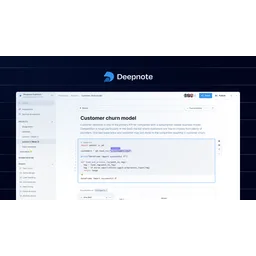
Deepnote
Business Intelligence
Collaborative cloud workspace for data analytics and machine learning
- From
- Free
- Free plan
- Yes

MicroStrategy
Business Intelligence
Enterprise analytics and mobility platform
- From
- $600/month
- Free plan
- No
The short version
- Deepnote is a collaborative cloud-based workspace; MicroStrategy is an enterprise analytics and mobility platform.
- Deepnote has a free plan, then $39/mo; MicroStrategy starts at $600/mo.
- Only Deepnote lists collaborative notebooks; only MicroStrategy lists enterprise Reporting.
- Where Deepnote falls short: free plan limited to 3 editors, restricting team usage.
- Where MicroStrategy falls short: no rate, no per-user price, no minimum and no named cost driver is published anywhere on the destination page.
- Prices and features on this page were last checked on 13 November 2026.
How do Deepnote and MicroStrategy differ?
Deepnote and MicroStrategy differ on starting price (Free against $600/month), pricing model and free tier (Yes against No). Only the attributes on which Deepnote and MicroStrategy actually diverge.
| Attribute | Deepnote | MicroStrategy |
|---|---|---|
| Starting price | Free | $600/month |
| Pricing model | Subscription with free tier | Subscription |
| Free tier | Yes | No |
| Platforms | Web, API | Web, Windows, macOS, iOS, Android |
Identical on both: category (Business Intelligence).
Not yet recorded: founded for Deepnote.
Which features does each one have?
They share no listed features; 8 appear only for Deepnote and 14 only for MicroStrategy. Drawn from each product's published feature list. An absence here means we hold no record of it - not that the product lacks it.
Only in Deepnote
- Collaborative notebooks
- Interactive dashboards
- Data agent building
- Scheduled pipelines
- Model management
- 100+ integrations
- GPU support
- API deployment
Only in MicroStrategy
- Enterprise Reporting
- Mobile Analytics
- HyperIntelligence
- Federated Analytics
- AI/ML
- SAP
- Oracle
- Salesforce
What is each one used for?
Deepnote is most often brought in for data exploration and analysis workflows; MicroStrategy for enterprise reporting and dashboards at Fortune 500 user counts. The jobs each tool is most often brought in to do.
Deepnote
- Data exploration and analysis workflowsnot MicroStrategy
- Building interactive business intelligence dashboardsnot MicroStrategy
- Collaborative machine learning model developmentnot MicroStrategy
- Automating ETL and data pipeline orchestrationnot MicroStrategy
- Creating shareable reports without exportsnot MicroStrategy
MicroStrategy
- A governed universal semantic layer defining metrics once across BI tools and AI agentsnot Deepnote
- Enterprise reporting and dashboards at Fortune 500 user countsnot Deepnote
- Connecting multiple warehouses and lakehouses under one set of business definitionsnot Deepnote
Where do Deepnote and MicroStrategy fall short?
Deepnote's most cited limit: free plan limited to 3 editors, restricting team usage. MicroStrategy's: no rate, no per-user price, no minimum and no named cost driver is published anywhere on the destination page. Documented limitations, not opinions. Every one is a constraint you would hit in normal use.
Deepnote
- Free plan limited to 3 editors, restricting team usage
- Limited revision history on free plan compared to competitors
- Requires Team plan or higher for automated scheduling
- GPU support incurs additional charges beyond base subscription
- No mentioned offline capability
MicroStrategy
- MicroStrategy has rebranded to Strategy and microstrategy.com/pricing now redirects to software.strategy.com, which is a product page with no pricing on it
- No rate, no per-user price, no minimum and no named cost driver is published anywhere on the destination page
- The only routes offered are a custom ROI analysis, a demo request or a proof-of-value pilot
- The product is positioned around a proof-of-value pilot and an approved architecture, implying a scoped implementation rather than self-serve purchase
How much do Deepnote and MicroStrategy cost?
Deepnote has a free plan, with paid plans from $39/mo; MicroStrategy starts at $600/mo. Plan by plan below, from each vendor's own pricing page.
Deepnote
Free- FreeFree
- Up to 3 editors
- Up to 5 projects
- Limited Deepnote AI
- Team$39/mo
- Unlimited viewers and notebooks
- Full Deepnote AI access
- Premium integrations
- EnterpriseOn request
- Everything in Team plan
- Custom contracts
- Priority support
MicroStrategy
$600/month- Cloud$600/mo
- Full BI Platform
- Mobile Apps
- Cloud Deployment
- EnterpriseFree
- On-premise
- Advanced Security
- Custom SLA
Which should you pick?
Choose Deepnote if
- You need collaborative notebooks.
- You want to start without paying.
- You work on Web, API.
- You also want interactive dashboards.
Choose MicroStrategy if
- You need enterprise reporting.
- You work on Web, Windows, macOS, iOS, Android.
- You also want mobile analytics.
Questions people ask
- Is Deepnote or MicroStrategy better?
- Neither clearly leads. Deepnote starts at Free and MicroStrategy at $600/month, and user ratings are close enough to be indistinguishable. Choose on capability and platform support.
- Which is cheaper, Deepnote or MicroStrategy?
- Deepnote has a free tier; the other does not. Paid plans start at Free for Deepnote and $600/month for MicroStrategy.
- Does Deepnote or MicroStrategy run on more platforms?
- Deepnote runs on Web, API. MicroStrategy runs on Web, Windows, macOS, iOS, Android.
- Can I use Deepnote for free?
- Yes. Deepnote has a free tier, so you can try it without paying. MicroStrategy starts at $600/month.
- What is Deepnote best used for?
- Deepnote is most often used for data exploration and analysis workflows, building interactive business intelligence dashboards, collaborative machine learning model development, automating etl and data pipeline orchestration. Of those, data exploration and analysis workflows and building interactive business intelligence dashboards are not what MicroStrategy is typically brought in for.
- What can Deepnote do that MicroStrategy cannot?
- Deepnote covers Collaborative notebooks, Interactive dashboards, Data agent building, Scheduled pipelines. MicroStrategy covers Enterprise Reporting, Mobile Analytics, HyperIntelligence, Federated Analytics.
Answered from the vendors’ own pages
Deepnote: What is included in the free Deepnote plan?
The free plan includes up to 3 editors, up to 5 projects, limited Deepnote AI, basic machines with 5 GB RAM, and 7-day revision history.
SourceDeepnote: What data sources can Deepnote integrate with?
Deepnote integrates with 100+ data sources including major data warehouses like Snowflake, BigQuery, and Redshift, as well as BI platforms like Looker, Tableau, and Power BI.
SourceDeepnote: Does Deepnote support collaboration?
Yes, Deepnote provides real-time collaborative notebooks where multiple team members can work simultaneously. The Team plan allows unlimited viewers and notebooks.
SourceDeepnote: What compliance certifications does Deepnote have?
Deepnote is SOC 2, HIPAA, GDPR, and CCPA compliant and offers role-based access control, single sign-on, and directory synchronization.
SourceRelated pages
More on MicroStrategy
Other head to heads
- Deepnote vs Fabi
- Deepnote vs Hex
- Deepnote vs Mode
- Deepnote vs Yellowfin
- Deepnote vs TIBCO Spotfire
- Deepnote vs Klipfolio
- Deepnote vs Databox
- Deepnote vs Domo
- Deepnote vs DashThis
- Deepnote vs Grow
- Deepnote vs Periscope Data
- Deepnote vs Luzmo
- Deepnote vs Phocas
- Deepnote vs Preset
- Deepnote vs ProfitWell
- Deepnote vs Quantum Metric
- Deepnote vs Quid
- Deepnote vs Reportz
- Deepnote vs IBM Cognos Analytics
- Deepnote vs Sisense
- Deepnote vs ThoughtSpot
- Deepnote vs Dundas BI
- Deepnote vs SAP BusinessObjects
- Deepnote vs Qlik Sense
- Deepnote vs Power BI
- Deepnote vs Amazon QuickSight
- Deepnote vs Zoho Analytics
- Deepnote vs Geckoboard
- Deepnote vs Google Data Studio
- Deepnote vs Lightdash
- Deepnote vs Oracle Analytics Cloud
- Deepnote vs Baremetrics
- MicroStrategy vs Fabi
- MicroStrategy vs Hex
- MicroStrategy vs Mode
- MicroStrategy vs Yellowfin
- MicroStrategy vs TIBCO Spotfire
- MicroStrategy vs Klipfolio
- MicroStrategy vs Databox
- MicroStrategy vs Domo
- MicroStrategy vs DashThis
- MicroStrategy vs Grow
- MicroStrategy vs Periscope Data
- MicroStrategy vs Luzmo
- MicroStrategy vs Phocas
- MicroStrategy vs Preset
- MicroStrategy vs ProfitWell
- MicroStrategy vs Quantum Metric
- MicroStrategy vs Quid
- MicroStrategy vs Reportz
- MicroStrategy vs IBM Cognos Analytics
- MicroStrategy vs Sisense
- MicroStrategy vs ThoughtSpot
- MicroStrategy vs Dundas BI
- MicroStrategy vs SAP BusinessObjects
- MicroStrategy vs Qlik Sense
- MicroStrategy vs Power BI
- MicroStrategy vs Amazon QuickSight
- MicroStrategy vs Zoho Analytics
- MicroStrategy vs Geckoboard
- MicroStrategy vs Google Data Studio
- MicroStrategy vs Lightdash
- MicroStrategy vs Oracle Analytics Cloud
- MicroStrategy vs Baremetrics