
Business Intelligence · head to head
Deepnote vs Amazon Redshift ML
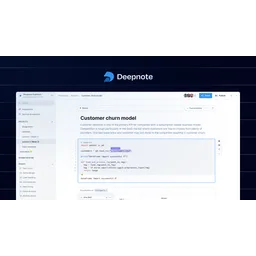
Deepnote
Business Intelligence
Collaborative cloud workspace for data analytics and machine learning
- From
- Free
- Rated
- -

Amazon Redshift ML
Machine Learning
SQL statements in Redshift that train models on SageMaker and return them as functions
- From
- Free
- Rated
- -
The short version
- Each has a real cost: Deepnote free plan limited to 3 editors, restricting team usage; Amazon Redshift ML training is billed by SageMaker separately from Redshift, so a feature that looks like a free SQL statement produces a second line item on a different part of the bill that the analyst who ran it usually cannot see.
- They diverge on capability: Deepnote covers Collaborative notebooks, Amazon Redshift ML covers CREATE MODEL in SQL.
- Prices and features above were last checked on 30 August 2026.
Where they differ
Only the attributes on which Deepnote and Amazon Redshift ML actually diverge.
| Attribute | Deepnote | Amazon Redshift ML |
|---|---|---|
| Pricing model | Subscription with free tier | usage-based |
| Platforms | Web, API | Web |
| Category | Business Intelligence | Machine Learning |
| Founded | Unknown | 2006 |
Identical on both: starting price (Free), free tier (Yes), user rating (Not yet rated).
What each one covers
Drawn from each product's published feature list. An absence here means we hold no record of it - not that the product lacks it.
Only in Deepnote
- Collaborative notebooks
- Interactive dashboards
- Data agent building
- Scheduled pipelines
- Model management
- 100+ integrations
- GPU support
- API deployment
Only in Amazon Redshift ML
- CREATE MODEL in SQL
- Automatic model selection
- Local inference
- Bring your own model
- Algorithm selection
- Cost ceiling controls
- Existing warehouse security
- Batch and interactive scoring
What people use each for
The jobs each tool is most often brought in to do.
Deepnote
- Data exploration and analysis workflowsnot Amazon Redshift ML
- Building interactive business intelligence dashboardsnot Amazon Redshift ML
- Collaborative machine learning model developmentnot Amazon Redshift ML
- Automating ETL and data pipeline orchestrationnot Amazon Redshift ML
- Creating shareable reports without exportsnot Amazon Redshift ML
Amazon Redshift ML
- Adding a churn or propensity score to an existing dashboard where the data is already in Redshift and nobody needs a bespoke modelnot Deepnote
- Letting an analytics team test whether a predictive column has any business value before asking for data science headcountnot Deepnote
- Scoring rows inside a SQL pipeline where moving data out to a separate service would add fragility for little benefitnot Deepnote
- Organisations committed to AWS whose main constraint is a data science backlog rather than modelling sophisticationnot Deepnote
Where each one falls short
Documented limitations, not opinions. Every one is a constraint you would hit in normal use.
Deepnote
- Free plan limited to 3 editors, restricting team usage
- Limited revision history on free plan compared to competitors
- Requires Team plan or higher for automated scheduling
- GPU support incurs additional charges beyond base subscription
- No mentioned offline capability
Amazon Redshift ML
- Training is billed by SageMaker separately from Redshift, so a feature that looks like a free SQL statement produces a second line item on a different part of the bill that the analyst who ran it usually cannot see.
- Autopilot searches many candidate models by default and the duration and cost of CREATE MODEL scale with the data size and the MAX_CELLS setting, so an unconstrained statement against a large table is an expensive accident rather than an experiment.
- Local inference runs on the Redshift cluster itself, so scoring millions of rows competes for the resources the warehouse exists to provide, and the remote inference alternative adds a per-batch network call plus an hourly SageMaker endpoint charge that persists whether or not anyone queries it.
- The supported problem types are limited to what the exposed algorithms cover, so anything involving text, images, sequences, a custom loss function or a bespoke evaluation metric is out of scope and has to be built conventionally.
- There is no retraining schedule, drift detection or model registry, so a model created by a statement stays exactly as trained until somebody remembers to recreate it, and nothing in the warehouse will report that its accuracy has decayed.
Pricing, plan by plan
Deepnote
Free- FreeFree
- Up to 3 editors
- Up to 5 projects
- Limited Deepnote AI
- Team$39/month
- Unlimited viewers and notebooks
- Full Deepnote AI access
- Premium integrations
- Enterprise$null/custom
- Everything in Team plan
- Custom contracts
- Priority support
Amazon Redshift ML
Free- Free TrialFree
- 2-month trial
- 750 DC2.Large hours
- On-Demand$0.25/hour
- Per-node pricing
- SageMaker training
Which should you pick?
Choose Deepnote if
- You need collaborative notebooks.
- You want to start without paying.
- You work on Web, API.
- You also want interactive dashboards.
Choose Amazon Redshift ML if
- You need create model in sql.
- You want to start without paying.
- You also want automatic model selection.
Questions people ask
- Is Deepnote or Amazon Redshift ML better?
- Neither clearly leads. Deepnote starts at Free and Amazon Redshift ML at Free, and user ratings are close enough to be indistinguishable. Choose on capability and platform support.
- Which is cheaper, Deepnote or Amazon Redshift ML?
- Deepnote starts at Free and Amazon Redshift ML at Free.
- Does Deepnote or Amazon Redshift ML run on more platforms?
- Deepnote runs on Web, API. Amazon Redshift ML runs on Web.
- Can I use Deepnote for free?
- Both have a free tier, so you can try either at no cost before committing.
- What is Deepnote best used for?
- Deepnote is most often used for data exploration and analysis workflows, building interactive business intelligence dashboards, collaborative machine learning model development, automating etl and data pipeline orchestration. Of those, data exploration and analysis workflows and building interactive business intelligence dashboards are not what Amazon Redshift ML is typically brought in for.
- What can Deepnote do that Amazon Redshift ML cannot?
- Deepnote covers Collaborative notebooks, Interactive dashboards, Data agent building, Scheduled pipelines. Amazon Redshift ML covers CREATE MODEL in SQL, Automatic model selection, Local inference, Bring your own model.
Answered from the vendors’ own pages
Deepnote: What is included in the free Deepnote plan?
The free plan includes up to 3 editors, up to 5 projects, limited Deepnote AI, basic machines with 5 GB RAM, and 7-day revision history.
SourceAmazon Redshift ML: Does it require SageMaker?
Yes. Redshift ML is an interface; the training happens in SageMaker and needs an IAM role and an S3 bucket for the intermediate data.
Deepnote: What data sources can Deepnote integrate with?
Deepnote integrates with 100+ data sources including major data warehouses like Snowflake, BigQuery, and Redshift, as well as BI platforms like Looker, Tableau, and Power BI.
SourceAmazon Redshift ML: Is there an extra charge?
The SQL interface is part of Redshift, but the training runs as a SageMaker job charged at SageMaker rates, and a remote inference endpoint is billed for as long as it exists.
Deepnote: Does Deepnote support collaboration?
Yes, Deepnote provides real-time collaborative notebooks where multiple team members can work simultaneously. The Team plan allows unlimited viewers and notebooks.
SourceAmazon Redshift ML: What kinds of model can it build?
Regression, binary and multiclass classification through the automatic path, plus direct use of XGBoost, linear learner, multilayer perceptron and K-means. Anything beyond structured tabular prediction is out of scope.
Deepnote: What compliance certifications does Deepnote have?
Deepnote is SOC 2, HIPAA, GDPR, and CCPA compliant and offers role-based access control, single sign-on, and directory synchronization.
SourceAmazon Redshift ML: Can I use a model I trained myself?
Yes, through the bring-your-own-model path, either compiled into the cluster for local inference or called as a remote SageMaker endpoint.
Amazon Redshift ML: Does it retrain automatically?
No. Retraining means running CREATE MODEL again, on a schedule you build yourself, and nothing in the product monitors whether it is needed.
Related pages
More on Amazon Redshift ML
Other head to heads
- Deepnote vs Fabi
- Deepnote vs Hex
- Deepnote vs Mode
- Deepnote vs TIBCO Spotfire
- Deepnote vs Yellowfin
- Deepnote vs Klipfolio
- Deepnote vs Domo
- Deepnote vs Periscope Data
- Deepnote vs Databox
- Deepnote vs Cyfe
- Deepnote vs DashThis
- Deepnote vs Grow
- Deepnote vs Zoho Analytics
- Deepnote vs Baremetrics
- Deepnote vs Board International
- Deepnote vs Cabin
- Deepnote vs Celonis
- Deepnote vs Google Vertex AI
- Deepnote vs DataRobot
- Deepnote vs Azure Machine Learning
- Deepnote vs MATLAB
- Deepnote vs Apache Spark MLlib
- Deepnote vs RapidMiner
- Deepnote vs Databricks
- Deepnote vs SAS
- Deepnote vs scikit-learn
- Deepnote vs H2O.ai
- Deepnote vs Weka
- Deepnote vs DVC
- Deepnote vs Hugging Face
- Deepnote vs Kubeflow
- Deepnote vs Langwatch
- Deepnote vs LlamaIndex
- Deepnote vs BigQuery ML
- Amazon Redshift ML vs Fabi
- Amazon Redshift ML vs Hex
- Amazon Redshift ML vs Mode
- Amazon Redshift ML vs TIBCO Spotfire
- Amazon Redshift ML vs Yellowfin
- Amazon Redshift ML vs Klipfolio
- Amazon Redshift ML vs Domo
- Amazon Redshift ML vs Periscope Data
- Amazon Redshift ML vs Databox
- Amazon Redshift ML vs Cyfe
- Amazon Redshift ML vs DashThis
- Amazon Redshift ML vs Grow
- Amazon Redshift ML vs Zoho Analytics
- Amazon Redshift ML vs Baremetrics
- Amazon Redshift ML vs Board International
- Amazon Redshift ML vs Cabin
- Amazon Redshift ML vs Celonis
- Amazon Redshift ML vs Google Vertex AI
- Amazon Redshift ML vs DataRobot
- Amazon Redshift ML vs Azure Machine Learning
- Amazon Redshift ML vs MATLAB
- Amazon Redshift ML vs Apache Spark MLlib
- Amazon Redshift ML vs RapidMiner
- Amazon Redshift ML vs Databricks
- Amazon Redshift ML vs SAS
- Amazon Redshift ML vs scikit-learn
- Amazon Redshift ML vs H2O.ai
- Amazon Redshift ML vs Weka
- Amazon Redshift ML vs DVC
- Amazon Redshift ML vs Hugging Face
- Amazon Redshift ML vs Kubeflow
- Amazon Redshift ML vs Langwatch
- Amazon Redshift ML vs LlamaIndex
- Amazon Redshift ML vs BigQuery ML