
Business Intelligence · head to head
Deepnote vs Jedox
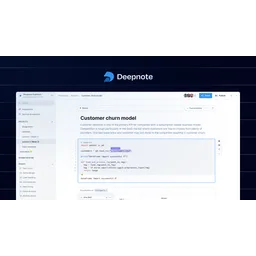
Deepnote
Business Intelligence
Collaborative cloud workspace for data analytics and machine learning
- From
- Free
- Rated
- -

Jedox
Business Intelligence
Excel-native planning and OLAP modelling for finance teams that refuse to leave spreadsheets
- From
- On request
- Rated
- -
The short version
- Only Deepnote has a free tier, so it costs nothing to try first.
- Each has a real cost: Deepnote free plan limited to 3 editors, restricting team usage; Jedox cube modelling is a specialist skill closer to IBM TM1 than to a modern SaaS planning tool, so most customers depend on a partner or a single internal expert whose departure leaves the model unmaintainable.
- They diverge on capability: Deepnote covers Collaborative notebooks, Jedox covers In-memory OLAP cube.
- Prices and features above were last checked on 31 August 2026.
Where they differ
Only the attributes on which Deepnote and Jedox actually diverge.
Identical on both: user rating (Not yet rated), category (Business Intelligence).
What each one covers
Drawn from each product's published feature list. An absence here means we hold no record of it - not that the product lacks it.
Only in Deepnote
- Collaborative notebooks
- Interactive dashboards
- Data agent building
- Scheduled pipelines
- Model management
- 100+ integrations
- GPU support
- API deployment
Only in Jedox
- In-memory OLAP cube
- Excel add-in
- Web spreadsheet
- Integrator ETL
- Workflow and approvals
- AIssisted planning
- Financial consolidation
- Report designer
What people use each for
The jobs each tool is most often brought in to do.
Deepnote
- Data exploration and analysis workflowsnot Jedox
- Building interactive business intelligence dashboardsnot Jedox
- Collaborative machine learning model developmentnot Jedox
- Automating ETL and data pipeline orchestrationnot Jedox
- Creating shareable reports without exportsnot Jedox
Jedox
- A manufacturer whose budget process is hundreds of Excel files emailed between plants and needs one governed cube without retraining plant controllersnot Deepnote
- A mid-market group doing statutory consolidation and management reporting on the same data instead of in two systemsnot Deepnote
- A finance team that priced IBM Planning Analytics, found it unaffordable, and still wants cube-based modellingnot Deepnote
- A retailer running driver-based sales and workforce plans that must reconcile to the financial budgetnot Deepnote
Where each one falls short
Documented limitations, not opinions. Every one is a constraint you would hit in normal use.
Deepnote
- Free plan limited to 3 editors, restricting team usage
- Limited revision history on free plan compared to competitors
- Requires Team plan or higher for automated scheduling
- GPU support incurs additional charges beyond base subscription
- No mentioned offline capability
Jedox
- Cube modelling is a specialist skill closer to IBM TM1 than to a modern SaaS planning tool, so most customers depend on a partner or a single internal expert whose departure leaves the model unmaintainable.
- Almost every deployment carries a partner implementation fee that frequently matches or exceeds the first year of licence, and that cost never appears in the vendor comparison you are shown.
- The Excel add-in is the strongest client, which means Mac-based and browser-only users get a materially thinner experience than the Windows majority.
- Dashboards and visual analytics are weaker than dedicated BI tools, so organisations typically keep Power BI or Tableau alongside Jedox and pay for both.
- Insight Partners took a majority stake in 2021, and the pressure toward a cloud subscription base has meant self-managed customers see new capability later than cloud ones.
Pricing, plan by plan
Deepnote
Free- FreeFree
- Up to 3 editors
- Up to 5 projects
- Limited Deepnote AI
- Team$39/month
- Unlimited viewers and notebooks
- Full Deepnote AI access
- Premium integrations
- Enterprise$null/custom
- Everything in Team plan
- Custom contracts
- Priority support
Jedox
On request- Jedox$undefined/year
- Named user subscription, tiered by user count
- Cloud or self-managed deployment
- Modules priced separately for consolidation and add-ons
Which should you pick?
Choose Deepnote if
- You need collaborative notebooks.
- You want to start without paying.
- You work on Web, API.
- You also want interactive dashboards.
Choose Jedox if
- You need in-memory olap cube.
- You work on Web, Windows, Linux, Cloud.
- You also want excel add-in.
Questions people ask
- Is Deepnote or Jedox better?
- Neither clearly leads. Deepnote starts at Free and Jedox at On request, and user ratings are close enough to be indistinguishable. Choose on capability and platform support.
- Which is cheaper, Deepnote or Jedox?
- Deepnote has a free tier; the other does not. Paid plans start at Free for Deepnote and On request for Jedox.
- Does Deepnote or Jedox run on more platforms?
- Deepnote runs on Web, API. Jedox runs on Web, Windows, Linux, Cloud.
- Can I use Deepnote for free?
- Yes. Deepnote has a free tier, so you can try it without paying. Jedox starts at On request.
- What is Deepnote best used for?
- Deepnote is most often used for data exploration and analysis workflows, building interactive business intelligence dashboards, collaborative machine learning model development, automating etl and data pipeline orchestration. Of those, data exploration and analysis workflows and building interactive business intelligence dashboards are not what Jedox is typically brought in for.
- What can Deepnote do that Jedox cannot?
- Deepnote covers Collaborative notebooks, Interactive dashboards, Data agent building, Scheduled pipelines. Jedox covers In-memory OLAP cube, Excel add-in, Web spreadsheet, Integrator ETL.
Answered from the vendors’ own pages
Deepnote: What is included in the free Deepnote plan?
The free plan includes up to 3 editors, up to 5 projects, limited Deepnote AI, basic machines with 5 GB RAM, and 7-day revision history.
SourceJedox: Does Jedox publish pricing?
No. It is quoted per named user with tiering by volume, and modules such as consolidation are priced separately.
Deepnote: What data sources can Deepnote integrate with?
Deepnote integrates with 100+ data sources including major data warehouses like Snowflake, BigQuery, and Redshift, as well as BI platforms like Looker, Tableau, and Power BI.
SourceJedox: Is Jedox a BI tool or a planning tool?
A planning tool with reporting attached. Organisations almost always keep a separate BI tool for visual analysis.
Deepnote: Does Deepnote support collaboration?
Yes, Deepnote provides real-time collaborative notebooks where multiple team members can work simultaneously. The Team plan allows unlimited viewers and notebooks.
SourceJedox: Can it run on premises?
Yes, on Windows or Linux, though the vendor pushes cloud and self-managed customers receive features later.
Deepnote: What compliance certifications does Deepnote have?
Deepnote is SOC 2, HIPAA, GDPR, and CCPA compliant and offers role-based access control, single sign-on, and directory synchronization.
SourceJedox: How does it compare to IBM Planning Analytics?
Similar cube architecture at a lower price point, with a friendlier web layer and a smaller partner ecosystem.
Related pages
Other head to heads
- Deepnote vs Fabi
- Deepnote vs Hex
- Deepnote vs Mode
- Deepnote vs TIBCO Spotfire
- Deepnote vs Yellowfin
- Deepnote vs Klipfolio
- Deepnote vs Domo
- Deepnote vs Periscope Data
- Deepnote vs Databox
- Deepnote vs Cyfe
- Deepnote vs DashThis
- Deepnote vs Grow
- Deepnote vs Zoho Analytics
- Deepnote vs Baremetrics
- Deepnote vs Board International
- Deepnote vs Cabin
- Deepnote vs Celonis
- Deepnote vs Pigment
- Deepnote vs Anaplan
- Deepnote vs Power BI
- Deepnote vs Zebra BI
- Deepnote vs Phocas
- Deepnote vs Cube
- Deepnote vs Qlik Sense
- Deepnote vs Hebbia
- Deepnote vs Chartio
- Deepnote vs ChartMogul
- Jedox vs Fabi
- Jedox vs Hex
- Jedox vs Mode
- Jedox vs TIBCO Spotfire
- Jedox vs Yellowfin
- Jedox vs Klipfolio
- Jedox vs Domo
- Jedox vs Periscope Data
- Jedox vs Databox
- Jedox vs Cyfe
- Jedox vs DashThis
- Jedox vs Grow
- Jedox vs Zoho Analytics
- Jedox vs Baremetrics
- Jedox vs Board International
- Jedox vs Cabin
- Jedox vs Celonis
- Jedox vs Pigment
- Jedox vs Anaplan
- Jedox vs Power BI
- Jedox vs Zebra BI
- Jedox vs Phocas
- Jedox vs Cube
- Jedox vs Qlik Sense
- Jedox vs Hebbia
- Jedox vs Chartio
- Jedox vs ChartMogul