
Logging · head to head
Cronitor vs Supabase
Cronitor
Logging
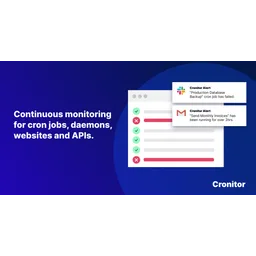
Monitoring for cron jobs, websites, and background tasks
- From
- Free
- Rated
- -

The short version
- Each has a real cost: Cronitor free tier limited to 5 monitors, limiting viability for small teams; Supabase free tier projects auto-pause after 1 week of inactivity
- They diverge on capability: Cronitor covers Cron job monitoring, Supabase covers PostgreSQL database.
Where they differ
Only the attributes on which Cronitor and Supabase actually diverge.
Identical on both: starting price (Free), free tier (Yes), user rating (Not yet rated).
What each one covers
Drawn from each product's published feature list. An absence here means we hold no record of it - not that the product lacks it.
Only in Cronitor
- Cron job monitoring
- Uptime and performance checks
- Heartbeat monitoring
- Status pages
- Real-user monitoring
- Alert integrations
- Email reports
Only in Supabase
- PostgreSQL database
- Auto-generated APIs
- Authentication & authorization
- Real-time subscriptions
- Storage
- Edge functions
- Vector embeddings
- Database migrations
What people use each for
The jobs each tool is most often brought in to do.
Cronitor
- Monitoring scheduled cron jobs and background tasksnot Supabase
- Tracking website and API uptime with global checksnot Supabase
- Alerting teams when critical jobs fail to executenot Supabase
- Communicating service status to customersnot Supabase
Supabase
- Web application backends using Postgres plus auto-generated REST/GraphQL APIsnot Cronitor
- Mobile app backends via Flutter/Swift/Kotlin client librariesnot Cronitor
- AI applications using vector/embeddings storagenot Cronitor
- Authentication with 20+ social providers plus email/passwordnot Cronitor
- File and media storage (S3-compatible with CDN) and realtime sync over WebSocketsnot Cronitor
Where each one falls short
Documented limitations, not opinions. Every one is a constraint you would hit in normal use.
Cronitor
- Free tier limited to 5 monitors, limiting viability for small teams
- Pay-per-monitor pricing scales quickly with infrastructure size
- Requires integrating ping calls into existing jobs
- Limited to monitoring jobs that can send pings
- No built-in workflow orchestration or task scheduling
Supabase
- Free tier projects auto-pause after 1 week of inactivity
- Free tier hard caps: 500 MB database, 1 GB file storage, 5 GB egress/month, 50,000 monthly active users, max 2 active free projects per organization
- Pro plan charges usage overages beyond included quotas, e.g. $0.00325 per MAU above 100,000 and $0.125/GB disk above 8 GB
- SOC2/ISO 27001 certification and HIPAA (add-on) compliance require the $599/month Team plan; not available on the $25/month Pro plan
Pricing, plan by plan
Cronitor
Free- HackerFree
- 5 monitors
- Email and Slack alerts
- Basic status page
- Business$2/monitor/month
- Unlimited monitors
- 30-second check frequency
- 10 alert integrations
- Enterprise$6000/year
- Custom features and integrations
- 5-second check frequency
- Dedicated engineer
Supabase
Free- FreeFree
- 50,000 MAU
- 500MB database
- 5GB egress
- Pro$25/month
- 100,000 MAU
- 8GB disk
- 250GB egress
- Team$599/month
- SOC2 and ISO 27001
- HIPAA add-on
- 28-day log / 14-day backup retention
- Enterprise$undefined/month
- Custom limits
- Dedicated support manager
- 24/7/365 support
Which should you pick?
Choose Cronitor if
- You need cron job monitoring.
- You want to start without paying.
- You work on Web, API.
- You also want uptime and performance checks.
Choose Supabase if
- You need postgresql database.
- You want to start without paying.
- You work on Web, iOS, Android.
- You also want auto-generated apis.
Questions people ask
- Is Cronitor or Supabase better?
- Neither clearly leads. Cronitor starts at Free and Supabase at Free, and user ratings are close enough to be indistinguishable. Choose on capability and platform support.
- Which is cheaper, Cronitor or Supabase?
- Cronitor starts at Free and Supabase at Free.
- Does Cronitor or Supabase run on more platforms?
- Cronitor runs on Web, API. Supabase runs on Web, iOS, Android.
- Can I use Cronitor for free?
- Both have a free tier, so you can try either at no cost before committing.
- What is Cronitor best used for?
- Cronitor is most often used for monitoring scheduled cron jobs and background tasks, tracking website and api uptime with global checks, alerting teams when critical jobs fail to execute, communicating service status to customers. Of those, monitoring scheduled cron jobs and background tasks and tracking website and api uptime with global checks are not what Supabase is typically brought in for.
- What can Cronitor do that Supabase cannot?
- Cronitor covers Cron job monitoring, Uptime and performance checks, Heartbeat monitoring, Status pages. Supabase covers PostgreSQL database, Auto-generated APIs, Authentication & authorization, Real-time subscriptions.
Answered from the vendors’ own pages
Cronitor: How does Cronitor billing work for the Business plan?
Business plan costs $2 per monitor per month plus $5 per user per month, billed monthly based on actual usage.
SourceSupabase: How much does Supabase cost?
Supabase offers a free tier and three paid plans. Pro starts at $25 per month, Team at $599 per month, and Enterprise requires a custom quote. All pricing is in USD charged monthly.
SourceCronitor: What is the difference between Hacker and Business plans?
Hacker plan ($0/month) includes 5 monitors and basic Slack/email alerts. Business plan ($2/monitor/month) offers unlimited monitors, 30-second checks, 10 integrations, 12-month retention, and email reports.
SourceSupabase: What are Supabase's usage overage fees?
Pro plan users pay $0.00325 per monthly active user over the 100,000 included, and $0.125 per GB for database storage exceeding 8 GB per project. Compute instances cost $10 to $3,730+ per month.
SourceCronitor: Does Cronitor offer a free trial?
Yes, Cronitor provides a 14-day free trial on the Business plan without requiring a credit card.
SourceRelated pages
Other head to heads
- Cronitor vs Elastic Stack
- Cronitor vs New Relic
- Cronitor vs Datadog Logs
- Cronitor vs Coralogix
- Cronitor vs Grafana Loki
- Cronitor vs incident.io
- Cronitor vs FireHydrant
- Cronitor vs Healthchecks
- Cronitor vs Openstatus
- Cronitor vs Rootly
- Cronitor vs Checkly
- Cronitor vs CloudWatch
- Cronitor vs Dynatrace
- Cronitor vs InfluxDB
- Cronitor vs Airbrake
- Cronitor vs AppDynamics
- Cronitor vs Axiom
- Cronitor vs Azure Monitor
- Cronitor vs Asana
- Cronitor vs ClickUp
- Cronitor vs Linear
- Cronitor vs Figma
- Cronitor vs Kubernetes
- Cronitor vs Notion
- Cronitor vs Datadog
- Cronitor vs Monday.com
- Cronitor vs Terraform
- Cronitor vs Docker
- Cronitor vs Greenhouse
- Cronitor vs Google Chrome
- Cronitor vs Intercom
- Cronitor vs Mozilla Firefox
- Cronitor vs Okta
- Cronitor vs PostHog
- Cronitor vs Redis
- Cronitor vs Amplitude
- Supabase vs Elastic Stack
- Supabase vs New Relic
- Supabase vs Datadog Logs
- Supabase vs Coralogix
- Supabase vs Grafana Loki
- Supabase vs incident.io
- Supabase vs FireHydrant
- Supabase vs Healthchecks
- Supabase vs Openstatus
- Supabase vs Rootly
- Supabase vs Checkly
- Supabase vs CloudWatch
- Supabase vs Dynatrace
- Supabase vs InfluxDB
- Supabase vs Airbrake
- Supabase vs AppDynamics
- Supabase vs Axiom
- Supabase vs Azure Monitor
- Supabase vs Asana
- Supabase vs ClickUp
- Supabase vs Linear
- Supabase vs Figma
- Supabase vs Kubernetes
- Supabase vs Notion
- Supabase vs Datadog
- Supabase vs Monday.com
- Supabase vs Terraform
- Supabase vs Docker
- Supabase vs Greenhouse
- Supabase vs Google Chrome
- Supabase vs Intercom
- Supabase vs Mozilla Firefox
- Supabase vs Okta
- Supabase vs PostHog
- Supabase vs Redis
- Supabase vs Amplitude