
Automation Integration · head to head
Camunda vs Deepnote

Camunda
Automation Integration
BPMN process orchestration engine, now source-available rather than open source
- From
- On request
- Free plan
- No
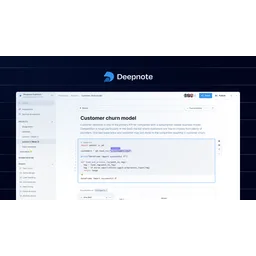
Deepnote
Business Intelligence
Collaborative cloud workspace for data analytics and machine learning
- From
- Free
- Free plan
- Yes
The short version
- Deepnote is a collaborative cloud-based workspace.
- Deepnote starts at $39/mo; Camunda prices on request.
- Only Camunda lists BPMN 2.0 execution; only Deepnote lists collaborative notebooks.
- Where Deepnote falls short: free plan limited to 3 editors, restricting team usage.
- Prices and features on this page were last checked on 31 August 2026.
Where they differ
Only the attributes on which Camunda and Deepnote actually diverge.
What each one covers
Drawn from each product's published feature list. An absence here means we hold no record of it - not that the product lacks it.
Only in Camunda
- BPMN 2.0 execution
- DMN decision tables
- Zeebe engine
- Operate console
- Job workers
- Optimize
Only in Deepnote
- Collaborative notebooks
- Interactive dashboards
- Data agent building
- Scheduled pipelines
- Model management
- 100+ integrations
- GPU support
- API deployment
What people use each for
The jobs each tool is most often brought in to do.
Camunda
- Long-running business processes crossing several services where the state must be visible to non-developersnot Deepnote
- Insurance claims or loan origination where the process model is itself a compliance artefactnot Deepnote
- Replacing orchestration logic scattered across microservices with one engine that owns the state machinenot Deepnote
- A regulated organisation that needs an auditable record of how each process instance actually executednot Deepnote
Deepnote
- Data exploration and analysis workflowsnot Camunda
- Building interactive business intelligence dashboardsnot Camunda
- Collaborative machine learning model developmentnot Camunda
- Automating ETL and data pipeline orchestrationnot Camunda
- Creating shareable reports without exportsnot Camunda
Where each one falls short
Documented limitations, not opinions. Every one is a constraint you would hit in normal use.
Camunda
- Camunda 7 Community Edition stopped receiving security patches after the 7.24 release in October 2025, so free production deployments are now running unpatched software
- Camunda 8 Self-Managed is source-available under the Camunda License 1.0, not open source: production use requires a paid licence, and organisations that adopted Camunda for its Apache licence have to renegotiate that decision
- Migrating from Camunda 7 to 8 is a rewrite rather than an upgrade because the engine, the API and the persistence model all changed, and there is no in-place migration for running instances
- Camunda 8 Self-Managed has substantial infrastructure requirements including Zeebe brokers, Elasticsearch and Identity, which is a considerable operations burden compared with the single database that Camunda 7 needed
- Pricing is not published at all, so evaluating total cost requires a sales process, and there is no way to size a budget before committing engineering time to a proof of concept
Deepnote
- Free plan limited to 3 editors, restricting team usage
- Limited revision history on free plan compared to competitors
- Requires Team plan or higher for automated scheduling
- GPU support incurs additional charges beyond base subscription
- No mentioned offline capability
Pricing, plan by plan
Camunda
On request- Camunda 8On request
- Self-Managed under Camunda License 1.0, production licence required
- SaaS with a thirty day full trial
- Free unlimited BPMN and DMN modelling after the trial
Deepnote
Free- FreeFree
- Up to 3 editors
- Up to 5 projects
- Limited Deepnote AI
- Team$39/mo
- Unlimited viewers and notebooks
- Full Deepnote AI access
- Premium integrations
- EnterpriseOn request
- Everything in Team plan
- Custom contracts
- Priority support
Which should you pick?
Choose Camunda if
- You need bpmn 2.0 execution.
- You work on Web, Linux, Self-hosted.
- You also want dmn decision tables.
Choose Deepnote if
- You need collaborative notebooks.
- You want to start without paying.
- You work on Web, API.
- You also want interactive dashboards.
Questions people ask
- Is Camunda or Deepnote better?
- Neither clearly leads. Camunda starts at On request and Deepnote at Free, and user ratings are close enough to be indistinguishable. Choose on capability and platform support.
- Which is cheaper, Camunda or Deepnote?
- Deepnote has a free tier; the other does not. Paid plans start at On request for Camunda and Free for Deepnote.
- Does Camunda or Deepnote run on more platforms?
- Camunda runs on Web, Linux, Self-hosted. Deepnote runs on Web, API.
- Can I use Deepnote for free?
- Yes. Deepnote has a free tier, so you can try it without paying. Camunda starts at On request.
- What is Camunda best used for?
- Camunda is most often used for long-running business processes crossing several services where the state must be visible to non-developers, insurance claims or loan origination where the process model is itself a compliance artefact, replacing orchestration logic scattered across microservices with one engine that owns the state machine, a regulated organisation that needs an auditable record of how each process instance actually executed. Of those, long-running business processes crossing several services where the state must be visible to non-developers and insurance claims or loan origination where the process model is itself a compliance artefact are not what Deepnote is typically brought in for.
- What can Camunda do that Deepnote cannot?
- Camunda covers BPMN 2.0 execution, DMN decision tables, Zeebe engine, Operate console. Deepnote covers Collaborative notebooks, Interactive dashboards, Data agent building, Scheduled pipelines.
Answered from the vendors’ own pages
Camunda: Is Camunda still open source?
No. Camunda 8 Self-Managed ships under the Camunda License 1.0, which is source-available and requires a paid production licence.
Deepnote: What is included in the free Deepnote plan?
The free plan includes up to 3 editors, up to 5 projects, limited Deepnote AI, basic machines with 5 GB RAM, and 7-day revision history.
SourceCamunda: What happened to Camunda 7?
Its final feature release, 7.24, was in October 2025 and the Community Edition receives no further patches. Enterprise support runs to April 2030.
Deepnote: What data sources can Deepnote integrate with?
Deepnote integrates with 100+ data sources including major data warehouses like Snowflake, BigQuery, and Redshift, as well as BI platforms like Looker, Tableau, and Power BI.
SourceCamunda: Can I upgrade from 7 to 8?
Not in place. The engine, API and persistence changed, so it is a rewrite of the integration layer.
Deepnote: Does Deepnote support collaboration?
Yes, Deepnote provides real-time collaborative notebooks where multiple team members can work simultaneously. The Team plan allows unlimited viewers and notebooks.
SourceCamunda: What does it cost?
Camunda does not publish prices. Both self-managed production and SaaS require a quote.
Deepnote: What compliance certifications does Deepnote have?
Deepnote is SOC 2, HIPAA, GDPR, and CCPA compliant and offers role-based access control, single sign-on, and directory synchronization.
SourceRelated pages
Other head to heads
- Camunda vs n8n
- Camunda vs Temporal
- Camunda vs Flowable
- Camunda vs Activiti
- Camunda vs Kogito
- Camunda vs jBPM
- Camunda vs Parabola
- Camunda vs Blue Prism
- Camunda vs UiPath
- Camunda vs Zapier
- Camunda vs Microsoft Power Automate
- Camunda vs Paragon
- Camunda vs SnapLogic
- Camunda vs Stitch
- Camunda vs Talend
- Camunda vs Tealium
- Camunda vs Tines
- Camunda vs Xano
- Camunda vs Fabi
- Camunda vs Hex
- Camunda vs Mode
- Camunda vs Yellowfin
- Camunda vs TIBCO Spotfire
- Camunda vs Klipfolio
- Camunda vs Databox
- Camunda vs Domo
- Camunda vs DashThis
- Camunda vs Grow
- Camunda vs Periscope Data
- Camunda vs Luzmo
- Camunda vs Phocas
- Camunda vs Preset
- Camunda vs ProfitWell
- Camunda vs Quantum Metric
- Camunda vs Quid
- Camunda vs Reportz
- Deepnote vs n8n
- Deepnote vs Temporal
- Deepnote vs Flowable
- Deepnote vs Activiti
- Deepnote vs Kogito
- Deepnote vs jBPM
- Deepnote vs Parabola
- Deepnote vs Blue Prism
- Deepnote vs UiPath
- Deepnote vs Zapier
- Deepnote vs Microsoft Power Automate
- Deepnote vs Paragon
- Deepnote vs SnapLogic
- Deepnote vs Stitch
- Deepnote vs Talend
- Deepnote vs Tealium
- Deepnote vs Tines
- Deepnote vs Xano
- Deepnote vs Fabi
- Deepnote vs Hex
- Deepnote vs Mode
- Deepnote vs Yellowfin
- Deepnote vs TIBCO Spotfire
- Deepnote vs Klipfolio
- Deepnote vs Databox
- Deepnote vs Domo
- Deepnote vs DashThis
- Deepnote vs Grow
- Deepnote vs Periscope Data
- Deepnote vs Luzmo
- Deepnote vs Phocas
- Deepnote vs Preset
- Deepnote vs ProfitWell
- Deepnote vs Quantum Metric
- Deepnote vs Quid
- Deepnote vs Reportz