JupyterHub vs Jupyter
Jupyter: The single user notebook and JupyterLab project that JupyterHub serves to many people


Open source multi user server that gives each person their own Jupyter environment
As of 20 November 2026, JupyterHub is free to use. JupyterHub is a BSD licensed multi user server for Jupyter notebooks, deployable on one machine or on Kubernetes for classes, research groups and data teams. Softwr lists it under Machine Learning. JupyterHub is made by Project Jupyter, launched in 2014, available on Linux, Web.
Overview
JupyterHub is the multi user version of the Jupyter notebook. It lets groups of users such as students, researchers and data scientists each work in their own environment on shared resources, without installing software on their own machines, while administrators manage the servers. A Tornado based hub handles login and starts single user servers on demand, a configurable HTTP proxy routes requests to the right server, and spawners launch and monitor those servers. Authentication is pluggable and supports OAuth and GitHub among other methods, and an admin panel and REST API support management. It supports many kernels and interfaces, including Jupyter Notebook, JupyterLab and RStudio. The Jupyter community maintains two distributions: The Littlest JupyterHub for a single virtual machine, suited to roughly 1 to 100 users, and Zero to JupyterHub for Kubernetes, a Helm chart for larger deployments. JupyterHub runs on commercial clouds, virtual machines or a laptop. It is free and open source under the BSD 3 clause licence, so there is no subscription price, though the hosting and staff time needed to run it are the operator's cost. The project is part of Project Jupyter, which was spun off from IPython in 2014. JupyterHub is a server for hosting notebooks, not a machine learning platform: it has no built in experiment tracking, model registry or managed compute, and it requires system administration skills to deploy and secure.
The honest half
The limits buyers hit most with JupyterHub: self hosted, so the operator must handle installation, upgrades and security; and no built in experiment tracking, model registry or managed compute. Each is concrete and checkable: the half of a review a vendor will not write.
Cross-shopped
The closest alternatives to JupyterHub are Jupyter, Deepnote and Anaconda. Each is a tool buyers genuinely weigh against it, with the reason why.
Jupyter: The single user notebook and JupyterLab project that JupyterHub serves to many people
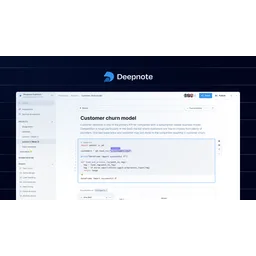
Deepnote: Hosted collaborative notebook service, for teams that do not want to run servers
Anaconda: Python distribution and commercial platform with notebook and package management
Databricks: Managed data and machine learning platform with collaborative notebooks
Kubeflow: Kubernetes machine learning toolkit with notebook servers and pipelines
Capabilities
JupyterHub lists 8 features, including spawners that launch single user servers; configurable HTTP proxy; and admin panel and REST API.
Multi user hub with per user notebook servers
Pluggable authentication including OAuth and GitHub
Spawners that launch single user servers
Configurable HTTP proxy
Admin panel and REST API
Support for JupyterLab, Jupyter Notebook and RStudio
Zero to JupyterHub for Kubernetes
The Littlest JupyterHub for a single machine
Answered, with sources
Each answer names the page it came from, so you can check it rather than take our word for it.
JupyterHub is a multi user version of the Jupyter notebook. It gives each user their own workspace on shared resources managed by administrators.
SourceThe documentation positions The Littlest JupyterHub for roughly 1 to 100 users on one server. Zero to JupyterHub on Kubernetes is intended for larger numbers.
SourceYes. The Jupyter site describes it as entirely open source, and GitHub lists the BSD 3 clause licence. You pay only for the infrastructure you run it on.
SourceThe Jupyter site says it supports dozens of kernels and interfaces. These include Jupyter Notebook, JupyterLab, RStudio and nteract.
SourceBehind it
JupyterHub is made by Project Jupyter, founded in 2014.
Keep looking
Unified analytics platform for data engineering and data science
Kubernetes model serving whose current version is licensed under the Business Source Licence
Data versioning and container pipelines that run on your Kubernetes cluster
Git-style versioning for data sets and models, with the files kept in object storage
LLM engineering platform for testing and evaluating AI agents in production
Open source Python framework that packages models into deployable inference services
The machine learning library inside Apache Spark, for data that will not fit on one machine
Softwr does not host reviews and shows no star rating for JupyterHub, because a rating we did not collect is not ours to publish. What is here is the pricing and platform detail from the vendor’s own pages, limitations we could state concretely, and alternatives a reviewer confirmed people weigh against it. Tell us if any of it is wrong.
What people switch to, and what they give up
Every tier, and where the cost actually lands
Put it head to head with anything we hold
Its rating, and an embed for your own site
Open-source MLOps platform for experiment tracking and orchestration
Open-source self-hosted, with paid hosted and enterprise tiersOpen-source AI orchestration framework for LLM applications
Open-source with optional paid enterprise supportLLM engineering platform for testing and evaluating AI agents in production
Tiered subscription with usage-based overage charges