
Databases · head to head
Estuary vs Apache Kafka
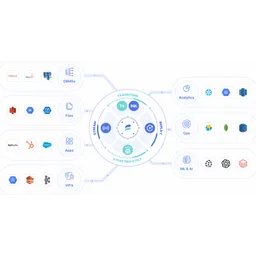
Estuary
Databases
Real-time data integration combining streaming, CDC, and batch
- From
- Free
- Rated
- -

Apache Kafka
Databases
Open-source distributed event streaming platform
- From
- Free
- Rated
- -
The short version
- Each has a real cost: Estuary per-GB pricing adds up quickly for high-volume scenarios; Apache Kafka operationally heavy to self-host: brokers, storage, rebalancing and upgrades are a standing job, which is why managed Kafka is a large market
- They diverge on capability: Estuary covers Real-time data delivery, Apache Kafka covers Durable commit log.
Where they differ
Only the attributes on which Estuary and Apache Kafka actually diverge.
| Attribute | Estuary | Apache Kafka |
|---|---|---|
| Pricing model | Usage-based per GB plus per-connector cost | Open source, no licence fee; managed services billed separately |
| Platforms | Cloud, Private Cloud, BYOC | Linux, Windows, macOS, Self-hosted, Docker |
| Founded | 2019 | Unknown |
Identical on both: starting price (Free), free tier (Yes), user rating (Not yet rated), category (Databases).
What each one covers
Drawn from each product's published feature list. An absence here means we hold no record of it - not that the product lacks it.
Only in Estuary
- Real-time data delivery
- Change data capture
- Batch processing
- Data transformation
- Pre-built connectors
- Multiple deployments
- RBAC and monitoring
Only in Apache Kafka
- Durable commit log
- Horizontal scale
- Kafka Connect
- Kafka Streams
- Replication
- Low latency
What people use each for
The jobs each tool is most often brought in to do.
Estuary
- Real-time data replication to data warehousesnot Apache Kafka
- Change data capture from operational databasesnot Apache Kafka
- Feeding analytics and BI systems with fresh datanot Apache Kafka
- Powering real-time AI and ML data pipelinesnot Apache Kafka
Apache Kafka
- Moving events between services without point-to-point couplingnot Estuary
- Feeding analytics and warehouses from operational systems in near real timenot Estuary
- Replaying history to rebuild state after a consumer bugnot Estuary
- Buffering bursty producers ahead of slower downstream systemsnot Estuary
Where each one falls short
Documented limitations, not opinions. Every one is a constraint you would hit in normal use.
Estuary
- Per-GB pricing adds up quickly for high-volume scenarios
- No transparent per-connector volume discounts below 6 connectors
- Limited to data movement; transformation capabilities are basic
- BYOC and private deployment requires enterprise plan
- Smaller ecosystem compared to established alternatives
Apache Kafka
- Operationally heavy to self-host: brokers, storage, rebalancing and upgrades are a standing job, which is why managed Kafka is a large market
- Overkill for straightforward job queues, where a simpler broker is easier to run and reason about
- Ordering guarantees hold per partition, not per topic, and getting partitioning wrong is a common and expensive design mistake
- The ecosystem is fragmented across the Apache project and vendor distributions, so documentation and tooling advice often assume a particular distribution
Pricing, plan by plan
Estuary
Free- DeveloperFree
- 10 GB per month
- 2 connector instances maximum
- No credit card required
- Cloud$0.5/GB
- $0.50 per GB of data moved
- $100 per connector monthly (6+ connectors $50 each)
- 200+ connectors
- Enterprise$null/custom
- Volume-based discounts
- SOC 2 and HIPAA compliance
- SSO authentication
Apache Kafka
Free- Apache KafkaFree
- Full platform
- Kafka Connect
- Kafka Streams
Which should you pick?
Choose Estuary if
- You need real-time data delivery.
- You want to start without paying.
- You work on Cloud, Private Cloud, BYOC.
- You also want change data capture.
Choose Apache Kafka if
- You need durable commit log.
- You want to start without paying.
- You work on Linux, Windows, macOS, Self-hosted, Docker.
- You also want horizontal scale.
Questions people ask
- Is Estuary or Apache Kafka better?
- Neither clearly leads. Estuary starts at Free and Apache Kafka at Free, and user ratings are close enough to be indistinguishable. Choose on capability and platform support.
- Which is cheaper, Estuary or Apache Kafka?
- Estuary starts at Free and Apache Kafka at Free.
- Does Estuary or Apache Kafka run on more platforms?
- Estuary runs on Cloud, Private Cloud, BYOC. Apache Kafka runs on Linux, Windows, macOS, Self-hosted, Docker.
- Can I use Estuary for free?
- Both have a free tier, so you can try either at no cost before committing.
- What is Estuary best used for?
- Estuary is most often used for real-time data replication to data warehouses, change data capture from operational databases, feeding analytics and bi systems with fresh data, powering real-time ai and ml data pipelines. Of those, real-time data replication to data warehouses and change data capture from operational databases are not what Apache Kafka is typically brought in for.
- What can Estuary do that Apache Kafka cannot?
- Estuary covers Real-time data delivery, Change data capture, Batch processing, Data transformation. Apache Kafka covers Durable commit log, Horizontal scale, Kafka Connect, Kafka Streams.
Answered from the vendors’ own pages
Estuary: What is included in the free Developer plan?
Developer plan ($0/month) includes 10 GB of data per month and up to 2 connector instances, no credit card required.
SourceApache Kafka: Is Apache Kafka free?
Yes. Kafka is open source under the Apache License v2 with no licence fee. Costs come from the infrastructure you run it on, or from a managed service such as Confluent Cloud.
Estuary: How is data pricing calculated on Cloud plan?
Cloud plan charges $0.50 per GB of data moved plus $100/month per connector for the first 6 connectors, then $50/month for additional connectors.
SourceApache Kafka: How is Kafka different from a message queue?
A queue usually removes a message once it is consumed. Kafka keeps an ordered, durable log, so consumers track their own position and history can be replayed — which is what makes rebuilding state after a bug possible.
Estuary: What discount is available when adding 6+ connectors?
When using 6 or more connectors, the per-connector cost drops to $50/month from $100/month, saving $50 per additional connector.
SourceApache Kafka: Who uses Kafka?
The project reports use by more than 80% of the Fortune 100, with over 5 million lifetime downloads.
Apache Kafka: Do I need to run Kafka myself?
No. Self-hosting is the operationally expensive option; managed services such as Confluent Cloud run the brokers for you and bill on throughput and storage instead.
Related pages
More on Apache Kafka
Other head to heads
- Estuary vs Cockroach Labs
- Estuary vs PostgreSQL
- Estuary vs Airtable
- Estuary vs Amazon Aurora
- Estuary vs Elasticsearch
- Estuary vs PlanetScale
- Estuary vs Meilisearch
- Estuary vs Turso
- Estuary vs Azure SQL
- Estuary vs ClickHouse
- Estuary vs Couchbase
- Estuary vs DuckDB
- Estuary vs MariaDB
- Estuary vs Oracle Database
- Estuary vs DataGrip
- Estuary vs Firebolt
- Estuary vs Google Cloud SQL
- Estuary vs MotherDuck
- Apache Kafka vs Cockroach Labs
- Apache Kafka vs PostgreSQL
- Apache Kafka vs Airtable
- Apache Kafka vs Amazon Aurora
- Apache Kafka vs Elasticsearch
- Apache Kafka vs PlanetScale
- Apache Kafka vs Meilisearch
- Apache Kafka vs Turso
- Apache Kafka vs Azure SQL
- Apache Kafka vs ClickHouse
- Apache Kafka vs Couchbase
- Apache Kafka vs DuckDB
- Apache Kafka vs MariaDB
- Apache Kafka vs Oracle Database
- Apache Kafka vs DataGrip
- Apache Kafka vs Firebolt
- Apache Kafka vs Google Cloud SQL
- Apache Kafka vs MotherDuck